Showing posts with label Soviet Union. Show all posts

Tuesday, 2 October 2018

Murdering Europeans


Europe has a long history of violence. Against the advances in philosophy, science and the arts, one must weigh the prolonged episodes of war, massacres, pogroms, colonial terror and oppression. The latter do not look good, so there is often a convenient framing of events in Europe’s historical memory, one that finds no place for the bad stuff. For example, every European country has its own mythology about the Second World War. Although the myths usually cannot withstand the slightest collision with facts, they nevertheless continue as persistent reference points for the mass of people in a particular country.
The UK has a particular weakness for this, with images of how the Dunkirk spirit, squadrons of spitfires and Churchill’s wartime speeches saved the day and led to victory over Nazi Germany. For some reason the historical ‘memory’ does not consider how it was that British deaths in the Second World War numbered only some 300,000, less than 1% of the population, compared to more than 25 million killed in the Soviet Union, 14% of its population. In the biggest confrontation with Germany that turned out to be the turning point for the whole war – the Battle of Stalingrad from August 1942 to February 1943 – the Soviet Union suffered nearly 500,000 killed or missing.

The main course

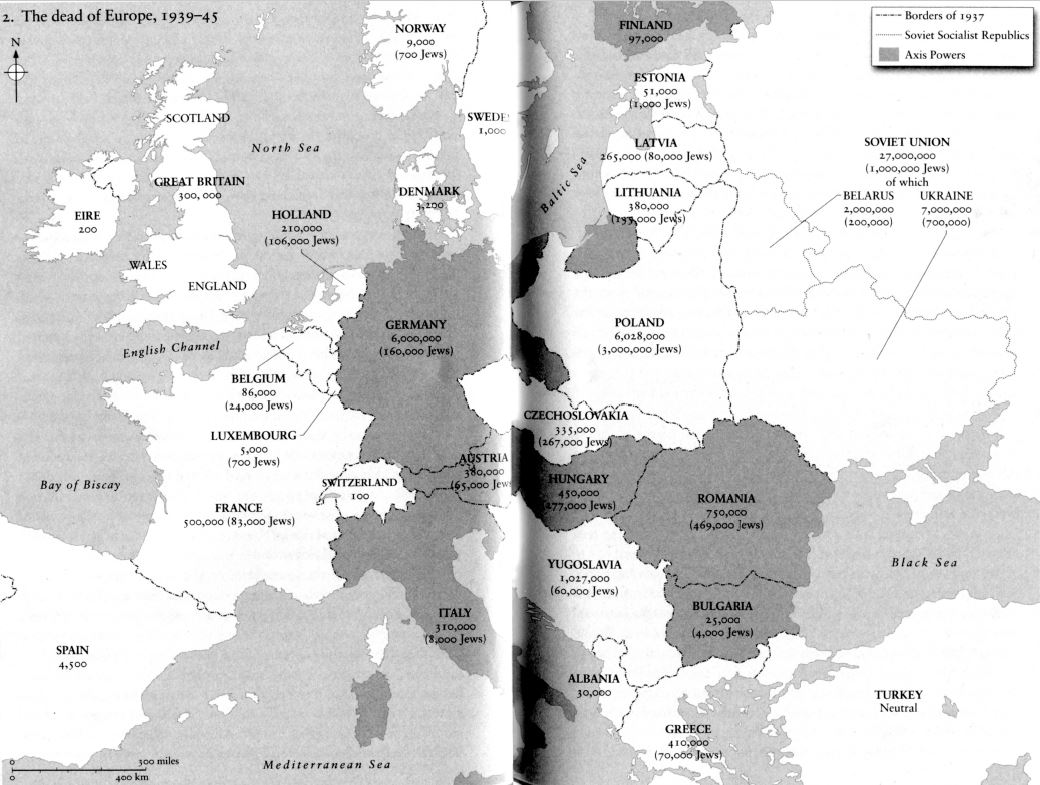
A record of how many people died in a long and extensive war is difficult to pin down with any precision, but the following map gives an interesting picture of the order of magnitude for different European countries in the 1939-1945 period. Brackets below the totals for each country show another chilling statistic for the murders of Jewish people. The bulk of the figures are from Germany, Austria, Central and Eastern Europe and the Soviet Union, but it is also worth comparing the absolute numbers with the sizes of the relevant populations to get an idea of the scale of the human destruction. While Poland’s number is large in both absolute and relative terms, six million dead (of which three million Jews) and around 17% of the population, Latvia’s and Lithuania’s figures are much smaller but still more than 12% of their populations. A Wikipedia tabulation here gives a fuller record.[1]
The dessert

With its topic being World War Two, the previously cited Wikipedia article and tables do not spell out that the human carnage in Europe continued until well after 1945. That is the focus of a book by Keith Lowe, from which the European map is taken: Savage Continent: Europe in the Aftermath of World War II (Penguin/Viking, 2004). To read Lowe’s review of post-war Europe is shocking, even if one first allows for the fact that it is unlikely that violence completely stops when formal hostilities cease.
Among other things, Lowe’s book details the continued attacks on Jewish people from 1944-45, especially in Central and Eastern Europe. Discussing the anti-Semitism and pogroms in Poland, he notes that
‘Poland was easily the most dangerous country for Jews after the war. At least 500 Jews were murdered by Poles between the German surrender and the summer of 1946, and most historians put the figure at around 1,500.’
It was not only murder, but also looting and theft:
‘In Hungary many peasants came into possession of decent clothes and footwear for the first time when the property of expelled Jews was shared out in 1944. In Poland, where the Jews had made up a substantial portion of the middle class, a new, Polish middle class rose to take their place.’
As you might imagine, any Jewish people returning home did not have much success in getting compensation.
But don’t think the violence was limited to anti-Semitism. The immediate post-war years had to deal with the aftermath of the destruction, with famine and millions of ‘displaced persons’ across the continent. Although some former collaborators with the German occupation found a way into the post-war establishment, they also risked humiliation or summary execution. Under the cover of revenge by resistance fighters, personal scores were settled. More importantly, there was a dramatic trend of ‘ethnic cleansing’ in the immediate post-war years.
In terms of numbers, the most striking development was the expulsion of over 11 million Germans from countries in Central and Eastern Europe. These were the so-called Volksdeutsch, the long-established populations of expatriate German speakers. Many also suffered forced labour in camps in Poland and Czechoslovakia.
Often the attacks on different groups were linked to their supposed role in the war. But the motive of revenge easily came to embrace all those in the ‘wrong’ community. Referring to developments in 1944-46, Lowe notes the tens of thousands killed in Poland and the Ukraine: ‘Poles and Ukrainians slaughtered one another and burned each other’s villages with an enthusiasm that far exceeded any of their actions against the German or Soviet occupiers’.
There was an attempted genocide of Serbs in Croatia, and Hungarians were expelled from Slovakia. Summing up on the Central and Eastern Europe dimensions, Lowe puts it like this:
‘These were the kinds of actions that were taking place all across Europe. Hungarians were also expelled from Romania, and vice versa. Albanian Chams were expelled from Greece; Romanians were expelled from Ukraine; Italians were expelled from Yugoslavia. A quarter of a million Finns were forced to leave western Karelia when the area was finally ceded to the Soviet Union at the end of the war. As late as 1950 Bulgaria began expelling some 140,000 Turks and Gypsies across their border with Turkey. And so the list goes on.’
‘As a result of all this forced population movement, Eastern Europe became far less multicultural than it had been at any time in modern history. In the space of only one or two years, the proportion of national minorities more than halved. Gone were the old imperial melting pots where Jews, Germans, Magyars, Slavs and dozens of other races and nationalities intermarried, squabbled and rubbed along together as best they could. In their place was a collection of mono-cultural nation-states, whose populations were more or less ethnically homogeneous.’
These events, barely 70 years ago, are something to consider when you observe the reactionary developments in European politics today.

Tony Norfield, 2 October 2018


[1] The Wikipedia article lists casualties from a wide range of countries, not just in Europe. Notable is the huge number of deaths in China, some 15-20 million and 3-4% of the population. China is little covered in films and books on the Second World War, but a good source is Rana Mitter’s Forgotten Ally: China’s World War II, 1937-1945, First Mariner Books, 2013.

Friday, 7 July 2017

Eric Hobsbawm’s 20th Century Self-Censorship


Eric Hobsbawm was a famous Marxist historian and member of the Communist Party who died in 2012. Recently I read his autobiography, Interesting Times: A Twentieth Century Life, first published in 2002. He overcame Cold War-inspired barriers to his early career and contributed much to our understanding, so his story looked to be fascinating. Instead, it was rather dull. What struck me as most interesting was interesting for bad reasons.
Not to be accused of quoting out of context, I will cite a relatively long passage of text. It occurs in Chapter 17, ‘Among the Historians’, on pages 291-292, and discusses post-1945 developments in historiography:
“Explosive subjects such as Russia, especially in the twentieth century, and the history of communism were, of course, ideological battlefields, although the debate was one-sided, since the orthodoxies enforced in the Soviet Empire crippled both their historians and their interpretations. If one was a serious Soviet historian, the best thing was to stick to the history of the ancient East and the Middle Ages, although it was touching to see how modernists rushed to say (within the constraints of the permissible) what they knew to be true every time the window seemed to be slightly opened – as in 1956 and in the early 1960s. I myself became essentially a nineteenth century historian, because I soon discovered – actually in the course of an aborted project of the CP [Communist Party] Historians’ Group to write a history of the British labour movement – that, given the strong official Party and Soviet views about the twentieth century, one could not write about anything later than 1917 without the likelihood of being denounced as a political heretic. I was ready to write about the century in a political or public capacity, but not as a professional historian. My history finished at Sarajevo in June 1914.
“Luckily, I abstained from twentieth century history until it was almost over, but it went against the grain of the historiographical movement, which was away from the remote past and towards the present. Until well past 1945 ‘real’ history finished, at the latest, in 1914 after which the immediate past reverted to chronicle, journalism or contemporary commentary. Indeed, since the archives remained closed in Britain for several decades, it simply could not be written to the standards of traditional historians. In most countries, even the nineteenth century had not yet been fully absorbed by academic history departments, except by the economic historians. The great historiographical debates had not been about it, although political radicalism, not least in the form of a new passion for labour history, now drew attention to an era which had been seriously neglected by historians in a number of countries. Even in Britain, until the 1960s politicians, serious journalists, relatives and essayists wrote the biographies of the great figures of Victorian Britain, not the professors. Nevertheless, the gap between past and present narrowed, perhaps because so many professional historians had actually been involved in the Second World War.”
While these are interesting biographical details, they are also an apologia for a lack of intellectual integrity. Hobsbawm starts out by noting the key point, Soviet censorship of dissident political views. Then he notes his capitulation, but tries to support his stance by arguing that, because ‘the archives remained closed’, he could not have analysed the post-1914 period until the late twentieth century ‘to the standards of traditional historians’. Ah yes, those ever so incisive and objective traditional historians!
Notably, his Age of Extremes: The Short Twentieth Century, 1914-1991, was first published in 1994. In its Preface, he makes the same basic point as in the later autobiography, distinguishing his ‘professional historian’ scholarly position from those cases where he wrote about post-1914 events in ‘other capacities’. There he also says: ‘I think it is now possible to see the Short Twentieth Century from 1914 to the end of the Soviet era in some historical perspective’ (p ix). This is the telling point: he could now exercise his historical scholarship on the post-1914 period because of the end of the Soviet Union in 1991!
In one book, Revolutionaries, published much earlier in 1973, Hobsbawm does cover post-1914 developments in a number of ‘contemporary essays’. But there his Preface makes the point that ‘speaking as a historian, these are not fields in which I would claim professional expertise’. His essays were written in a general style, and one that would be safe from political censure.
Hobsbawm’s argument about ‘closed archives’ meaning that historians cannot analyse a historical period to a sufficient standard is just ridiculous, especially so for the UK. Yes, more information of all kinds may well surface in future, and possibly it will provide a different perspective. But neither that future information, nor the present sources to analyse, need necessarily be the government’s officially released archives. Nor is one only limited to ‘chronicle, journalism or contemporary commentary’. Let me take one example from the supposedly barren, pre-1991 days of insufficient material.
In 1975, Partha Sarathi Gupta published a book on the labour movement in Britain, a topic close to Hobsbawm’s favoured subject area. Gupta was a professor of British and European history at Delhi University and president of the Indian History Congress, who died in 1999. His book, Imperialism and the British Labour Movement, 1914-64, was published by Macmillan as part of the Cambridge Commonwealth Series. So he was well within the realm of the ‘traditional historians’. Gupta’s focus was not on the British working class as such, although he makes a number of pertinent comments on its political outlook. Instead, the book focuses on ‘the attitudes and policies of the British Labour Movement towards the British Empire and Commonwealth’.
Gupta recognises a limitation due to British government records after 1945 being closed at the time he was writing. However, he still makes a thorough analysis of the available private papers and public documents. The latter for the post-1945 period include House of Commons debates, statements by policymakers and advisers, and records from the conferences of the major political parties. Having read Gupta’s book only a few years ago, I was not aware of anything that has since emerged from the ‘archives’ to question his basic conclusions written some three decades earlier. My citation from his work is in an article on Labour’s colonial policy, on this blog.
I do not blame the late Eric Hobsbawm for the weak analysis of (British) imperialism after 1914. Yet it is a pity that someone of his abilities could not have applied himself more effectively, and much sooner, to this subject.

Tony Norfield, 7 July 2017

Sunday, 14 May 2017

Lenin in London


Lenin stayed in London during 1902-03, using the time to write for and edit Iskra, while also studying in the British Museum library, riding around on buses, learning English and trying to avoid proletarian food. An address he stayed at was 30 Holford Square, WC1, in Islington, while he also worked in the office of a socialist publisher in Clerkenwell that is now the Marx Memorial Library at 37a Clerkenwell Green, EC1.*
Holford Square was bombed during the Second World War, and the building in which Lenin once lived no longer survives. What does survive, however, is a commemorative bust of Lenin that in 1942 the Soviet Ambassador to the UK, Ivan Maisky, unveiled in the square, facing number 30. This was a time when Britain’s relations with the Soviet Union had thawed, following Germany’s breaking of the German-Soviet Non-Aggression Pact with Operation Barbarossa in mid-1941. With Russia now an ally in the war, it was time for Britain to be friendly. Nevertheless, the memorial to Lenin was repeatedly vandalised and it had to be moved.
Russian émigré architect, Berthold Lubetkin, was commissioned to build a block of flats on the bomb-damaged site for working class accommodation. It was an ambitious and effective design, although its scope was later limited by lack of sufficient funding. The name for the block was going to be the Lenin Court, but the Cold War had made this impossible by the time it was opened in 1954. Instead it was named to commemorate the pugnacious, pro-imperialist, anti-communist Labour statesman, Ernest Bevin, who had died in 1951.
Here is a link to a Pathe News report on the 1942 Lenin commemoration at Holford Square, with a hilarious upbeat, upper class commentary.
This is the Lenin bust, now held in the Islington Museum, St John Street, EC1:

This is Bevin Court today:

 
Note added 14 January 2021 *: Lenin seems to have stayed in London on five occasions. A good review can be found here.
 
Tony Norfield, 14 May 2017