Showing posts with label British imperialism. Show all posts

Monday, 18 October 2021

Winston Churchill & British Imperialism


Even patriotic Brits know that their hero Winston Churchill did not win World War 2 or fly a Spitfire. What they, and others, may not know is how his statements often shed a clear light on British imperialism. From Britain’s reliance on colonies, to the political rationale for giving the working class some welfare services, Churchill’s rhetorical flourishes in speeches, newspaper articles, and deliberations with his peers, illuminate things all too often absent from contemporary political consciousness.

The text cited below is in chronological order. Information is taken from many sources,[1] including articles previously on this blog and from other material I have put onto Twitter and Facebook. But it should not overtax the modern attention span. I do not claim or aim to cover everything, and will give a few lines of context where these might be helpful.

When all of these statements were made, except one, Churchill had a senior position in the British government of the day, or had even been Prime Minister. They are not just the musings of a random reactionary and empire enthusiast.


Social welfare and a stake in the country, 1909

Social welfare measures have often been introduced by the ruling class to boost loyalty to the state, apart from the need to have a reasonably healthy and educated workforce. It has worked in rich countries. Here is Winston Churchill backing unemployment benefits in a Daily Mail article from August 1909:

“The idea is to increase the stability of our institutions by giving the mass of industrial workers a direct interest in maintaining them.

With a ‘stake in the country’ in the form of insurances against evil days these workers will pay no attention to the vague promises of revolutionary socialism.”


Splendid colonial possessions, 1914

In a comment to his British Cabinet colleagues in January 1914, Churchill noted:

“We are not a young people with an innocent record and a scanty inheritance... We have engrossed to ourselves an altogether disproportionate share of the wealth and traffic of the world. We have got all we want in territory, and our claim to be left in the unmolested enjoyment of vast and splendid possessions, mainly acquired by violence, largely maintained by force, often seems less reasonable to others than to us.”


Colonial terror, 1919-1921

This is his support for the RAF's request to use mustard gas in Mesopotamia (today’s Iraq):

“I do not understand this squeamishness about the use of gas ... I am strongly in favour of using poisoned gases against uncivilised tribes. … Gases can be used which … would leave a lively terror and yet would leave no serious permanent effect [!] on most of those affected.”

Unfortunately for the RAF, no gas bombs were available at that time (April 1919). Churchill had already used most of them against the Bolsheviks! But he did find some later for use in Mesopotamia, in 1920 to help put down a rebellion. I would add that the RAF was also seen as a good, inexpensive means of putting down colonial revolts and encouraging tax payments with machine guns and regular bombs, not just gas.

And here is his opinion on using gas to subdue Afghanistan, in May 1919:

“The objections of the India Office to the use of gas against natives are unreasonable. Gas is a more merciful weapon than [a] high explosive shell … The moral effect is also very great. There can be no conceivable reason why it should not be resorted to.”

In line with his general view of the world, he only thought such gas was ‘hellish poison’ when used on white people, eg British soldiers in the First World War.


Gold Standard, Imperial status, 1925

Britain returned to the gold standard in 1925, in a move roundly condemned by JM Keynes. But Keynes, always wanting to be a helping hand for British imperialism, gave no indication that he understood the logic of the move. Churchill, by contrast, was very clear in his comments at the time:

“If we had not taken this action, the whole of the rest of the British Empire would have taken it without us, and it would have come to a gold standard, not on the basis of the pound sterling, but a gold standard of the dollar.”

And

“I have only one observation to make on the merits. In our policy of returning to the gold standard we do not move alone. Indeed, I think we could not have afforded to remain stationary while so many others moved. The two greatest manufacturing countries in the world on either side of us, the United States and Germany, are in different ways either on or related to an international gold exchange. Sweden is on the gold exchange. Austria and Hungary are already based on gold, or on sterling, which is now the equivalent of gold. I have reason to know that Holland and the Dutch East Indies – very important factors in world finance – will act simultaneously with us today. As far as the British Empire is concerned – the self-governing Dominions – there will be complete unity of action. The Dominion of Canada is already on the gold standard. The Dominion of South Africa has given notice of her intention to revert to the old standard as from 1st July. I am authorised to inform the Committee that the Commonwealth of Australia, synchronising its action with ours, proposes from today to abolish the existing restrictions on the free export of gold, and that the Dominion of New Zealand will from today adopt the same course as ourselves in freely licensing the export of gold.”


Pro-Italian fascism, against ‘beastly’ Leninism, 1927

Here is a page from Ponting’s book on Churchill's trip to Italy in 1927:


So much for Churchill being the steadfast anti-fascist!  


Britain’s imperial parasitism & the welfare payoff, 1929

On 15 April 1929, Churchill spoke in Parliament about the City’s revenues, and its role as a global broker, as well as the big returns on British foreign investments:

“The income which we derive each year from commissions and services rendered to foreign countries is over £65,000,000, and, in addition, we have a steady revenue from foreign investments of close on £300,000,000 a year, 90 per cent of which is expressed in sterling. Upon this great influx there is levied, as a rule, the highest rates of taxation. In this way we are helped to maintain our social services at a level incomparably higher than that of any European country, or indeed of any country.” (Hansard)

(Other related information here)

Note that both kinds of revenue noted in the quotation above do not all come from the colonies, at least not directly, and most will have derived from transactions with and investments in other major countries. Nevertheless, such revenues were important for social services even before the post-1945 ‘welfare state’. I give an updated, contemporary assessment of these in my book, The City.


Britain’s colonies and its status in the world, 1939

This is from Churchill’s address to West Indies sugar plantation owners! It is cited in Peter Fryer's book, Black People in the British Empire, 1988, Pluto Press:


The ‘cradle to the grave’ welfare state, state ownership, NHS, etc, 1943

These are excerpts from a 1943 speech from Churchill as Prime Minister during World War 2. The measures introduced by the Labour Government from 1945 were largely prefigured in this address.


Thanks for the bomb, 1952

To finish with a bang, here is Churchill as Prime Minister again, thanking the Labour Party for its efforts in making the UK a nuclear weapons power:

“All those concerned in the production of the first British atomic bomb are to be warmly congratulated on the successful outcome of an historic episode and I should no doubt pay my compliments to the Leader of the [Labour] Opposition and the party opposite for initiating it.” Hansard, 24 October 1952


Tony Norfield, 18 October 2021


[1] Where not otherwise indicated, the quotations are taken from Clive Ponting’s excellent book, Churchill, 1994.

Saturday, 23 December 2017

Some Books #2


These are some of the better books I have read in the past year, and ones to look for if you want to find out about …

The British Labour Movement and Ireland

Geoffrey Bell, Hesitant Comrades: The Irish Revolution and the British Labour Movement, Pluto Press, 2016
This book is an interesting study that undermines the notion that the British labour movement was ever progressive when faced with a challenge to British imperialism. Its focus is on Britain and Ireland in the early 20th century, and it shows there was only some limited support for Irish freedom from British rule in British cities where there were many Irish workers. Neither the mainstream workers’ organisations, nor the more radical ones, took up the issue in any substantial way. This leads Bell to his book’s title of ‘hesitant comrades’. The Catholic Herald summed it all up in March 1920: ‘Ireland is in the throes of a national agony, a victim of merciless militarism, and British Labour remains quiescent and inactive’ (p. 218).
William O’Brien of the Irish TUC and Labour Party had made a similar point a year after the 1916 Easter Rising. Addressing delegates at the Leeds Convention in 1917, he said: ‘In Ireland you have a small nationality at your door which is demanding the right of its own life, … I gather from reading some of the capitalist papers that revolution is popular nowadays. Twelve months ago you had a revolution in Ireland. The papers and politicians that acclaimed the revolution in Russia did not acclaim the revolution in Ireland whose leaders were taken out and shot like dogs’ (pp. 217-218).
Even Sylvia Pankhurst’s Workers’ Dreadnought sidelined the issue of Irish freedom from political oppression by belittling the Sinn Fein-supporting nationalists. It promoted hopes for the class struggle instead. It is tricky to follow the development of inconsistent comments by labour movement radicals. But while some, like the Communist Party of Great Britain (CPGB), ended up being more ‘theoretically’ correct, they still did next to nothing about the issue, or even wrote much about it.
All the workers’ organisations wanted to avoid the question of sectarianism in Ulster, which was replicated in the working class in Liverpool, Glasgow and elsewhere. Confronting sectarianism would also have caused problems for the trade unions. So they blamed sectarianism on Unionist politicians, like Carson, and on the British Government, and downplayed the material basis for the support of anti-Catholic policies among the Protestant-Loyalist working class.
In the second half of 1921, after anti-Catholic pogroms by the Ulster Loyalists, CPGB member William Paul, in his pamphlet Irish Crisis, said: ‘The peculiar psychology of Orangeism … with its fierce and violent hatred against its enemies will be easily diverted against a capitalist class during a revolutionary crisis. It was Carson who taught them how to arm against the status quo … When the workers move against Capitalism, the revolutionary movement of Ulster will have good reason for thanking Carson for his magnificent work’ (p. 191). This view rested on the delusion that somehow the loyalist workers’ ‘fierce and violent hatred’ towards Catholics would be overcome in a ‘move against Capitalism’. It dishonestly used the mirage of future workers’ unity to avoid dealing with the ugly reality of the day.
The left sometimes recognised how Ireland’s struggle was a political embarrassment. For example, in June 1920 the British Communist paper, The Call, said: “The suppression of Ireland is one of the world’s great crimes; the silence of Englishmen is one of the tragedies” (p. 111). But despite this, and other, similar statements by the CPGB in 1920-21, they did little about it. To say the least, they would have scored few points when measured on the Bolshevik reckoning of how many Communist supporters had been imprisoned for their agitation on Ireland.


The British and India

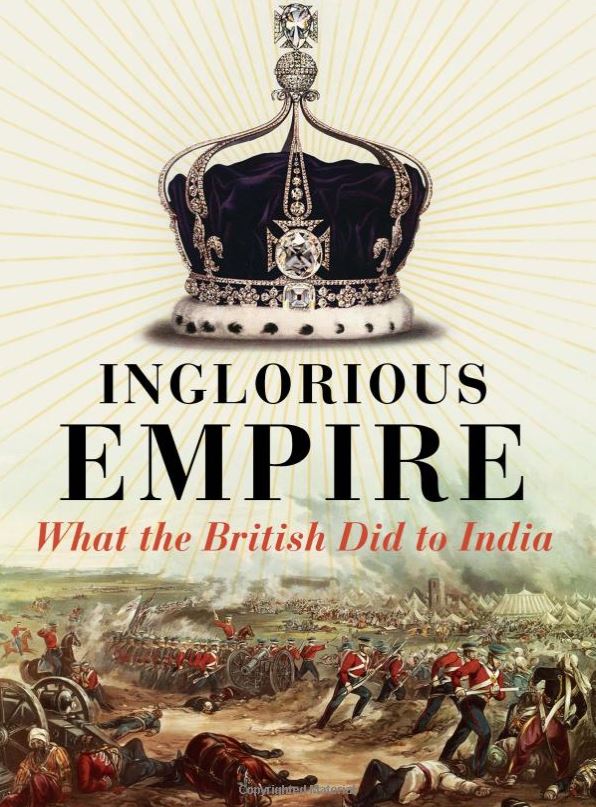
Shashi Tharoor, Inglorious Empire: What the British Did to India, Hurst & Co, 2017
Tharoor is an Indian politician, and a good polemicist. Two points stood out for me in this well-written book. Firstly, he does a good job of confronting Niall Ferguson, the historian and apologist for British (and American) imperialism, on the subject of India. This illustrates how a polemic can provide a useful theme for guiding the exposition of an argument.
Secondly, and for me the most interesting parts of the book, were not where he detailed how the British destroyed the Indian textile industry to promote India’s imports of British textile products – often woollen clothes that were completely unsuited to India’s climate. This has been covered many times by others. The new point for me was where he showed how British domination undermined India’s commercial shipping sector and its shipbuilding industry, an industry that, at the time, was at least as advanced as the British one. This resulted from British commercial power, setting the rules on what ships could be used between British controlled ports and also who could run that business. Commercial power is often greatly underestimated by those who focus only on industry, and these examples help explain more fully Britain’s exploitation of India.


Machinations in the Middle East

Christopher Davidson, Shadow Wars: The Secret Struggle for the Middle East, One World, 2016
This book is a good, easy to read, although lengthy review of events in the Middle East and Northern Africa. It will help a lot in understanding the background to present day news stories, since it details the actions both of the major powers – the US, Britain and France in particular – and of the different political groupings in the region. There is a welcome coverage of countries from Nigeria, to Libya, to Saudi Arabia, Syria and Turkey, with comprehensive information on the supporters of ISIS, Al-Qaeda, Al-Nusra, Boko Haram, etc.
Davidson has incorporated a mass of material into the book, providing some important details that even close observers of these events are likely to have missed. His 2,500 footnotes are encyclopedic, even to excess, covering 121 of the near-700 pages, but they do give useful documentation for anyone doing research on these issues. However, although in many places the book gives a useful summary of the relevant historical background, its disadvantage is that it reads more like an extended news review. This is at the cost of giving a more theoretical assessment of what is going on and explaining how this results from the latest phase of imperial disintegration.


The Balfour Declaration, British Support for Zionism

David Cronin, Balfour’s Shadow: A Century of British Support for Zionism and Israel, Pluto Press, 2017
This book does what it says in the title, and reviews British government policy towards Palestine and Zionism from the time of the Balfour Declaration in 1917 up to the present day. There are more twists and turns in this story than it is easy to summarise here, but I would recommend Cronin’s work as well-written, well-documented and mercifully concise!
Although it covers some similar ground, I would also recommend reading John Newsinger’s telling critique of the British Labour Party and Zionism, available here.

Tony Norfield, 23 December 2017

Thursday, 21 July 2016

A Dreadful Waste of Money

'Crowdfunding' has become common in recent years to accumulate small sums of money from many people to achieve a particular objective. So far, so social and, potentially at least, progressive. But what is one to think of the reported 180,000-plus people who have recently joined the British Labour Party at a cost of £25 each, giving it some £5 million? Even with the lower value of sterling, that is a dreadful waste of money.

The Labour Party deserves disdain, at a minimum, even if one were ignorant of its blood-strewn history as a defender of (British) imperialism when in government. In all manner of wars and subterfuges, from the partition of India, to Vietnam, to Ireland, to Iraq and the Middle East in general, the Labour party has been the proponent of, or an ally in, a wide variety of imperial crimes.
An apparently saintly Jeremy Corbyn, embattled leader of the Labour Party, shares the same sins. Apart from being a member of the Labour Party for more than 30 years, he is now a member of the Privy Council. This Council includes senior political figures from all major parties, who are informed about the ill-doings of the British state and pledge not to tell. The oath is as follows:
 
“You do swear by Almighty God to be a true and faithful Servant unto the Queen’s Majesty, as one of Her Majesty’s Privy Council. You will not know or understand of any manner of thing to be attempted, done, or spoken against Her Majesty’s Person, Honour, Crown, or Dignity Royal, but you will let [ie stop] and withstand [ie prevent] the same to the uttermost of your Power, and either cause it to be revealed to Her Majesty Herself, or to such of Her Privy Council as shall advertise Her Majesty of the same. You will, in all things to be moved, treated, and debated in Council, faithfully and truly declare your Mind and Opinion, according to your Heart and Conscience; and will keep secret all Matters committed and revealed unto you, or that shall be treated of secretly in Council. And if any of the said Treaties or Counsels shall touch any of the Counsellors, you will not reveal it unto him, but will keep the same until such time as, by the Consent of Her Majesty, or of the Council, Publication shall be made thereof. You will to your uttermost bear Faith and Allegiance unto the Queen’s Majesty; and will assist and defend all Jurisdictions, Pre-eminences, and Authorities, granted to Her Majesty, and annexed to the Crown by Acts of Parliament, or otherwise, against all Foreign Princes, Persons, Prelates, States, or Potentates. And generally in all things you will do as a faithful and true Servant ought to do to Her Majesty. So help you God.”

Corbyn's principal divergence from this blood-oath loyalty to the British state shortly after becoming Labour Party leader was ... not to kneel before the Queen. Perhaps his knees were playing him up a bit.

My message to those who have already pledged their £25 to the Labour Party, or may do so, is that they would have a much better chance of a positive outcome by betting on a three-legged horse next running in the Grand National.

Still better a reward would be secured by purchasing, reading and reflecting upon an informative book by, admittedly, a right-wing, former Labour Party member, Edmund Dell: A Strange Eventful History, Democratic Socialism in Britain, Harper Collins, 2000. It should be read with critical eyes (what should not?), but this book is well-written, full of enlightening information and is available at much less than the otherwise wasted £25.

Tony Norfield, 21 July 2016

Thursday, 8 October 2015

Origins of the UK Welfare State


The golden age of the British Labour Party was the 1945-51 Labour government. So it is worth noting some little known aspects of its policies to cast some light on the political background to the modern day resurgence of ‘Corbynism’. Highlights of this administration in British popular consciousness are the introduction of the welfare state, establishing the NHS and a pension system. While there were economic problems in spending on welfare, since the UK was essentially bankrupt in 1945, the Labour government rose to the challenge. How did they do this? By using British imperial power!
One of the 1945-51 Labour government’s priorities was to maintain Britain’s imperial role. For good measure, this also included re-establishing French and Dutch colonial power in Asia, as a sign that the status quo ante could be revived in Burma, Malaya, Vietnam, Indonesia, etc. Using colonial Indian troops and Japanese troops to bring this about highlighted British politicians’ pragmatism and flair. Who else would have come up with the idea of defeating anti-colonial nationalists with soldiers both from a colony and from a recently defeated imperialist power? A stroke of imperial genius![1]
Although these events might seem to be an unfortunate foreign policy to liberal souls, having nothing to do with progressive social policies at home, in fact the two things were closely linked. Just look at how the new welfare state was financed.
Britain’s finances in 1945 depended upon foreign loans in 1945 amounting to £2,100m, or a massive 20% of GDP (note that £1 used to be worth something in those days). Of this sum, £1,100m was from the US. It was not exactly enthusiastic about Labour’s spending plans, but it was happy that the Brits were playing a necessary role worldwide in suppressing ‘communism’. For example, apart from the colonial efforts, think of Britain’s role in the defeat of Greek radicals and establishing a military dictatorship after 1945. So, history will record that the US played a role in funding the setting up of the UK welfare state! Another £250m was from Canada, which was both politically close to the UK and had done well out of the Second World War. Significantly, Britain’s colonies ‘lent’ £750m through the financial mechanism of the Sterling Area that gave them no choice but to do so. These were borrowings by Britain whose international value was reduced when sterling’s exchange rate against the US dollar fell in later years.[2]
After 1945, the welfare system quickly became unaffordable on the basis of Britain’s economy, especially when Labour increased defence spending during the Korean War. Apart from charges for prescriptions of medicines, something that led to ructions in Labour’s ranks and the resignation from government of Labour saint Aneurin Bevan in 1951, it also led to several years of rationing goods even more stringently than during the war. Above all, it prompted ever more nefarious plans to milk the colonies for economic resources in addition to the previous Sterling Area financial rip offs. Details on the former are set out in my article on this blog, 'Labour's Colonial Policy', 7 December 2014.
That is some of the historical background to typical Labour ‘progressive, alternative’ policies. It is based on using Britain’s privileged position in the world economy to deliver benefits to the British populace, completely consistent with Britain’s imperial role and nothing that could be described as a socialist view of policy in the world economy, far less anything that is anti-capitalist.
Jeremy Corbyn may know the history, in which case being a longstanding, proud member of the Labour Party raises a few questions. If he does not know the history, then it would reflect the more widespread arrogance, all appearances to the contrary in his case, of assuming that the rest of the world owes the Brits a living.

Tony Norfield, 8 October 2015


[1] I am not making this up. See Christopher Bayley and Tim Harper’s book, Forgotten Wars: the End of Britain’s Asian Empire, Allen Lane, London, 2007.
[2] There are few studies of these embarrassing (for Labour loyalists) events. One accessible source, written from a pro-capitalist market, although strikingly critical, perspective, is Edmund Dell, A Strange Eventful History: Democratic Socialism in Britain, Harper Collins, London, 1999, especially Chapter 7.

Sunday, 7 December 2014

Labour's Colonial Policy


This article is based on notes prompted by reading an interesting book, Imperialism and the British Labour Movement, 1914-1964, by Partha Sarathi Gupta, published in 1975. I find it particularly of interest because it presents some original material from a time when the Labour Party will claim to have been 'socialist' in some sense. So, this article can be seen as an anti-nostalgia exercise! Things never were any good with this pro-imperialist party.
Gupta has extensive documentation of debates in the House of Commons, Labour Party conference speeches and policy recommendations from such bodies as the Fabian Colonial Bureau and the Movement for Colonial Freedom. He also gives examples of the racism of many leaders of the 'labour movement', especially regarding Africa. More important for my current purpose is that he highlights how Britain's plans for colonial development were always presented as being mutually beneficial, but were always based upon Britain's needs and in directions determined by the colonial rulers, not by the local populations.
The book is a dry read, and with a number of questionable views, for example that by the early 1960s 'social imperialist sentiment had been eliminated' in the UK (p. 393). However, it offers some striking comments and statements that illustrate the 'socialism in words' and 'imperialism in deeds' perspective of the Labour Party in the 1940s and 1950s that I will set out below. A good summary of Labour politics is given in Gupta's conclusion to a chapter on 'Colonial reforms':
"A large body of opinion inside the [labour] movement was representative of 'little Englanders', who were preoccupied with social transformation at home and anxious to avoid military and political engagements abroad. In moments of crisis a social imperial syndrome became active. Though it was originally noticed mainly among those trade unionists who were least affected by socialist ideas, the imperialist bias displayed by Bevin in general [Ernest Bevin, Labour's staunch anti-communist Foreign Secretary, 1945-1951] and by John Strachey over the groundnuts affair [see below] showed that persons with a Marxist background could slide easily into a social-imperialist position once they became pre-occupied with building socialism in their own country only." (pp. 346-347)
Despite the little Englanders being 'anxious to avoid military and political engagements abroad', Gupta does not mention that there was no labour movement opposition to Britain's military efforts to re-establish its own and other European colonies after 1945, possibly because these used Indian and recently defeated Japanese troops against local nationalists in Asia, and hardly any British troops. But, I will turn attention to the more direct British dimension of colonial economic exploitation.
The first example is John Strachey. Named in House of Commons records as Evelyn Strachey, MP for Dundee, and with the more elaborate nomenclature on his birth certificate of Evelyn John St Loe Strachey, he was an outcome of Eton and Oxford and an itinerant politician (see his Wikipedia entry) with successive socialist, Mosley, Communist, anti- and pro-Keynesian views. He was also a Minister of Food and a Secretary of State for War. Despite these dizzying turns, throughout his life he remained a consistent British nationalist. In a January 1948 House of Commons debate on the Colonial Development Corporation bill, he concluded:
"I should like to end this discussion by striking this note, that by one means or another, by hook or by crook, the development of primary production of all sorts, in the Colonial areas, Colonial territories and dependent areas in the Commonwealth, as well as generally throughout the world, in far more abundant quantities than exist today is, it is hardly too much to say, a life and death matter for the economy of this country."
This perspective was behind his support for the infamous groundnut scheme in Tanzania, then called Tanganyika. Britain's plan to plant groundnuts in an unsuitable region with idiotic technology turned into a loss-making fiasco and was abandoned. However, while this is often seen as a dumb development project, the basic notion behind it receives less attention: it was to use cheap labour in the colonies to grow products that would feed the British back home, and so reduce the need to import from outside the Empire. This would avoid paying in US dollars for some food supplies when there was already a shortage of dollars in Britain's reserves. Instead, the producers of Tanzania would receive payment in terms of a devaluing sterling.
The groundnuts scheme was only one case of colonial exploitation, realised or planned. More importantly, Britain had a number of marketing boards that were monopoly buyers of the commodity output of its colonies, and limited the development of any processing operations so that they received at best, and usually below, the world market price for the raw commodity. House of Commons Parliamentary debates always argued that a 'fair price' was being set, and that the buying operation carried risks to Britain's finances. But the buying prices were always set at below what the market price turned out to be. Furthermore, the surpluses from selling these products on the market always ended up in sterling balances based in London banks! This was how the system worked.
In a May 1951 debate on the West African Marketing Boards, one Labour MP, the Rugby and Oxford educated barrister, Richard Acland, made the following comment as part of a longer apologia:
"Firstly, the prices in the long-term contracts made by our Government were perfectly fair prices, there being genuine arguments at the time of the contracts to suggest that world prices for the crops might have fallen. But in fact that has never happened and the opposite has always taken place. To give an example: We are purchasing West African palm oil at £94 a ton, when the same oil on the free market has been fluctuating from £134 to £210 per ton."
What a stroke of luck that no West Africans were listening! Just in case they were, he denied that the amounts concerned were of any significance.
This is not to say that Labour MPs were being too truthful, and not forward-looking enough. How forward-looking, to see the way in which British imperialism's economic stresses could be solved so that we could have a 'Jerusalem builded here', on the backs of the colonies, is shown in the next quotation. Harold Wilson, a future Labour Prime Minister, had this to say in the House of Commons when Labour was in opposition in February 1953:
"There are very many schemes that can earn and save dollars and we want to know about them. There is copper in Rhodesia and Uganda; zinc and lead in Nigeria and tin in Uganda and British Honduras. We have to face the working out of the tin reserves in Malaya, before many years are over. There is, too, bauxite in Jamaica, manganese in India and South Africa, tungsten in Uganda, beryllium in India and columbium in Uganda. I am sure that these things are being considered by the Foreign Secretary, and what we should like to know at some convenient time—I would not press him to answer in detail tonight—is what is being done to press on with these schemes.
"Perhaps the most important step in the Commonwealth development [sic!] would be for the Government to work out now a wide-ranging geological survey of Colonial Territories ... I do not think that anyone in the House would deny that the answer to all our dollar problems may well be found 200 or 1,000 feet below the soil in the Colonial areas, and a really imaginative geological survey might possibly solve a lot of our problems over rather a long time."
The economic policy in the colonies, now given the honeyed description of 'Commonwealth' rather than Empire, was to meet British imperialism's requirements. That is not a surprise for critics of imperialism, but let me leave you with a sickening Labour socialist conclusion. Recognising that the Empire, sorry, Commonwealth, may not persist on the same footing, noting the colonies' contribution to the Sterling Area balances and expressing a desire that colonial peoples have a better future, Jennie Lee, wife of Aneurin Bevan, the Labour left saint, had this to say at Labour's Annual Conference in October 1956:
"We have to work for the day when there will be a higher standard of living here, a higher standard of living in the colonies, and when as free and friendly nations they will want us to be their bankers." (p. 376)
She was ahead of her time. The City of London today is the biggest centre of global banking, despite Britain having a much worse current account deficit than when she was speaking. British imperialism found other ways of appropriating the value of what others produce.

Tony Norfield, 7 December 2014

Thursday, 6 February 2014

A Brief Note on Scottish (British) Imperialism

How would you characterise this country? It has a banking sector with assets more than 12 times the size of GDP, is the base for a large nuclear weapons and defence industry, has a militaristic tradition (providing brutal troops for colonial invasions) and has had its leading politicians in charge of parties that supported the invasion of other countries. Is it progressive? Radical? Proud and independent, perhaps? Or an integral part of British imperialism and very likely to want to remain that way?

Scotland is the latter. The posturing by Scottish nationalists for the 'independence' referendum due in September 2014 is simply a negotiating tactic to try and get further benefits from the London plutocrats.

Their problem is that the money has run out and their bluff is being called. The Bank of England governor recently told them that they cannot have sterling (but they no longer want the euro). It is also likely that the arms companies will threaten to exit, while oil and gas companies will raise questions about how the Law of the Sea will impact their operations on either side of the indeterminate, prospective Scottish/English dividing line.


Tony Norfield, 6 February 2014

Wednesday, 3 October 2012

The City of London: Parasite of the World Economy


This article examines the City of London. My focus is on its international trading, bringing together some important material on British imperialism and finance. I will not be discussing whether banks based in the UK are ripping off consumers, failing to lend cash to struggling companies, mis-selling financial products or manipulating LIBOR. These matters are mere bagatelles. The bigger story is how tens of billions of pounds are extracted every year from the labour of others in the world economy by the regular daily mechanism of British finance.


1. Economic decline, but financial power


Most people know that the City of London is a big financial centre. However, the large scale of its operations is striking given that the British economy is a second-tier economic power at best, ranking well behind the US, behind China, Japan and Germany, and even behind France and Brazil, according to GDP data for 2011. When it comes to finance, the UK moves from being an also-ran to one of the major global medal winners.

Britain first achieved the position of being the world’s premier centre of commerce, credit and finance in the 19th century. This was a natural complement to its domination of trade and its rule of a global empire. Some historians have characterised Britain as being more the ‘warehouse of the world’ than the ‘workshop of the world’ at this time. However, even when Britain’s position was challenged by rivals and weakened by two cataclysmic imperialist wars in the 20th century, the prominence of commerce, and particularly of finance, continued as a critical dimension of the British economy. From a relatively weak position as a major power post-1945, British governments took every opportunity to prop up British economic privileges. First this happened by bleeding the colonies to help pay for the ‘welfare state’ and to subsidise British living standards. Then, until the 1970s, it was by using privileged trading and financial deals with ‘Commonwealth’ countries to protect British economic interests. But, it was clear to British governments that competition was tough, even in the post-war boom years, and that Britain’s economy was falling behind and losing market share to more successful countries. This was the backdrop for a succession of policies that promoted – or at least did not impede – the growth of the City’s international financial business.

From the late 1950s, this City business developed not on the back of UK sterling, as in the glory days of Empire, but by using the US dollar. American corporations were dominating world trade and the dollar was now the key currency for international transactions and most financial deals. However, government restrictions on financial markets in the US and elsewhere – but far less so in Britain – enabled the City of London to build up a strong business in dollar lending and borrowing. It was not as if the City was starting from scratch; it was already an international bank dealing centre. However, the eventual impact of this new development of the ‘eurodollar’ market – transacting in dollars outside the US, and outside the jurisdiction of the US government – was dramatic. It was a major step in the growth of global financial markets. By the early 1970s, the gross size of the eurodollar market in loans had already exceeded $500bn, exploding to some $3000bn by the end of the 1980s, helped by huge current account imbalances worldwide and credit expansion by international banks. By the 2000s, the eurodollar market’s size, some 75% of the total eurocurrency market, had reached $5000bn. These expansions of credit helped underpin a boom in all kinds of international financial deals.

Such developments should not be understood in narrow financial terms. They reflect firstly the chronic problems that capital accumulation encountered by the early 1970s, depending more and more upon credit expansion to keep the system ticking over, although this entailed more frequent financial crises. Secondly, the opening up of financial markets worldwide, promoted especially by the US, but in close cooperation with Britain, meant that the already limited scope for national-based policies had diminished to vanishing point. Hence, the minuscule differences in economic policy among political parties in all countries. Thirdly, this new financial system helped put the powers at its centre in a surprisingly strong position, at least in a position much stronger than would seem consistent with their not-so-competitive economies. The two powers at the centre of the world financial system are the US and Britain. Most analysts focus on the US as the hegemon of global finance. While this is an understandable bias, it overlooks the role played by the UK, imperialism’s broker-dealer.


2. Uptown Top Ranking


The size of the financial system in Britain compared to the national economy is far bigger than it is in the US. One measure of this is to look at the size of bank assets compared to GDP. In the UK, total bank assets were roughly four times GDP in 2011; in the US they were only a little larger than GDP. US bank assets were still larger than those in the UK in absolute terms, reflecting the much bigger US economy. However, other measures of absolute financial weight put the UK in a top ranking position. These measures are not all based on British-owned financial companies, but on financial companies with operations based in the UK. Nevertheless, this UK-based business is vital for the fortunes of British imperialism.

In summary, before giving the statistical details, the City of London is:

-         the world’s largest international money market
-         the largest foreign exchange market
-         the largest ‘over-the-counter’ interest rate derivatives market
-         the 2nd biggest issuer of international debt securities (after the US)
-         the 4th largest location for the listing of equities (after the US, China and Japan)
-         one of the two largest net earners of revenues on financial services

While there are diverse ways in which to measure such things, these results are persistent features that emerge in many different methods of calculation. They reflect the structural privilege that Britain has in world finance, privileges that bring significant rewards (see section 3).

Table 1 details the UK’s international banking position compared to other countries. The totals in the table are for 44 countries that report to the principal body that collates these figures, the Bank for International Settlements, based in Basel, Switzerland. Notably, the UK has by far the largest total of claims (loans to) and liabilities (deposits from) other countries. The data are for banks located in a particular country, including these countries’ so-called ‘offshore’ banking facilities. The UK has 20% of total outstanding business; the US is in second place with a 12% share. UK-owned banks do not all this business; foreign banks in the City do a large share. However, a separate table compiled by the BIS on the business done by banks according to their nationality does show that British banks have a larger volume of international business than the banks of other countries. The listed UK figures in the table exclude the separate banking business of a variety of tax havens outside the UK, including the Cayman Islands, the Bahamas, Bermuda, Jersey, Guernsey and the Isle of Man. While these islands are not technically part of UK territory, they all sing ‘God Save the Queen’ and are each given a special status by the British authorities. Together, they would rank third in the table, making up 9% of international bank business.


Table 1:           International positions of banks by country, March 2012

                        ($ billion, amounts outstanding in all currencies)

Country
Claims + Liabilities
Share of Total
UK
12,171
20.2%
US
7,147
11.9%
Germany
4,613
7.7%
France
4,602
7.6%
Japan
4,303
7.1%
Cayman Islands
3,089
5.1%
Netherlands
2,631
4.4%
Singapore
1,816
3.0%
Hong Kong
1,672
2.8%
Switzerland
1,583
2.6%
Italy
1,447
2.4%
Luxembourg
1,345
2.2%
Belgium
1,269
2.1%
Spain
1,237
2.1%
Bahamas
1,179
2.0%
Other
10,118
16.8%
Total
60,220
100.0%

Source: BIS


Table 2 details another dimension of global finance: the foreign exchange market. Banks in the UK (basically, London) have a clear and persistent lead in terms of market share. Foreign exchange dealing is not bank lending or borrowing; it is exchanging one currency for another. Banks make money on these deals by taking a dealing margin. The margin can look very small – for example, one or two hundredths of a percent of the value of the deal for widely traded currencies. However, given the huge volume of dealing – 5 trillion dollars daily in 2010 - this can add up to big earnings! In the latest BIS triennial survey, London had by far the biggest share of the global FX market in spot, forward, swaps and options transactions. This might not seem surprising, given London’s historical role that grew out of international commerce. However, Britain has twice the volume of currency dealing of the US despite being only in sixth position in world trade in goods and services, compared to the US’s top position in trade. The size of London’s foreign exchange market is the clearest sign of British imperialism’s role as the broker for global capitalism, taking a cut of more than one-third of the value of foreign exchange deals in the world economy.


Table 2:           Foreign Exchange Turnover By Country, 1995-2010

                        (Daily averages for April in each year, $ billion)


1995
2001
2007
2010
% of 2010 Total
UK
 479
 542
 1,483
 1,854
 36.7
US
 266
 273
 745
 904
 17.9
Japan
 168
 153
 250
 312
 6.2
Singapore
 107
 104
 242
 266
 5.3
Switzerland
 88
 76
 254
 263
 5.2
Hong Kong
 91
 68
 181
 238
 4.7
Australia
 41
 54
 176
 192
 3.8
France
 62
 50
 127
 152
 3.0
Denmark
 32
 24
 88
 120
 2.4
Other
 300
 362
 735
 756
 14.9
Total
 1,633
 1,705
 4,281
 5,056
 100.0

Source: BIS


Table 3 shows an even stronger picture of London dominance in the so-called ‘over-the-counter’ (OTC) interest rate derivatives market, which comprises direct deals between banks and their customers. OTC trading is the biggest part of the derivatives market, principally made up from trading of interest rate swaps. Other trading of derivatives takes place on exchanges, and the US is home to the biggest exchanges for derivatives, mainly based in Chicago. However, the volume of trading on exchanges is a small fraction of that in the OTC market.


Table 3:           Over-the-Counter Interest Rate Derivatives Turnover, 2010

                        (Single currency derivatives, daily average for April 2010, $ billion)


      FRAs
Swaps
Options
Other
Total
% World Total
UK
 382.0
 738.6
 113.9
 0.3
 1,234.9
 46.5
US
 268.4
 309.3
 64.1
 -  
 641.8
 24.2
France
 46.4
 128.2
 17.7
 1.0
 193.3
 7.3
Japan
 2.0
 82.3
 5.7
 0.0
 89.9
 3.4
Switzerland
 20.1
 58.7
 0.1
 -  
 78.8
 3.0
Netherlands
 0.9
 60.0
 0.4
 -  
 61.3
 2.3
Germany
 15.1
 31.6
 1.8
 -  
 48.5
 1.8
Canada
 6.5
 34.6
 0.6
 -  
 41.7
 1.6
Australia
 6.7
 33.6
 0.3
 -  
 40.6
 1.5
Singapore
 4.7
 28.6
 1.3
 -  
 34.6
 1.3
Spain
 3.6
 24.8
 2.3
 -  
 30.7
 1.2
Italy
 8.4
 17.0
 1.9
 -  
 27.3
 1.0
Hong Kong
 1.3
 15.8
 1.3
 0.0
 18.5
 0.7
Other
 24.7
 70.5
 16.5
 -
 111.7
 4.2
Total
 791.0
 1,633.5
 227.9
 1.3
 2,653.7
 100.0

Source: BIS


UK and US financial centres together account for 70% of the world market, once more illustrating the concentration of global financial trading. The US authorities have been angered by the way that trading derivatives in London has led to big financial scandals hitting their own pockets, from the collapse of AIG in 2008 to the recent loss of $6 billion by JP Morgan’s ‘London Whale’. However, this overlooks the fact that an Anglo-American partnership designed this system, with implicit and explicit government approval, and it has been mutually beneficial to both powers. The US and the UK are also the leading issuers of international debt securities (to which a lot of this derivatives trading is linked), giving them easy access to investment funds from across the world.

Another means of getting access to global funds – and also to the revenues from trading in securities – is via the equity market. Here, the UK is less able to compete with the US in terms of equity market size, since the US economy is around six times bigger than the UK’s and nationally-owned and controlled companies tend to list their stock on national stock exchanges. Nevertheless, the market capitalisation and volume of trading on the UK stock exchange is high, and is the largest in Europe. Companies listed on the London Stock Exchange do not have to be UK-owned or controlled, and stock exchanges compete with each other as markets for attracting international funds and international company listings. My calculations indicate that around 30% of the capitalisation of the FTSE100 index is made up from companies that are principally foreign owned, eg Glencore and Kazakhmys.

Table 4 details the countries with the largest stock exchanges, ranked in order of market capitalisation. The ups and downs of share prices affect the data, but the relative sizes do not change much over time, with the exception of one country that has risen to prominence in this area of global finance: China. I have added together the two ‘mainland’ exchanges to Hong Kong to give a total for China, but even without Hong Kong, China would have the second rank in terms of global market capitalisation of companies. The London Stock Exchange ranks behind Tokyo’s, but is far bigger than the exchanges for other European countries, including the combined Euronext exchange figures for Belgium, France, the Netherlands and Portugal.


Table 4:           Equity Market Capitalisation and Turnover, 2012

                        (All figures in $ billion)

Country
Exchanges
Capitalisation1
Turnover2
US


NYSE Euronext (US) plus NASDAQ
 17,503

 12,588


China

Shanghai plus Shenzhen plus Hong Kong Exchanges
 5,936

 3,703


Japan
Tokyo Stock Exchange
 3,385
 1,810

UK
London Stock Exchange
 3,332
 1,190

Belgium, France, Netherlands, Portugal
NYSE Euronext (Europe)


 2,460


 853


Canada
TMX Group
 1,860
 672

Germany
Deutsche Börse
 1,212
 698

Notes: (1) Market capitalisation for end-June 2012. (2) Electronic order book volume of trades for first half of 2012. Turnover data for Hong Kong estimated by the author.
Source: Calculated using data from the World Federation of Stock Exchanges.


There are other dimensions of global finance than those noted above, including commodities trading and pricing, fund management and insurance. I will not risk drowning the reader in a further torrent of data, however, and just note that the UK ranks at the top end of these global tables too, usually second only to the US as a base for these operations.


3. How to make money by making nothing


The term ‘finance’ in this article has been used to encompass all the lending, borrowing and trading operations of financial institutions. In Marx’s theory of value, two important dimensions of such activities are identified. The first is ‘money-dealing’ activities that are part of the process of buying and selling commodities, and of providing the liquidity that may be necessary for industrial and commercial companies to continue their business. This money-dealing includes discounting bills and providing foreign exchange transaction services. The second is borrowing and lending of money by banks, especially for investment, which comes under the heading of what Marx calls ‘interest-bearing capital’. Out of this form of interest-bearing capital, capitalist financial markets also create various securities that attract forms of interest payment – bonds and equities. One step beyond this is to create derivatives, securities whose value is derived from the prices of bonds, equities and other financial instruments. The demand for derivatives initially arises out of a need for a form of insurance against the volatility in prices of these securities, but this soon builds a momentum for speculative, leveraged trading, especially when capitalist profitability is under pressure.

Issuing these financial securities (bonds, equities and derivatives) can attract investment funds from around the world – especially if pressure has been brought to bear on countries to relax any controls they may have on capital flows! Furthermore, the trading in these securities, the exchange of currencies that may be a part of such trading, and the provision of legal, advisory and custodian services that come with the investment in financial titles, all amount to the build-up of a huge financial infrastructure that can demand its cut for the ‘services’ rendered.

There is a problem, though. All these financial operations are not producing anything; they are simply dealing in titles to things that others have produced. All the costs of such operations are a deduction from social output. Even if one person’s financial deal makes a profit, that profit is offset by a market trading loss for someone else. The most that these financial services can do is to be more efficient, and so waste less money. In capitalist market terms, this is seen as being ‘productive’, and the more efficient financial services company would gain market share. Nevertheless, the financial sector is an economic burden and this fact puts a limit on how big it is likely to grow in any particular country.

However, such limits are greatly relaxed for an imperialist power like Britain that can use its privileged position in the world economy to be the banker, broker, dealer, securities trader and derivatives provider for everybody else. That is why financial services in Britain are so outsized compared to the domestic economy. Of course, having a large financial services sector does not make sense if it does not absorb money from elsewhere. But that is exactly what the UK financial services sector does.

Table 5 details the UK’s net earnings from financial services. These are the summary revenues from overseas for each sector, minus the foreign payments made by these sectors. In total, the net financial services earnings amounted to nearly £40bn in 2011. This covered almost 40% of the UK’s £100bn trade deficit in goods in that year and was roughly 2.5% of UK GDP. The UK has the second biggest surplus on financial services in the world, usually just behind that of the US. If insurance services are added to the reckoning on this account, then the UK surplus is the highest, given that the UK has steady net revenues on insurance (around £8-12bn per annum, not included in Table 5) while the US has a large deficit. These net foreign revenues are a good measure of what value is deducted from the world economy by financial operations based in Britain.


Table 5:           UK Net Earnings from Financial Services, 2009-2011

                        (All figures in £ billion)


2008
2009
2010
2011
Monetary financial institutions
31.7
26.9
23.3
29.0
Fund managers
4.2
2.9
3.5
3.3
Securities dealers
9.0
7.1
4.9
5.5
Baltic Exchange
0.9
0.7
0.7
0.8
Other institutions
-6.2
-0.7
0.9
0.0
Total
39.6
37.0
33.4
38.7

Source: UK ONS

‘Monetary financial institutions’ are what normal people call banks, and they account for the bulk of the revenues. In 2011, the banks’ net interest income on loans made up only about a third of their net foreign income, with fees and commissions about a quarter. The bulk of their earnings, nearly half, came from dealing spreads – amounting to £14.3bn in 2011. Securities dealers outside the banks gained almost all of their income from commissions and fees, rather than from dealing margins. Fund managers based in the UK are less important in the totals, as is the Baltic Exchange, which is linked to dealing in ‘freight futures’, and is the main broker for dry cargo and tanker fixtures, including the sale and purchase of merchant vessels.

The striking thing about the earnings data on financial services is that they have shown little sign of being affected by the financial market slump. In the immediate pre-crisis years 2006 and 2007, the total UK net earnings were close to £24bn and £33bn, respectively, and in the five years before that the figures were in the range of £15-20bn. These are below the numbers seen in 2010 and 2011. The figures give one indication of the material basis for successive British governments backing financial market trading.


4. Conclusion


The legacy of the financial crash has led to recriminations against banks in the UK and elsewhere. However, in the UK the focus has been on the stupendous salaries and bonuses of the lords of finance, and on how to regulate banks in order to avoid economic trouble. There is little investigation of the system itself, and no acknowledgement that the British financial system is a parasitic leech on the world economy. It provides services for the functioning of the capitalist market, taking a cut of the value of every deal. This pays not only for the bank executives and traders, not only for those in other financial operations, but also for a myriad of other functionaries in legal, accounting and other jobs that depend on this huge financial services centre. The ‘City’ also pays the UK government tens of billions in taxes and, as the previous section showed, revenues from its services cover a large portion of the UK trade deficit.

Marx once famously summed up capital as ‘dead labour, that, vampire-like, only lives by sucking living labour, and lives the more, the more labour it sucks’. To continue the metaphor, British imperialism has developed a financial system that acts like a blood bank for the value produced worldwide, one that takes a sip of every value flowing through it.


Tony Norfield, 3 October 2012