Showing posts with label Middle East. Show all posts

Wednesday, 9 May 2018

Iran Sanctions, Imperial problems


Trump's anti-Iran move on Tuesday was deeply worrying for allies of the US. It is a blow for those countries, especially in Europe, that were hoping to build on the big expansion of trade with and investment in Iran after the July 2015 nuclear deal was signed. But it is more than just an economic opportunity under threat. As Germany’s Zeit Online commented ‘with nationalism and protectionism, Donald Trump is gradually eliminating the world order shaped by the USA’. Here I look at some implications of the latest US policy and the reasons for its timing.

Holy orders

The extent of the new US sanctions is at present unclear, although there will be some delay before full implementation. What worries the Europeans is that they are unlikely to apply only to US companies, like Boeing.
On past form, any company not doing as the US wishes could be liable to suffer financial penalties. They could also face problems of access to the US market and its banking system – the latter being necessary for all international companies that use the US dollar. This extra-territoriality of US sanctions, in the words of France’s Finance Minister, Bruno Le Maire, makes the US ‘the economic policeman of the planet’, and that is ‘not acceptable’.
Last October, the now ex-Secretary of State Rex Tillerson claimed that the US will not interfere in Europe’s business dealings with Iran. But the newly appointed US ambassador to Germany, Richard Grenell, has taken a very different tack. He followed up Trump’s statement with a threatening tweet: ‘German companies doing business in Iran should wind down operations immediately’.
It would be hard to top that as a sign of imperial arrogance, something that has become ever more embarrassing for US allies under the Trump regime. To have a smoothy like Obama advance US interests after a chat among ‘friends’ was acceptable. Now the veneer is off and the modus operandi of the nincompoop POTUS is to fart, blame someone else and carry on regardless.[1]

The little, big problem

Following the long years of sanctions, Iran is far from being a big economic partner for the major western powers. Last year it was only number 33 in the ranking of external trading partners of the European Union. Trade between the EU and Iran was close to €21bn, with a little over €10bn of both exports and imports, but this made up less than 1% of the EU’s total external trade. EU trade with India is four times bigger, and it is more than seven times bigger with Turkey. US trade with Iran is much smaller still, roughly $200m last year, which is barely a rounding error in the statistics.
Nevertheless, there had been rapid growth in trade for the EU in recent years, mostly imports of fuel from Iran and exports to Iran of manufactured goods, especially machinery and transport equipment. From 2014 to 2017, EU exports grew by nearly 70% and EU imports by nearly nine times.
Much more trade growth has been in prospect, together with attractive investment opportunities, for EU companies such as Renault, PSA Group, Airbus, Siemens, Total, Alstom and others. Iran’s half-wrecked economy offered a cornucopia of deals in the tens of billions to refurbish, resupply and rebuild.
All that is at risk with the new US policy. More important, however, is that the Iran deal was the result of a longwinded negotiation involving all the major powers, and now the US has walked away from it. This calls into doubt the status of more or less anything else the US has signed up for in the past, and also the status of the US as the unquestioned leader of the western powers.

Why now?

Why did former president Obama’s signing of the joint agreement with Iran look like the ‘worst deal ever’ for Trump? First, note that the US has sustained hostility to a country that dared to step out of line in 1979, when the Shah was overthrown, and has since not been cooperative enough. While the US has come around to accepting other miscreants – notably Vietnam, which beat it in a war – this is very rare and is, in any case, a very slow process. Similarly for Cuba. The irony in Iran’s case is that, aside from sections of the elite who make gains from managing the sanctions regime to their advantage, the country was overwhelmingly in favour of doing a deal with the west as a means of gaining access to technology and development. Nevertheless, despite signing the 2015 deal, Obama was not exactly friendly to Iran. Even afterwards, US political prejudice hindered American business prospects in Iran, with the Europeans much quicker to take advantage.
What seems to have scuppered the Iran deal now is the problem that US policy faces in the Middle East region. This is behind Trump’s long signalled change of course.
Apart from its own direct military intervention, the US has had two elements of control in the Middle East: Israel and Saudi Arabia. Each of these has become more unstable and problematic in recent years, causing trouble for western policy and some embarrassment when it comes to ‘human rights’ in family plutocracy Saudi Arabia and Palestinian rights in the racist gangster state of Israel. Yet the US has not been able to find alternative local tools. After the disaster of US policy in Iraq, another adventure, to replace Assad in Syria, and so to undermine Russia, has failed. This now leaves the US with two dysfunctional supports in a region scarred by imperialism, a mess that it cannot sort out.
The US inability to get rid of Assad has raised Saudi Arabian and Israeli paranoia about Iran. Worried about the stability of their own regimes, they see a long shadow from the bogeyman who does not necessarily do what the US wants and use this to disturb the US’s own discontent. This is neatly summed up in the invention of the so-called ‘Shia crescent’ of Iranian power and influence from Iran through Iraq, Syria and into Lebanon and the Gaza Strip. Saudi Arabia even sees Iran in Yemen, while Netanyahu starred in his own special anti-Iran video for Trump. In an inversion of reality that only someone of his powers can provide, Trump even outdid them with his latest comment that Iran backs al-Qaeda and ISIS.
Trump will tweet and things may change again. But it looks like the foundations of the world order are crumbling further.

Tony Norfield, 9 May 2018


[1] Apologies for lowering the tone, but the word ‘trump’ in colloquial English also means to break wind.

Saturday, 23 December 2017

Some Books #2


These are some of the better books I have read in the past year, and ones to look for if you want to find out about …

The British Labour Movement and Ireland

Geoffrey Bell, Hesitant Comrades: The Irish Revolution and the British Labour Movement, Pluto Press, 2016
This book is an interesting study that undermines the notion that the British labour movement was ever progressive when faced with a challenge to British imperialism. Its focus is on Britain and Ireland in the early 20th century, and it shows there was only some limited support for Irish freedom from British rule in British cities where there were many Irish workers. Neither the mainstream workers’ organisations, nor the more radical ones, took up the issue in any substantial way. This leads Bell to his book’s title of ‘hesitant comrades’. The Catholic Herald summed it all up in March 1920: ‘Ireland is in the throes of a national agony, a victim of merciless militarism, and British Labour remains quiescent and inactive’ (p. 218).
William O’Brien of the Irish TUC and Labour Party had made a similar point a year after the 1916 Easter Rising. Addressing delegates at the Leeds Convention in 1917, he said: ‘In Ireland you have a small nationality at your door which is demanding the right of its own life, … I gather from reading some of the capitalist papers that revolution is popular nowadays. Twelve months ago you had a revolution in Ireland. The papers and politicians that acclaimed the revolution in Russia did not acclaim the revolution in Ireland whose leaders were taken out and shot like dogs’ (pp. 217-218).
Even Sylvia Pankhurst’s Workers’ Dreadnought sidelined the issue of Irish freedom from political oppression by belittling the Sinn Fein-supporting nationalists. It promoted hopes for the class struggle instead. It is tricky to follow the development of inconsistent comments by labour movement radicals. But while some, like the Communist Party of Great Britain (CPGB), ended up being more ‘theoretically’ correct, they still did next to nothing about the issue, or even wrote much about it.
All the workers’ organisations wanted to avoid the question of sectarianism in Ulster, which was replicated in the working class in Liverpool, Glasgow and elsewhere. Confronting sectarianism would also have caused problems for the trade unions. So they blamed sectarianism on Unionist politicians, like Carson, and on the British Government, and downplayed the material basis for the support of anti-Catholic policies among the Protestant-Loyalist working class.
In the second half of 1921, after anti-Catholic pogroms by the Ulster Loyalists, CPGB member William Paul, in his pamphlet Irish Crisis, said: ‘The peculiar psychology of Orangeism … with its fierce and violent hatred against its enemies will be easily diverted against a capitalist class during a revolutionary crisis. It was Carson who taught them how to arm against the status quo … When the workers move against Capitalism, the revolutionary movement of Ulster will have good reason for thanking Carson for his magnificent work’ (p. 191). This view rested on the delusion that somehow the loyalist workers’ ‘fierce and violent hatred’ towards Catholics would be overcome in a ‘move against Capitalism’. It dishonestly used the mirage of future workers’ unity to avoid dealing with the ugly reality of the day.
The left sometimes recognised how Ireland’s struggle was a political embarrassment. For example, in June 1920 the British Communist paper, The Call, said: “The suppression of Ireland is one of the world’s great crimes; the silence of Englishmen is one of the tragedies” (p. 111). But despite this, and other, similar statements by the CPGB in 1920-21, they did little about it. To say the least, they would have scored few points when measured on the Bolshevik reckoning of how many Communist supporters had been imprisoned for their agitation on Ireland.


The British and India

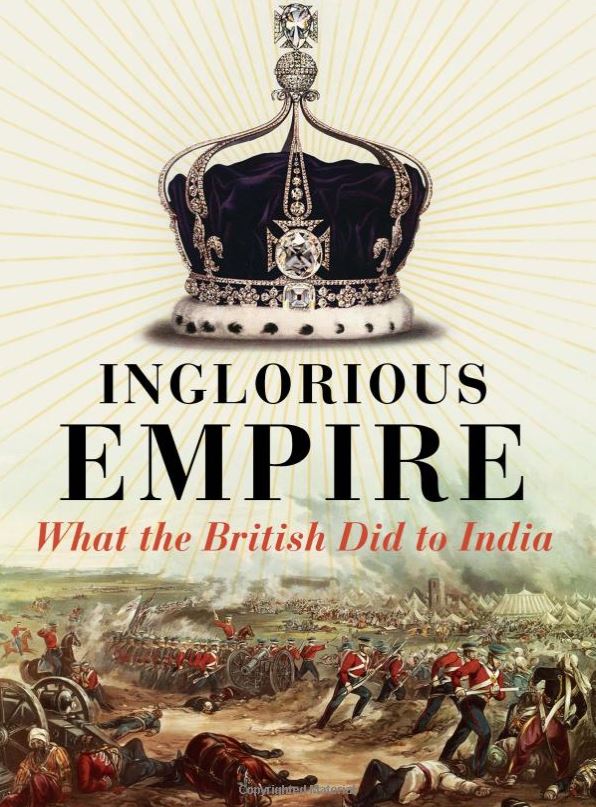
Shashi Tharoor, Inglorious Empire: What the British Did to India, Hurst & Co, 2017
Tharoor is an Indian politician, and a good polemicist. Two points stood out for me in this well-written book. Firstly, he does a good job of confronting Niall Ferguson, the historian and apologist for British (and American) imperialism, on the subject of India. This illustrates how a polemic can provide a useful theme for guiding the exposition of an argument.
Secondly, and for me the most interesting parts of the book, were not where he detailed how the British destroyed the Indian textile industry to promote India’s imports of British textile products – often woollen clothes that were completely unsuited to India’s climate. This has been covered many times by others. The new point for me was where he showed how British domination undermined India’s commercial shipping sector and its shipbuilding industry, an industry that, at the time, was at least as advanced as the British one. This resulted from British commercial power, setting the rules on what ships could be used between British controlled ports and also who could run that business. Commercial power is often greatly underestimated by those who focus only on industry, and these examples help explain more fully Britain’s exploitation of India.


Machinations in the Middle East

Christopher Davidson, Shadow Wars: The Secret Struggle for the Middle East, One World, 2016
This book is a good, easy to read, although lengthy review of events in the Middle East and Northern Africa. It will help a lot in understanding the background to present day news stories, since it details the actions both of the major powers – the US, Britain and France in particular – and of the different political groupings in the region. There is a welcome coverage of countries from Nigeria, to Libya, to Saudi Arabia, Syria and Turkey, with comprehensive information on the supporters of ISIS, Al-Qaeda, Al-Nusra, Boko Haram, etc.
Davidson has incorporated a mass of material into the book, providing some important details that even close observers of these events are likely to have missed. His 2,500 footnotes are encyclopedic, even to excess, covering 121 of the near-700 pages, but they do give useful documentation for anyone doing research on these issues. However, although in many places the book gives a useful summary of the relevant historical background, its disadvantage is that it reads more like an extended news review. This is at the cost of giving a more theoretical assessment of what is going on and explaining how this results from the latest phase of imperial disintegration.


The Balfour Declaration, British Support for Zionism

David Cronin, Balfour’s Shadow: A Century of British Support for Zionism and Israel, Pluto Press, 2017
This book does what it says in the title, and reviews British government policy towards Palestine and Zionism from the time of the Balfour Declaration in 1917 up to the present day. There are more twists and turns in this story than it is easy to summarise here, but I would recommend Cronin’s work as well-written, well-documented and mercifully concise!
Although it covers some similar ground, I would also recommend reading John Newsinger’s telling critique of the British Labour Party and Zionism, available here.

Tony Norfield, 23 December 2017

Friday, 7 April 2017

Trump, Syria & the Middle East


The US has hit Syria’s Shayrat military air base near Homs with 59 Tomahawk cruise missiles. Whether there is any more to come nobody can say because the strikes do not appear to have much logic to them and so war aims cannot be drawn from political objectives.
But the central weakness flows not from Trump’s knee-jerk response but from the dubious nature of the event that provoked it. A chemical attack by Syria simply does not make sense. Assad has virtually won his war by sheer perseverance, western incompetence and Russian help. At the least, he has no viable opponents on the ground. His strategy is to sit it out while his opponents exhaust themselves, realise the futility of their actions or just leave the country. The West, when it tried at last to put down some sort of marker in a war it could do nothing about, defined the use of chemical weapons as a red line. The Russians agreed and Assad followed through. He gave them up in a quid quo pro negotiated by the Russians. In return, the West abandoned ‘regime change’ in all but words. Both sides kept to the agreement. Why would Assad now use a weapon that could only provoke the West and which is of very limited military use, and one day ahead of a major international meeting on Syria held in Brussels? Former Congressman Ron Paul, a leading, although sometimes critical Trump supporter, argues that the chemical attack is ‘false flag’ operation: “It doesn’t make any sense for Assad under these conditions to all of a sudden use poison gases – I think there’s zero chance he would have done this deliberately”.
Far from showing Trump’s willingness to ‘go to war’ – reversing his supposed ‘isolationism’ which, in any case, was a silly and unrealistic proposition – the bombings instead show the West’s very limited options in Syria. If the West really wants to eliminate Assad, why slam 59 missiles into an isolated airfield? Why not do some real damage, and show ‘global leadership’, by destroying Assad’s military command and control structure?
The plain fact is that while America has the military means to obliterate whatever it likes, both America and the West as a whole has very little power to influence events.
The West would not be able to contain the fall out if Assad were forcibly removed
The US probably has the capacity to ‘take out’ Assad in a surgical strike, or seriously to degrade his already limited military capacity, though his regime is pretty smart and also has Russian assistance. But how would his removal by force affect regional players?
For example, Iran is currently a stabilising force in the region since it wants to rebuild its relationship with the West and wants to show that it can be a trusted, competent and effective regional manager. A significant section of the Iranian elite, and the Shia community in the region, do not believe this can be pulled off and that such a strategy will only weaken Iran in the long run since Western imperialism cannot change its nature.  How would killing Assad alter this critically-balanced situation? Almost certainly not in the interests of the West. Eliminating Assad by force, and the fall out that comes after it, would significantly alter Iran’s position as a regional manager.
Furthermore, Turkey is currently playing a very dangerous game in pursuit of establishing itself as the main player and arbiter in the region. Its overriding goal had been to join the European Union. But it has abandoned all hope of joining by negotiation. It has realised instead that potential EU entry is not about reason or willingness to be reasonable, but about power. It thinks it has a much better chance of forcing a better long-standing deal with Europe by establishing its status as the region’s key pacifier and manager, which Europe desperately needs. This has led it to meddle in regional politics in hugely irresponsible ways that are often counter to western interests and alarm the West. Indeed, Turkey is now the main obstacle to a settlement in Syria.
It is very likely that Assad’s removal would embolden Turkey to be even more reckless. Turkey would almost certainly want to take a major position in a post-Assad Syria, if not to subjugate Syria under its control, which would immediately snarl up all regional relations. This would reproduce Turkey’s inability to reach a settlement with the Kurds on a much grander scale.
Then there is Russia. The West has been forced to establish an uneasy and very limited ‘partnership’ with Russia, given that it has been unable to handle on its own the mess it has made of the Middle East. This has obliged the West to accept that Russia is a legitimate regional player and to accept its more active military presence in the Eastern Mediterranean – something unthinkable in the Cold War years. Russia plays a peculiar role in the region. Most of the regional players are anti-Russian, but they want Russia to serve as a counterweight to the power of the West. Iran is by no means a Russian ally, but it benefits greatly from Russia’s presence in the region. Assad’s violent removal would not only be a defeat for Russia, it would perturb regional relations.
What replaces the Assad regime?
If the Iraq war and its fall out has shown the West anything, it is that military action alone cannot achieve stability and war has unexpected consequences. As Napoleon once said of the limitations of war, “you can do anything with bayonets except sit on them”. War can be the continuation of politics by other means if there is a plausible political settlement at the end of it. Clausewitz in reverse does not work.
Perhaps all this explains the almost apoplectic Western response to Syria, including that of western liberals and former radicals. It is a response born of their frustration about the absence of a military or political solution they can be in charge of, rather than a willingness to go to war.

Susil Gupta, 7 April 2017

Thursday, 29 December 2016

Some Books


Based on my non-economic readings over the past year or so, here are some books to follow up if you want to find out about …

The British Labour Party
Edmund Dell, A Strange, Eventful History: Democratic Socialism in Britain, Harper Collins, 1999
Written by a Labour right-winger, this book contains a telling critique of the reformism and hypocrisy of the Labour left, plus rarely noted information on how the colonies (and the US) provided the funds with which to set up the welfare state in 1945. Its main message is that the British electorate will not warm to ‘socialism’, so Labour has always had to retreat from radical programmes, even ones that were far from socialistic and which at best could be called national welfarism.
The Partition of India
Narendra Singh Sarila, In the Shadow of the Great Game: the Untold Story of India’s Partition, Harper Collins 2005 and 2009
This is the only book I have found that explains what was in it for the British when India was partitioned. It shows how the British backed Muhammad Ali Jinnah in his opposition to the Indian National Congress, and how they encouraged the formation of Pakistan as a dependent state that they could better rely upon to be anti-Russian than an independent India. Historians usually avoid this and explain partition by claiming that there were deep-rooted ethnic/religious differences that demanded a Moslem Pakistan separate from a Hindu India.
Middle East historical background
James Barr, A Line in the Sand: Britain, France and the Struggle that Shaped the Middle East, Simon and Schuster, 2011
A very interesting account of the carve up of the region between the British and the French, from Iraq to Syria, Lebanon, Palestine and Israel, mainly covering the 1915-49 period. This brings out the hypocrisy and double dealing of the major powers very clearly. For example, it shows how France armed and supported the Zionist opposition to Britain in Palestine as a means of getting back at the Brits for edging them out of Syria.
David Fromkin, A Peace to End All Peace: the Fall of the Ottoman Empire and the Creation of the Modern Middle East, Phoenix Press, 2000
Fromkin has some very good coverage of the machinations of the big powers in the region, from the late 1800s to the 1920s. Although he is pro-Zionist, he provides a lot of useful material on who did what, when and why.
However, neither of these books (nor many others) asks the question of why the Palestinians had to pay the price for the European murder of millions of Jews – in terms of expulsions and seized land in the UN 1948 deal to set up Israel (quite apart from the new state’s later annexations).
Immigration/racism in Britain
Robert Winder, Bloody Foreigners: the Story of Immigration to Britain, Abacus Books, 2004 and 2005
This covers a long history from the 1200s (!), but very well, and with interesting insights into popular prejudice and political responses, giving many striking examples. The 20th century takes up most of the book, and is most relevant for contemporary politics.
Africa and nationalism
Basil Davidson, The Black Man’s Burden: Africa and the Curse of the Nation State, James Currey, 1992
This is the best thing I have read on the problem of nationalism, and why Africa is such a mess. Davidson shows how the efforts of post-colonial governments in Africa to adopt a national perspective, largely adopted from Europe, could not work. This perspective did not suit the realities on the ground, where there were all kinds of cross-border relationships and also divergences within supposedly unified nations. Davidson puts this in a materialist perspective, showing how the up and coming African bourgeoisie was still very weak, and in the 20th century could not replicate what the Europeans did in the 19th in terms of building nation states. This was a clear sign of the limits on development created by the imperialist world economy, both in colonial times and today.

Tony Norfield, 29 December 2016

Friday, 16 December 2016

Trump and the US-Russia-China Triangle


Although it is the world’s major power, the US has found it difficult to impose its will in the past decade or so. From President Bush’s ‘mission accomplished’ speech about Iraq in 2003, to the continuing disasters in Afghanistan, Libya and Syria, from US policy in Ukraine also being upset by Russian intervention in Crimea, to how the Saudis and other Gulf states have destabilised the Middle East, the US has not been getting its own way and has been unable to impose settlements that would otherwise be expected of a hegemonic power. This puts the incoming US administration under The Donald in an interesting position.
Early signs suggest that POTUS-elect Trump is taking a softer line on Russia, one different from the still Cold War-inspired position of the Obama regime. Trump has stated that he expects the Europeans to pay more for their own NATO-related defence, which might make them less willing to finance an increased build up of military operations close to Russia’s borders. Trump has also rejected Obama’s rhetoric on Putin’s supposed involvement in Russia’s alleged cyber attack on Clinton’s emails. Perhaps most striking of all, Trump plans to appoint Rex Tillerson as US Secretary of State, that is to be the main person in charge of foreign policy. Tillerson is Chief Executive Officer of ExxonMobil, and is well known to have friendly relationships with the Russian government.
ExxonMobil opposed sanctions on Russia from its own business perspective, but one would have to agree that the aggression shown to Russia by the current US administration makes little economic or political sense. Russia is far from being a threat to US interests. Instead, Russia may have prevented the unravelling of Syria that was the direction of previous US policy, and which would have had a deleterious impact on the stability of the Middle East, with knock on impacts into Europe. For this reason, Trump’s likely Russian rapprochement makes sense, even if it will embarrass the Europeans.
All this, and more, is still to be determined, since the billionaire has yet to establish himself in the White House. However, it seems that while there is very likely to be a US-Russia rapprochement, the US political antagonism to China will continue under the Trump administration.
Under Obama and previous US presidents, Taiwan had remained in the limbo of being diplomatically isolated (it has not been a member of the UN since 1971, under the ‘one China’ policy) although politically and militarily supported by the US. But Trump took a call from Taiwan’s president, much to China’s displeasure, which saw the incident as an implicit recognition of Taiwan. This also makes sense from a US perspective. China is both a political and an economic threat to US interests, one that has been recognised in numerous US Congressional reports. China’s economic power has seen it gain influence in Africa, Latin America and Asia, often giving governments in these regions an alternative to the US-dominated world financial and economic system.
More pointedly for the current political climate, it is China, rather than Russia or anywhere else, which is being singled out as the country that is being ‘unfair’ in trade and taking American jobs. An anti-Chinese political stance makes far more sense for the US on many more levels than the anti-EU stance does for the UK, since it not only appeals to the latest domestic populism but also coincides with longer-term US strategic interests.
Trump’s election is one more sign of a shift in the tectonic plates of the imperial world economy. It will impact not only US relationships with Russia and China, but also the position of Europe, and even the acceptability of Russia outside Europe. Interestingly, in the past day or so, Russian President Putin had a meeting in Japan with Japan’s Prime Minister Abe on the Northern Territories/Kurile Islands, an area of dispute between the two countries since the end of World War Two. No resolution was made, and no peace treaty agreed on this, but there were 80 documents signed, including 68 on planned commercial deals between the two countries.

Tony Norfield, 16 December 2016

Wednesday, 22 April 2015

The Dead Sea

The Mediterranean is becoming the new Dead Sea. Dead, not because of a lack of fish, but because of an abundance of human corpses. Hundreds of refugees from the Middle East and Africa try to cross into western Europe every day on unseaworthy traffickers' boats and many of them drown: 1500 so far this year.

One irony of not being able to swim is that, if you drown, your body decomposes and gases inflate your stomach. This then makes you lighter than water. So, after failing to stay afloat alive after many hours in the cold sea, you end up being able to float, dead, and coloured a little more grey and blue than a European beach tourism brochure would want to have on its front page.

Italy and Malta have raised the alarm about refugees crossing the Mediterranean, and this week European ministers will decide what to do about it. But they have a problem, since European politics is at the centre of the trouble. The UK and France promoted the intervention in Libya to unseat Gaddafi; France has screwed up its colonies in Tunisia, Mali and Chad; Sudan, Kenya, Ethiopia and Somalia have been on the receiving end of many powers' interests; Syria has been undermined by the western powers, while Israel, a key force of instability in the Middle East, is persistently backed by the Europeans as well as by the US, something adding to the Palestinian contingent among the refugees.

The political trouble for Europe is exacerbated by a chronic economic crisis that means it is even harder to maintain the veneer of supporting 'human rights' and all the other verbiage. So, their policy will probably target the symptoms, ie the traffickers. The cause, their role in the oppression of the Middle East and Africa, will obviously not be considered.

Tony Norfield, 22 April 2015

Thursday, 25 September 2014

Obama at the UN


Here is an edited transcript of the speech given by Barack Obama, aka POTUS, at the United Nations in New York on 24 September 2014. He is revered throughout the world for his shameless appeal to humanitarian, democratic values, and we were so impressed by the manner in which his speech obscured what was really going on that, at great expense, we have commissioned a translation into plain English:
"Fellow citizens of the world, one that we had previously controlled with little problem, I am greatly concerned that recent events have exposed the shortcomings of our former strategy. I would now ask for your cooperation so that this becomes less embarrassing.
"It is your decision, but you can either join what I will call, after my illustrious predecessor, a 'coalition of the willing' to intervene against ISIL, or I will consider you to be a traitor to the cause. If such a gambit is beyond your abilities, and is only supported by our friends in the Gulf, so be it. But, even so, you will be called upon next year, maybe, to explain what you are doing to help us out. The least you can do is to arrest a couple of jihadi crazies when they come back home and explain to them that their madness has nothing to do with us. Whatever, Guantanamo is full up, so you must sort it out yourselves.
"On another pressing topic, I know for some of you that it will be difficult to accept that president al-Assad is now not such a bad guy. The news media has understood this, but let me explain further in case there is any misunderstanding. We still do not like him all that much, and it pains me deeply to think that we are now bombing the opposition to his regime that only a few weeks ago we were arming and training. But my latest perspective is based upon fundamental principles: facts change, people are gullible and hardly anyone that counts will be bothered by this new position.
"As an example, I have arranged that more extensive discussions will now take place between Iran, with whom we will have no dealings whatever, and our closest ally, the UK. In this respect, I would like to thank Donald Trump for his efforts in securing the continued unity of this sceptred isle. You never know when you need your friends, although, personally, I have not been so confident about the value of the Brits.
"I will not mention, and neither will you, that financial support for ISIL came not only from us, but also from our Gulf allies who are joining this intervention. Let there at least be a consensus on that issue. We can build on this for the good of all. The funding of ISIL must stop, so we ask our friends in the Gulf not to do it any more. Regime change in Syria looked like a good idea at the time. But can we really risk undermining the wider range of imperial borders when this can only start a war over resources and influence - not only between different Middle East groups, Kurds, Sunnis, Shia, etc, but also between the major powers that have run the system in their own interests?
"I am pleased that Russia has been polite enough not to laugh in our faces about the shit we have caused in the Middle East. This is especially polite, because today I will continue to insult them further about Ukraine. I count on your press corps not to mention too often that we provoked the turmoil in that country, with some help from the Europeans who also do not understand politics.
"The assembly before me will support my affirmation of human rights and dignity today. And I ask you not to complicate matters by comparing my support of Israel's slaughter in Gaza with my opposition to the beheading and murder of innocents. The world surely knows that our provision of Israeli missiles and weapons to destroy residential apartments and our support of the Israeli military sniping at civilians in Gaza cannot be compared with Youtube videos of Americans being killed anywhere."

Translation by G Orwell, 25 September 2014

Friday, 22 March 2013

UK Foreign Direct Investment Profits


The table below is an update of some figures shown in the first article on this blog, 'The Economics of British Imperialism' in May 2011. That article covered the broad mechanism in play, something I am still researching, particularly its financial aspects. This table only refers to one dimension of the total picture, but an interesting one nevertheless. It shows the profit rates of outward UK direct investment, in total and by geographical region, including some key countries.

Profit rates are calculated by measuring company earnings divided by the average value of share capital and reserves owned by UK companies in that year and the previous one. The same pattern of profit rates applies for these numbers that go up to end-2011 as the for the ones to end-2009 in the 2011 article: the bulk of FDI assets are located in the richer countries, but a much higher profit rate is gained from the poorer countries. There are exceptions, especially for UK investment (largely in mining operations) in Australia. However, the overall divergence is clear. Africa, Asia (including the Middle East in these data) and Brazil stand out as sources of huge premium investment returns compared to other locations. The India numbers probably explain UK Prime Minister Cameron's visit last month to India, together with representatives of more than 100 British companies.

It seems odd that there would be such a divergence in profit rates. After all, if a higher profit rate is available elsewhere, then why does not more capital migrate to that country, rather than stay in one of the richer countries? This raises bigger issues about the monopolistic structure of the world market, whether there is much of a process of equalising rates of profit in the world economy, and whether having a presence in major, rich markets is necessary from the perspective of maintaining commercial control of major consumer markets, even if it turns out not to be directly profitable. Or, alternatively the data may just be rubbish, hiding the real locations of company operations and/or giving the wrong view of the returns on investment! One obvious problem here is that companies can relatively easily relocate the location of their profits to countries with lower tax rates, whether by charging 'licence fees' to a pretend headquarters in a tax haven, or by some other means of transfer pricing.

John Smith, cited elsewhere on this blog, has argued correctly that one should distinguish FDI by its type: where is the productive FDI capital located, as opposed to the commercial or financial capital, or other unproductive operations? In addition, what may appear to be productive capital might be getting most of its 'value added' from cheap supplies from poor countries. UK FDI data suggest that most productive UK FDI is located in rich countries, but these are regional figures with little country breakdown, something that is omitted to secure individual company information, but which only adds to scepticism about what the data actually reflect. In any case, such data cannot take into account the benefits to major companies of their links with foreign suppliers that they dominate in so-called value-chains.

This is a complex topic that is hard to resolve with official statistics. However, insofar as the data represent anything, the following table is what they show:


In 2011, the UK gained £102 billion of profits in total from its foreign direct investment, £58 billion more than was accrued by foreign direct investment in the UK, and the highest net earnings figure since 2008. Nice work if, as an imperial power, you can get it ...


Tony Norfield, 22 March 2013


Wednesday, 13 June 2012

The Geometry of Imperialism


I have a globe on my desk. One of the tell-tale signs on such maps of the world is not the pink colour of colonies of the British Empire. That is so passé, and these maps are no longer published. Instead, the significant feature is the number of lengthy straight lines on the parts of the global map covering Africa and the Middle East. While there are straight lines elsewhere, these are the ones that stand out, the ones relating most clearly to the division of colonies in this region by the main European imperial powers.[1]

The straight lines are the product of colonial power that divided areas of influence, irrespective of the different ethnic and social groups that lived in them. The ruling groups in Arab countries were then determined by their relationship with the influential imperialist powers; Israel was, in a more complex way, established as a tool of imperialism to overlook the potentially less obedient Arabs. This means that political issues in these regions cannot be solved within the ‘countries’ concerned. A stable political deal between the different groups has not been established by agreement between them; rather the ascendancy of a particular group has been supported by imperialist influence. This is the basis for civil war, especially when the interests of imperialism change and the formerly leading group no longer has its previous power and support. Then a fragile peace, or a just-acceptable degree of terror or oppression, is no longer sustainable.

In this context, I recommend that you read the linked article/interview that gives an excellent account of the current situation in Syria. This shows, although implicitly, how solutions to the problems in a particular country cannot be resolved within that country, especially when these affect the balance of forces in the region and the interests of the imperialist powers.


Tony Norfield, 13 June 2012


[1] Just look on Wikipedia for the histories of the formation of African and Middle Eastern states. Britain and France are the main players, with a small role played by Italy, though many decisions on the continent were taken to limit German influence before World War 1. A topic not covered in these otherwise useful details is the way in which Britain’s colonial policy exacerbated ethnic and religious tensions, often with the classic policy of backing the minority faction in a country because they would be more dependent on the external power for support. One would not expect Wikipedia to be able to give a decent account of the role of Israel as a tool of imperialism.