Just in case you had forgotten that China is a major part of the global economy, here is a chart from the Bank of England's Financial Stability Report. It shows that China's share of the international trade in goods is bigger than others for South America and Asia (including Japan and Australia). It is nearly as big as total European trade with the US.
Annoyingly, Africa is left out of the chart calculations, but I suspect China is also biggest there.
This is a stubborn fact that Trump and friends will find it difficult to deal with as they attempt to bully and isolate China in the world economy. It is also one reason they are very likely to fail.
Tony Norfield, 15 July 2019
Showing posts with label Europe. Show all posts
Monday, 15 July 2019
Monday, 22 October 2018
Big Tech & Global Finance
Last week I attended a two-day
DECODE Symposium in Barcelona on digital capitalism. It was an interesting and
informative conference, with speakers giving perspectives from Europe, Asia,
North America and South America. One somewhat predictable theme of comments
from many Europeans was their concern that Europe, or their ‘own’ country, had
a weak position in modern developments. They seemed to be more worried about US
and Chinese competition than about how imperialism channels technical progress
into an oppressive system of exploitation. For those interested in this topic,
I would recommend taking a look at the readings listed on the DECODE website
here. Over the next week or so, videos and presentation material from the
Symposium should be available on the same site.
My talk at the Symposium was on
the subject of ‘Big Tech and Global Finance’, the slides of which are reproduced
below:
Note: the table on page 9 was corrected on 19 November to give the correct years, 2015-2017
Tony Norfield, 22 October 2018
Labels:
Alibaba,
Amazon,
Apple,
China,
Digital capitalism,
EU,
Europe,
Facebook,
Google,
Monopoly,
US
Tuesday, 2 October 2018
Murdering Europeans
Europe has a long history of
violence. Against the advances in philosophy, science and the arts, one must
weigh the prolonged episodes of war, massacres, pogroms, colonial terror and
oppression. The latter do not look good, so there is often a convenient framing
of events in Europe’s historical memory, one that finds no place for the bad
stuff. For example, every European country has its own mythology about the
Second World War. Although the myths usually cannot withstand the slightest collision
with facts, they nevertheless continue as persistent reference points for the
mass of people in a particular country.
The UK has a particular weakness
for this, with images of how the Dunkirk spirit, squadrons of spitfires and
Churchill’s wartime speeches saved the day and led to victory over Nazi
Germany. For some reason the historical ‘memory’ does not consider how it was
that British deaths in the Second World War numbered only some 300,000, less
than 1% of the population, compared to more than 25 million killed in
the Soviet Union, 14% of its population. In the biggest confrontation with
Germany that turned out to be the turning point for the whole war – the Battle
of Stalingrad from August 1942 to February 1943 – the Soviet Union suffered
nearly 500,000 killed or missing.
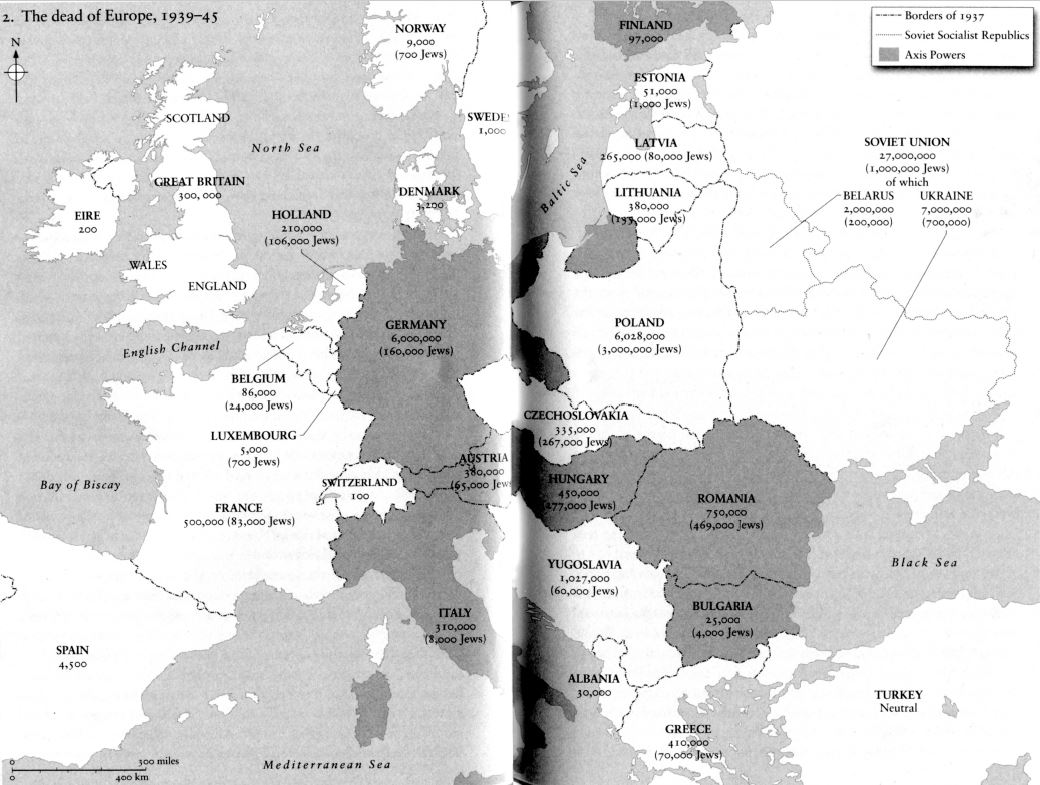
The main course
A record of how many people died
in a long and extensive war is difficult to pin down with any precision, but
the following map gives an interesting picture of the order of magnitude for
different European countries in the 1939-1945 period. Brackets below the totals
for each country show another chilling statistic for the murders of Jewish
people. The bulk of the figures are from Germany, Austria, Central and Eastern
Europe and the Soviet Union, but it is also worth comparing the absolute
numbers with the sizes of the relevant populations to get an idea of the scale
of the human destruction. While Poland’s number is large in both absolute and
relative terms, six million dead (of which three million Jews) and around 17%
of the population, Latvia’s and Lithuania’s figures are much smaller but still
more than 12% of their populations. A Wikipedia tabulation
here gives a fuller record.[1]
The dessert
With its topic being World War
Two, the previously cited Wikipedia article and tables do not spell out that
the human carnage in Europe continued until well after 1945. That is the focus
of a book by Keith Lowe, from which the European map is taken: Savage
Continent: Europe in the Aftermath of World War II (Penguin/Viking, 2004).
To read Lowe’s review of post-war Europe is shocking, even if one first allows
for the fact that it is unlikely that violence completely stops when formal
hostilities cease.
Among other things, Lowe’s book
details the continued attacks on Jewish people from 1944-45, especially in
Central and Eastern Europe. Discussing the anti-Semitism and pogroms in Poland,
he notes that
‘Poland was easily the most dangerous country for Jews after
the war. At least 500 Jews were murdered by Poles between the German surrender
and the summer of 1946, and most historians put the figure at around 1,500.’
It was not only murder, but also
looting and theft:
‘In Hungary many peasants came into possession of decent clothes
and footwear for the first time when the property of expelled Jews was shared
out in 1944. In Poland, where the Jews had made up a substantial portion of the
middle class, a new, Polish middle class rose to take their place.’
As you might imagine, any Jewish
people returning home did not have much success in getting
compensation.
But don’t think the violence was
limited to anti-Semitism. The immediate post-war years had to deal with the
aftermath of the destruction, with famine and millions of ‘displaced persons’
across the continent. Although some former collaborators with the German
occupation found a way into the post-war establishment, they also risked
humiliation or summary execution. Under the cover of revenge by resistance
fighters, personal scores were settled. More importantly, there was a dramatic
trend of ‘ethnic cleansing’ in the immediate post-war years.
In terms of numbers, the most
striking development was the expulsion of over 11 million Germans from
countries in Central and Eastern Europe. These were the so-called Volksdeutsch,
the long-established populations of expatriate German speakers. Many also
suffered forced labour in camps in Poland and Czechoslovakia.
Often the attacks on different
groups were linked to their supposed role in the war. But the motive of revenge
easily came to embrace all those in the ‘wrong’ community. Referring to
developments in 1944-46, Lowe notes the tens of thousands killed in Poland and
the Ukraine: ‘Poles and Ukrainians slaughtered one another and burned each
other’s villages with an enthusiasm that far exceeded any of their actions
against the German or Soviet occupiers’.
There was an attempted genocide
of Serbs in Croatia, and Hungarians were expelled from Slovakia. Summing up on
the Central and Eastern Europe dimensions, Lowe puts it like this:
‘These were the kinds of actions that were taking place all
across Europe. Hungarians were also expelled from Romania, and vice versa.
Albanian Chams were expelled from Greece; Romanians were expelled from Ukraine;
Italians were expelled from Yugoslavia. A quarter of a million Finns were
forced to leave western Karelia when the area was finally ceded to the Soviet
Union at the end of the war. As late as 1950 Bulgaria began expelling some
140,000 Turks and Gypsies across their border with Turkey. And so the list goes
on.’
‘As a result of all this forced population movement, Eastern
Europe became far less multicultural than it had been at any time in modern
history. In the space of only one or two years, the proportion of national
minorities more than halved. Gone were the old imperial melting pots where
Jews, Germans, Magyars, Slavs and dozens of other races and nationalities
intermarried, squabbled and rubbed along together as best they could. In their
place was a collection of mono-cultural nation-states, whose populations were
more or less ethnically homogeneous.’
These events, barely 70 years
ago, are something to consider when you observe the reactionary developments in
European politics today.
[1] The
Wikipedia article lists casualties from a wide range of countries, not just in
Europe. Notable is the huge number of deaths in China, some 15-20 million and
3-4% of the population. China is little covered in films and books on the
Second World War, but a good source is Rana Mitter’s Forgotten Ally: China’s
World War II, 1937-1945, First Mariner Books, 2013.
Monday, 29 May 2017
Warming Up
After the mixed martial arts
Handshake[1]
bouts between The Donald and France’s new president, Emmanuel Macron, there
have been further signs of strain between the US and Europe. Speaking after
last week’s NATO and G7 meetings, Germany’s Chancellor Angela Merkel called the
G7 meeting ‘six against one’. You can guess who the latter was. In a separate
speech, Merkel also remarked:
‘The times in which we could completely rely upon others are
more or less over. That’s what I have experienced in the last few days … We
Europeans have to take our destiny into our own hands … of course in friendship
with the US, in friendship with Great Britain, also with Russia and other
countries, but we have to know that we fight for our own future as Europeans,
for our destiny.’
Notably, this was an ex-UK
‘Europe’.
Trump’s America First policy
questions how far the US can still pretend to act both as the referee and as
the biggest player in the imperial game. But the election of Trump is not the
only thing that has called into question the ‘western alliance’ of major
powers. Britain’s rejection of EU membership is also a big worry for the
European members, ironically including Britain itself. While Brexit does not
quite hurl the UK into the mid-Atlantic, the Brits are finding it difficult to
keep a happy family together by using anti-Russian propaganda and posturing at
NATO. Not surprisingly, since Brexit has upset the European institutions
established over decades.
Merkel’s call for Europeans to
take charge of their own destiny basically means that the major
continental European powers need to prepare for the breakdown of the former international
order from which they had benefited. It is a striking comment from a German
conservative leader, and one that fits well with a more general European
concern about Trump.
Things are warming up in the
oven of imperial rivalry, not just on the fringes of the imperial system.
[1] Macron won
on points. The Handshake is a relatively new sport in diplomatic
circles. It blends a rictus smile, white knuckle grips and macho, fake bonhomie
arm slapping. The player with steadiest stance and gaze, showing the least
perturbation throughout the 1-2 minute contest, wins. Points are given by the
international news media and on Youtube. See here for example.
https://www.theguardian.com/world/2017/may/28/emmanuel-macron-my-handshake-with-trump-was-a-moment-of-truth
Friday, 7 April 2017
Trump, Syria & the Middle East
The US has hit Syria’s Shayrat military air base near Homs
with 59 Tomahawk cruise missiles. Whether there is any more to come nobody can
say because the strikes do not appear to have much logic to them and so war
aims cannot be drawn from political objectives.
But the central weakness flows not
from Trump’s knee-jerk response but from the dubious nature of the event that
provoked it. A chemical attack by Syria simply does not make sense. Assad has
virtually won his war by sheer perseverance, western incompetence and Russian
help. At the least, he has no viable opponents on the ground. His strategy is
to sit it out while his opponents exhaust themselves, realise the futility of
their actions or just leave the country. The West, when it tried at last to put
down some sort of marker in a war it could do nothing about, defined the use of
chemical weapons as a red line. The Russians agreed and Assad followed through.
He gave them up in a quid quo pro
negotiated by the Russians. In return, the West abandoned ‘regime change’ in
all but words. Both sides kept to the agreement. Why would Assad now use a
weapon that could only provoke the West and which is of very limited military
use, and one day ahead of a major international meeting on Syria held in
Brussels? Former Congressman Ron Paul, a leading, although sometimes critical
Trump supporter, argues that the chemical attack is ‘false flag’ operation: “It
doesn’t make any sense for Assad under these conditions to all of a sudden use
poison gases – I think there’s zero chance he would have done this
deliberately”.
Far from showing Trump’s willingness to ‘go to war’ –
reversing his supposed ‘isolationism’ which, in any case, was a silly and
unrealistic proposition – the bombings instead show the West’s very limited
options in Syria. If the West really wants to eliminate Assad, why slam 59
missiles into an isolated airfield? Why not do some real damage, and show
‘global leadership’, by destroying Assad’s military command and control
structure?
The plain fact is that while America has the military means
to obliterate whatever it likes, both America and the West as a whole has very
little power to influence events.
The West would not be able to contain the fall out if Assad
were forcibly removed
The US probably has the capacity to ‘take out’ Assad in a
surgical strike, or seriously to degrade his already limited military capacity,
though his regime is pretty smart and also has Russian assistance. But how
would his removal by force affect regional players?
For example, Iran is currently a stabilising force in the
region since it wants to rebuild its relationship with the West and wants to
show that it can be a trusted, competent and effective regional manager. A
significant section of the Iranian elite, and the Shia community in the region,
do not believe this can be pulled off and that such a strategy will only weaken
Iran in the long run since Western imperialism cannot change its nature. How would killing Assad alter this
critically-balanced situation? Almost certainly not in the interests of the
West. Eliminating Assad by force, and the fall out that comes after it, would
significantly alter Iran’s position as a regional manager.
Furthermore, Turkey is currently playing a very dangerous
game in pursuit of establishing itself as the main player and arbiter in the
region. Its overriding goal had been to join the European Union. But it has
abandoned all hope of joining by negotiation. It has realised instead that
potential EU entry is not about reason or willingness to be reasonable, but
about power. It thinks it has a much better chance of forcing a better
long-standing deal with Europe by establishing its status as the region’s key
pacifier and manager, which Europe desperately needs. This has led it to meddle
in regional politics in hugely irresponsible ways that are often counter to
western interests and alarm the West. Indeed, Turkey is now the main obstacle
to a settlement in Syria.
It is very likely that Assad’s removal would embolden
Turkey to be even more reckless. Turkey would almost certainly want to take a
major position in a post-Assad Syria, if not to subjugate Syria under its
control, which would immediately snarl up all regional relations. This would
reproduce Turkey’s inability to reach a settlement with the Kurds on a much
grander scale.
Then there is Russia. The West has been forced to establish
an uneasy and very limited ‘partnership’ with Russia, given that it has been unable
to handle on its own the mess it has made of the Middle East. This has obliged
the West to accept that Russia is a legitimate regional player and to accept
its more active military presence in the Eastern Mediterranean – something
unthinkable in the Cold War years. Russia plays a peculiar role in the region.
Most of the regional players are anti-Russian, but they want Russia to serve as
a counterweight to the power of the West. Iran is by no means a Russian ally,
but it benefits greatly from Russia’s presence in the region. Assad’s violent
removal would not only be a defeat for Russia, it would perturb regional
relations.
What replaces the Assad regime?
If the Iraq war and its fall out has shown the West
anything, it is that military action alone cannot achieve stability and war has
unexpected consequences. As Napoleon once said of the limitations of war, “you
can do anything with bayonets except sit on them”. War can be the continuation
of politics by other means if there is a plausible political settlement at the
end of it. Clausewitz in reverse does not
work.
Perhaps all this explains the almost apoplectic Western
response to Syria, including that of western liberals and former radicals. It
is a response born of their frustration about the absence of a military or
political solution they can be in charge of, rather than a willingness to go to
war.
Susil Gupta, 7 April 2017
Sunday, 5 March 2017
The Politics of Counting Billions of Beans
Just in case you were one of the half dozen or so people who thought that Brexit would be a simple affair, the UK's House of Lords European Union Committee has produced a report. Published yesterday, Brexit and the EU Budget is a 65-page analysis, with hyperlinks to the detailed evidence given on more than 70 questions and references to a multitude of EU-related documents. As one expert witness put it, there are 'many unknowns'. The chairman asked: 'Are these known unknowns or unknown unknowns?' The response was: 'All of them'.
The report covers the UK's potential liabilities to the EU and details the kinds of asset over which it might have a claim. Estimates in the media have claimed the net UK exit 'bill' as being anywhere from zero to 60 billion euros or more, and these different takes are analysed. However, the general conclusion is that all of this comes down to politics and a trade-off between different areas as part of the broader exit negotiations. It is not a thrilling read, but an instructive one that spells out the complex web of relationships within the EU.
Tony Norfield, 5 March 2017
The report covers the UK's potential liabilities to the EU and details the kinds of asset over which it might have a claim. Estimates in the media have claimed the net UK exit 'bill' as being anywhere from zero to 60 billion euros or more, and these different takes are analysed. However, the general conclusion is that all of this comes down to politics and a trade-off between different areas as part of the broader exit negotiations. It is not a thrilling read, but an instructive one that spells out the complex web of relationships within the EU.
Tony Norfield, 5 March 2017
Friday, 16 December 2016
Trump and the US-Russia-China Triangle
Although it is the world’s major
power, the US has found it difficult to impose its will in the past decade or
so. From President Bush’s ‘mission accomplished’ speech about Iraq in 2003, to
the continuing disasters in Afghanistan, Libya and Syria, from US
policy in Ukraine also being upset by Russian intervention in Crimea, to how
the Saudis and other Gulf states have destabilised the Middle East, the US has
not been getting its own way and has been unable to impose settlements that
would otherwise be expected of a hegemonic power. This puts the incoming US
administration under The Donald in an interesting position.
Early signs suggest that
POTUS-elect Trump is taking a softer line on Russia, one different from the
still Cold War-inspired position of the Obama regime. Trump has stated that he
expects the Europeans to pay more for their own NATO-related defence, which
might make them less willing to finance an increased build up of military
operations close to Russia’s borders. Trump has also rejected Obama’s rhetoric
on Putin’s supposed involvement in Russia’s alleged cyber attack on Clinton’s
emails. Perhaps most striking of all, Trump plans to appoint Rex Tillerson
as US Secretary of State, that is to be the main person in charge of foreign
policy. Tillerson is Chief Executive Officer of ExxonMobil, and is well known
to have friendly relationships with the Russian government.
ExxonMobil opposed sanctions on
Russia from its own business perspective, but one would have to agree that the
aggression shown to Russia by the current US administration makes little
economic or political sense. Russia is far from being a threat to US interests.
Instead, Russia may have prevented the unravelling of Syria that was the direction
of previous US policy, and which would have had a deleterious impact on the
stability of the Middle East, with knock on impacts into Europe. For this
reason, Trump’s likely Russian rapprochement makes sense, even if it will
embarrass the Europeans.
All this, and more, is still to
be determined, since the billionaire has yet to establish himself in the White
House. However, it seems that while there is very likely to be a US-Russia
rapprochement, the US political antagonism to China will continue under the
Trump administration.
Under Obama and previous US
presidents, Taiwan had remained in the limbo of being diplomatically isolated
(it has not been a member of the UN since 1971, under the ‘one China’ policy)
although politically and militarily supported by the US. But Trump took a call
from Taiwan’s president, much to China’s displeasure, which saw the incident as
an implicit recognition of Taiwan. This also makes sense from a US perspective.
China is both a political and an economic threat to US interests, one that has
been recognised in numerous US Congressional
reports. China’s economic power has seen it gain influence in Africa, Latin
America and Asia, often giving governments in these regions an alternative to
the US-dominated world financial and economic system.
More pointedly for the current
political climate, it is China, rather than Russia or anywhere else, which is
being singled out as the country that is being ‘unfair’ in trade and taking
American jobs. An anti-Chinese political stance makes far more sense for the US
on many more levels than the anti-EU stance does for the UK, since it not only
appeals to the latest domestic populism but also coincides with longer-term US
strategic interests.
Trump’s election is one more
sign of a shift in the tectonic plates of the imperial world economy. It will
impact not only US relationships with Russia and China, but also the position
of Europe, and even the acceptability of Russia outside Europe. Interestingly,
in the past day or so, Russian President Putin had a meeting in Japan with
Japan’s Prime Minister Abe on the Northern Territories/Kurile Islands, an area
of dispute between the two countries since the end of World War Two. No
resolution was made, and no peace treaty agreed on this, but there were 80
documents signed, including 68 on planned commercial deals between the two
countries.
Tony Norfield, 16 December 2016
Labels:
Abe,
China,
Donald Trump,
Europe,
ExxonMobil,
Iraq,
Japan,
Kurile islands,
Middle East,
Putin,
Russia,
Syria,
Taiwan,
Tillerson,
trade,
US
Friday, 9 September 2016
Shifting World Corporate Power
Those who like international comparisons that highlight the shift in global power will be interested in the following table. It is from research by Paul Kellogg, University of Toronto, published in 2015, and shows the geographical breakdown of the 2,000 largest public corporations, ie those whose shares are quoted on stockmarkets.
There is a striking decline of the US, Europe and Japan over this period, countered by a rise of the BRICS countries, but mainly China. To some extent, China's data will also have been boosted by the stockmarket bubble in 2014, which burst in 2015. But the underlying trend is nevertheless clear, and China's stockmarket in 2016 has since recovered to and beyond 2014 levels. As Kellogg puts it: 'In 2004 there were just 50 corporations from China on the full list of 2,000 (25 of which in Hong Kong). By 2010, the Hong Kong total had jumped to 49, the total in all of China to 162. In 2014 the Hong Kong total stood at 58, the total for all China at 207.'
My only quibble with the table is that he would have better shown only one decimal place in the numbers!
Tony Norfield, 9 September 2016
There is a striking decline of the US, Europe and Japan over this period, countered by a rise of the BRICS countries, but mainly China. To some extent, China's data will also have been boosted by the stockmarket bubble in 2014, which burst in 2015. But the underlying trend is nevertheless clear, and China's stockmarket in 2016 has since recovered to and beyond 2014 levels. As Kellogg puts it: 'In 2004 there were just 50 corporations from China on the full list of 2,000 (25 of which in Hong Kong). By 2010, the Hong Kong total had jumped to 49, the total in all of China to 162. In 2014 the Hong Kong total stood at 58, the total for all China at 207.'
My only quibble with the table is that he would have better shown only one decimal place in the numbers!
Tony Norfield, 9 September 2016
Thursday, 1 September 2016
Farewell European Finance?
The latest Bank for International Settlements survey of the global FX market offers some interesting insights into the development of the global economy. Currency trading is critical as a measure of market activity, since it encompasses all the deals between countries (assuming they have a different currency), whether for trade, investment, hedging or speculation. Deals are largely done between financial companies, but they also reflect the activity of non-financial ones and the economy in general. Between April 2013, the date of the previous survey, and April 2016, the latest one, the striking feature of the BIS report is the decline in the volume of currency trading for the first time in many years. On a net-gross basis (the measure used, there are others!), the volume of global FX trading fell by 2%.
The main casualty is the UK (basically, London) as a trading centre, although it remains by far the biggest in the world. The gainers in terms of market share are the US and Canada, but more significantly the Asian FX trading centres. To have a smaller share of a market in decline, as the UK has had, is a big problem for a previously lucrative financial business.
The UK's share of global currency trading fell from 40.8% in 2013 to 37.1% in 2016, a very sharp drop, although still above the level in 2010. Meanwhile, the US, in second position, rose by 0.5% to 19.4% from 2013 to 2016. The US rise in share nevertheless meant that its volume of dealing rose by less than 1% over the three years; the UK's volume fell by 11%. The UK decline reflects the weaker European economy and the related weakness in euro currency trading in London (some three-quarters of the total euro trading), while US banks were in a relatively strong position, but that was not saying much.
Overall, Europe's share of currency dealing fell between 2013 and 2016, not only due to the UK. France, the Netherlands, Luxembourg, Italy, Ireland and Switzerland also declined. Although Germany had a slight gain in market share over this period, its share in this financial business is minimal at less than 2%.
Asian trading centres are recorded as the winners from the latest BIS report. Despite the impact of the global crisis on 'emerging market' countries that are vulnerable to changes in developments in the world economy, several Asian trading centres have had success on this financial dealing measure. Singapore's share of the volume of trading rose from 5.7% to 7.9%; taken together, China and Hong Kong's rose from 4.8% to 7.8%. This is an astonishing result for China, especially, backed by the near-doubling of the use of the renminbi in global FX dealing to 4%, making it the eighth largest trading currency, just behind the more established Canadian dollar and the Swiss franc. Meanwhile, the euro slipped to its lowest share since its inception, to just 31%, while the US dollar rose slightly to 88% (note that with two currencies in each deal, the total shares add up to 200%).
Financial dealing is far from being a full picture of reality. But the shift in economic weight from Europe to Asia is a clear message from the latest BIS FX report, with the US holding its own. This is consistent with a wide variety of other economic assessments.
Tony Norfield, 1 September 2016
The main casualty is the UK (basically, London) as a trading centre, although it remains by far the biggest in the world. The gainers in terms of market share are the US and Canada, but more significantly the Asian FX trading centres. To have a smaller share of a market in decline, as the UK has had, is a big problem for a previously lucrative financial business.
The UK's share of global currency trading fell from 40.8% in 2013 to 37.1% in 2016, a very sharp drop, although still above the level in 2010. Meanwhile, the US, in second position, rose by 0.5% to 19.4% from 2013 to 2016. The US rise in share nevertheless meant that its volume of dealing rose by less than 1% over the three years; the UK's volume fell by 11%. The UK decline reflects the weaker European economy and the related weakness in euro currency trading in London (some three-quarters of the total euro trading), while US banks were in a relatively strong position, but that was not saying much.
Overall, Europe's share of currency dealing fell between 2013 and 2016, not only due to the UK. France, the Netherlands, Luxembourg, Italy, Ireland and Switzerland also declined. Although Germany had a slight gain in market share over this period, its share in this financial business is minimal at less than 2%.
Asian trading centres are recorded as the winners from the latest BIS report. Despite the impact of the global crisis on 'emerging market' countries that are vulnerable to changes in developments in the world economy, several Asian trading centres have had success on this financial dealing measure. Singapore's share of the volume of trading rose from 5.7% to 7.9%; taken together, China and Hong Kong's rose from 4.8% to 7.8%. This is an astonishing result for China, especially, backed by the near-doubling of the use of the renminbi in global FX dealing to 4%, making it the eighth largest trading currency, just behind the more established Canadian dollar and the Swiss franc. Meanwhile, the euro slipped to its lowest share since its inception, to just 31%, while the US dollar rose slightly to 88% (note that with two currencies in each deal, the total shares add up to 200%).
Financial dealing is far from being a full picture of reality. But the shift in economic weight from Europe to Asia is a clear message from the latest BIS FX report, with the US holding its own. This is consistent with a wide variety of other economic assessments.
Tony Norfield, 1 September 2016
Labels:
Asia,
BIS,
China,
EU,
Europe,
FX,
Hong Kong,
market share,
Singapore,
The City of London,
UK,
US
Thursday, 16 June 2016
Political Fundamentals and the UK Brexit Referendum
What explains the desperation of
British capitalism and Conservative Party in the lead up to the Brexit
referendum on 23 June? Opinion polls have shifted in favour of a Leave vote
and, while the accuracy of the polls is always in doubt, a shift towards Leave
seems evident from widespread vox pop views in the media, in the panic of the
Remain camp and in the financial market setbacks for sterling’s exchange rate.
Equity markets have also been hit, and not just in the UK. As a sign of
desperation, the Remain camp has even called upon the Labour Party’s lumbering
has-been, Gordon Brown, to add his weight to what looks like a failing balance.
Her Majesty has so far been allowed to stay above the dispute, just about. One
can imagine that if the polls get any worse for Remain, then Downing Street
could try to prompt a Royal appeal to her loyal subjects to do the right thing.
Where has this revolt of popular sentiment come from?
My previous coverage of the
Brexit referendum has focused on the situation facing the British ruling class
in a world where its economic and political interests are clearly bound up with
Europe, but where there has been a minority view that an alternative is
possible ‘outside’, especially in a context of European economic crisis. But
the significant support for Leave shows that this has underestimated a key
point. What might otherwise be considered simply as popular disgruntlement with
political elites – ‘vote Leave to teach them a lesson’ – is better explained as
a widespread view that these elites have broken their pact with the people. The
‘Leave’ support, however disruptive it might be to existing power structures,
is based on an appeal to the British state to restore the status quo ante.
To understand this point, it needs to be put in context, one that will also
confirm that this is not a debate in which one can take sides.
The World System of Power
No country’s politics, still
less its economics, can be understood outside its relationships with the rest
of the world. Since at least the early 19th century, the world economy has
increasingly shaped the position of all countries within it. The world system
as we have known it in recent decades has been based upon three elements:
American dominance and supervision of capitalism, the European Union project
and the relationship between America and Britain. These elements may have come
under some threat, for example with the growth of China and the crisis in
Europe, but this pattern of world power remains intact.
The dominant European states
wish that Britain would be more European, and that it would do more to curb the
xenophobic, anti-European drift of British popular culture. But Britain’s
relationship with the US is in their interests, because Britain’s mediating,
intermediary role helps keeps the whole structure of Western dominance intact,
with America at its apex and Europe benefiting from it. The Europeans are
worried about an increasingly unstable world that sees the rise of China, a
more assertive Russia, all sorts of threats around the Mediterranean and the
Middle East, and in Africa. They are concerned that a Brexit vote would begin
to unravel their security network, or at least begin to call into question who
is allied with whom, and how committed they are to a joint project.
The dominant European
imperialist states could easily accommodate Britain’s refusal to join the euro
zone, a central plank of European policy. Britain’s role with respect to the
European Union is not so much the product deeply ingrained cultural attitudes
(although these do exist); it is more an expression of its important role
within the pattern of power and the dynamics of its mediating role on the world
stage. This role allows, and calls for, the British state to operate at the
same time both outside and within the continental European political and
economic set up. For example, the British-based financial system is a worldwide
one, brokering the US dollar, and the political and economic interests of
Britain do not support its membership of the euro zone. But the British state
also needs to have a say in the development of European policy to sustain its
position and the workings of the world financial system that it has helped to
create and from which it benefits. The US also wants Britain in Europe because
it is vital to US-European relationships. Every time Britain has shown itself
truculent over European membership, and especially now, the US has reminded it,
in a firm but friendly way, that it would prefer no change.
A new series of bilateral
arrangements between Britain and other countries, as envisaged by the Brexit
camp, cannot replace this system. The point is not only why on earth it would
make sense for Britain, one of the major world powers, to tear up longstanding
agreements that it has helped to produce and try to start again. It is also
that a country stepping outside an established system of power would not have
much leverage to devise another one. The pro-Brexit calculation can only
convince those who ignore, or do not understand, the structure of Western
dominance and Britain’s vital role within it. Britain’s business media has
reminded the Leave advocates both that Britain alone is a small share of the EU
market and that exiting the EU would put at risk all the other relationships
that give British imperialism status in the world, from permanent membership of
the UN Security Council downwards.
The Working Class Brexit Vote
Nevertheless, British opinion
polls show that Brexit looms. A broad section of the population, especially the
working class, is now liable to go against the establishment consensus and vote
Leave as a way to complain, especially when it sees its troubles as resulting
from global economic trends that the establishment has embraced. The focus of
complaint is immigration. While the claimed economic benefits of the UK staying
in the EU have been the main argument for ‘Remain’, this has been submerged by
immigration as the dominant anti-EU point in the referendum debate. Many Brits,
perhaps most, including those who themselves or whose families may have been
relatively recent immigrants, support tighter immigration controls, as was
already clear in the 2015 UK General Election.
Immigration plays such a role
because it touches on a key point in British working class consciousness, one
that reflects its material interests: a loyal commitment to the British state.
This longstanding commitment has given the working class social protection as
part of a deal not to cause too much trouble, a kind of ‘social contract’. Now,
the immigration question helps to identify the national, British-based working
class as the legitimate recipient of state assistance versus the
immigrants (or even refugees) from other countries. In this pro-imperial
outlook, the issue of inadequate housing, jobs and services delivered by
capitalism becomes a moan about the supply of housing, jobs and services taken
by migrants. In previous decades, the moan was about blacks and Asians; now it
is more about white (East) Europeans.
This is not to say that such a
view is held by all working class people, but the fact that it is so
widely held should not really shock those who have read any history. For more
than a century, despite occasional trade union militancy, the British working
class has supported British imperialism and its war efforts. From the First
World War, even earlier, the British state had made concessions to workers with
welfare measures, ones that were developed further in the late 1930s and into
the Second World War, when more ‘sacrifices for the nation’ had to be made.
Introducing future plans for comprehensive welfare spending in March 1943, the
arch-imperialist and violent opponent of the 1926 General Strike, Winston
Churchill, declared himself in favour of ‘national compulsory
insurance for all classes, for all purposes, from the cradle to the grave’ as
part of his attempt to secure a solid national
consensus of all classes.
It may surprise readers familiar with the story that the 1945
Labour Government invented the National Health Service, and broke the mould
with state ownership of national assets, that Churchill also said in the same
speech that ‘we must establish on broad and solid foundations a national health
service’ and that there was ‘a broadening field for State ownership and
enterprise, especially in relation to monopolies of all kind’. To underpin his
endorsement of a national consensus, Churchill praised the Labour Party’s
coalition government Minister for Labour and National Service, Ernest Bevin,
for ‘the practical absence of strikes in this war compared to what happened in
the last [ie in World War One]’. The rationale for Churchill’s support of
welfare spending for the working class was that for Britain ‘to keep its high
place in the leadership of the world and to survive as a great power that can
hold its own against external pressure, our people must be encouraged by every
means to have larger families’. Supporting more education spending, he added
that the ‘future of the world is left to highly educated races who alone can
handle the scientific apparatus necessary for pre-eminence in peace or survival
in war’.[1]
Other articles on this blog have
shown how, in the post-1945 period, Labour Governments continued in this
pro-imperialist outlook, using exploitation of the colonies to help fund their
national welfare spending to benefit the domestic working class.[2]
But this perspective is not of only historical interest; in the same way that
imperialism – a system of privilege and domination in the world economy – is
not confined to the colonial period.
The Brexit debate shows that the
British working class wants not so much a better deal within the existing
system, but a return to the previous post-war consensus.[3]
This perspective is not only far from being any challenge to capitalism; it
supports Britain’s privileged position within the world system of power from
which the working class had benefited. Brexit has risen in popularity because
the domestic working class has faced the problem that British capitalists have
benefited greatly from their increased links to the world economy, including an
influx of cheap workers, less so from the more ‘home grown’ operations, so
British workers have felt neglected. That is why Wetherspoons, a UK and Irish
pub chain, very dependent upon local business links, is one of the few large UK
companies to be pro-Brexit.
From the perspective of the
British working class, the call for Brexit is a call upon the British state to
keep to its previous compact with the workers for what can be presented as a
fair, national deal. (Incidentally, the British left has the same approach to
economic and political problems) Widespread complaints such as this may work to
some extent, shifting the balance of the government’s policy tactics. For example,
the collapse of Tata Steel Europe’s UK operations in the lead up to this
troublesome EU referendum led to some government measures to delay the
inevitable. However, the game is up. Whether Britain leaves the EU or not,
capitalist companies will not turn their back on the world market and the
relevant calculations. Neither will the UK government pretend in its policies
that there is no capitalist crisis to deal with.
Above all, the British working
class cannot explain to itself why the British ruling class has broken its
previous agreement to deliver national welfare, and why it has turned its back
on its natural supporters in favour of seeking better profits in international
market dealings. That is why its anger is real and solid, although its political
economy remains crap because it cannot understand why what used to work before
does not work now. Simply belonging to a rich, imperialist country does not
mean that you necessarily get a decent share of the rich pickings.
Awkward Moments for UK Policy
Now take a step back and ask
yourself why the Conservative Party, the unabashed defender of big capital and
the super-rich, has got itself into this mess, which now witnesses senior
ministers attacking the Prime Minister’s stance for ‘Remain’. The simplistic view
is that there were Conservative Party divisions that had to be resolved by
Cameron calling a vote on EU membership, or that Conservative votes were being
threatened by the rise of UKIP. But, while true, this story hides a more
telling, political problem suggested by what has already been explained.
If a political party is openly
ruthless in enforcing capitalist market discipline on everyone, unfortunately
for the ruling class that is no way to win the necessary popular support to get
elected. Instead, a broad base of loyalists has to be built, one of the
annoying features of universal suffrage. The need to have a broad base of
support is the reason we still find many ‘one nation’ Tories, why successive
Conservative governments did not reverse the post-1945 welfare state reforms
and why Prime Minister Cameron still claims to defend the National Health
Service. But this creates political difficulties when popular opinion in the UK
turns against what is evidently the best policy for British imperialism, ie staying
in the EU.
US President Obama, a wide range
of other US and European politicians, together with the IMF, OECD, etc, etc,
have declared that they favour the status quo, as do the majority of
British corporations and the leaderships of the main UK political parties. The
logic here is that the existing pattern of world power relationships would be
upset, unpredictably and possibly dangerously, if any major country tried to
strike out on its own.
At risk is the EU itself, which
could well see other countries heading for the exit, undermining an economic
and political project that has been decades in the making. Neither is this a
good environment for other agencies of imperial rule that have been in place
since the late 1940s, the UN and NATO. These could be faced with new questions
on who is a key member and why, or who has voting rights on the UN Security
Council.
A Referendum Dispute Between
Loyalism and Imperialism
At first sight, a vote for
Brexit might look to be the more progressive option, because it would help
undermine the established structures of power in the world. Many UK voters
disagree, noting that it would also give credence to a set of policies that
would be driven by reactionary pundits and politicians. The problem with these
views is that they do not understand how the debate is between a
pro-imperialist populace and British imperialism. That is why the debate lacks
any content and there are few substantial differences between the respective
positions.
The ‘Leave’ side is not against
developments in world capitalism. The bulk of its votes will come from a
working class that has sided with imperialism and would like the British state
to return the favour, backing up its privileges against others in the world
economy, as in the good old days. The ‘Remain’ side too argues for no change to
world capitalism, and will attract those who fear an upset to their current
economic circumstances. The former expresses complaints against the status quo,
wanting an exit in which they think changes could be implemented within the
imperial system; the latter thinks the status quo is acceptable, although it
might be amended somewhat within the imperial system.
How can complaints about
capitalist market discipline be resolved in a crisis-ridden world economy, if
the complainers want to keep the system that enforces that discipline, and
especially the imperial privileges that accrue to one of the leading powers? If
the complainers understood this problem, then progressive politics would be in
with a chance. However, that is not the case in the UK, or in a number of other
rich countries where the working class is loyal to its powerful state. Instead,
the political logic is for pro-imperialist policies to win the day.
If you want to oppose the
depredations of capitalism and imperialism, then please do so, but this is not
what the Brexit debate is about. Above all, remember the classic revolutionary
phrase: ‘the enemy is at home’.
[1] To emphasise
this point, note that Sir William Beveridge, the main early planner of the UK
welfare state – not the UK unions or the Labour Party, or pressure from them –
was a collaborator of Churchill’s and supported by him, even though Churchill
had doubts on committing to spending when it was not clear it could be
afforded. The most that could be said for the 1945-51 Labour Government is that
it implemented a more generous welfare system than had been envisaged by
Beveridge, although that was paid for by loans from the US and by exploiting
the colonies! A transcript of Churchill’s BBC broadcast in March 1943 is
available at http://www.ibiblio.org/pha/policy/1943/1943-03-21a.html.
[2] For example this article.
[3] I will not
cover this point further here, but for further information I recommend a book
on the history of the Labour Party by Edmund Dell, A Strange, Eventful
History: Democratic Socialism in Britain, HarperCollins, London: 2000. A
Labour right-winger, Dell also spells out, in ways one rarely finds from the left, the consistently pro-imperialist and state-‘socialist’ nature of
the British Labour Party, something that was consistent with the political
outlook of their electoral constituency.
Labels:
Brexit,
Cameron,
Churchill,
Conservative Party,
EU,
Europe,
Imperialism,
loyalism,
power,
referendum,
UK,
US,
war,
welfare state,
working class
Wednesday, 3 June 2015
FIFA and World Power
It is amusing to see the powerful fall down, but more interesting to see who pushed them over, especially when the ramifications highlight how the world works. Football (soccer, to some) is a big global business, but has developed with some odd features that are now being ironed out in a complex political game.
Sepp Blatter, head of FIFA, has sort of resigned, but not quite yet. The immediate cause of his almost-exit was the probe by the US Department of Justice into fraud and money transfers using the US payments system, with many FIFA officials in the frame, and with more revelations to come. FIFA officials should have been more aware of the risk of such a reaction because US agencies have a strong record of tracking down dollar-based fraud when it does not involve their own top financiers. They might have done better to transfer funds in euros, not US dollars.
Blatter's problem was his success in getting support for his shenanigans from countries outside the usual realm of power, since in the FIFA form of democracy there was one vote per FIFA member-country irrespective of economic size or population, which included a large number of often small states outside Europe and North America. You do not need to imagine how much this annoyed the established powers, since they have made their complaints clear. For example, the UK has been anti-FIFA since losing its bid to host the 2018 World Cup tournament, when its own attempts to influence the vote were outmanoeuvred.
The main mistake of the Blatter-FIFA set up looks like it was to award Qatar with the 2022 World Cup, given the absurdly high summer temperatures in the country and the unwillingness of the Europeans to reschedule the tournament because it would then clash with their league season. That decision put the voting mechanism under more scrutiny. However, the real problem for FIFA in the current political climate was that the 2018 tournament was given to Russia. Can you imagine? A pariah country facing the barbs of all media news outlets in Europe and the US, and one that has had the cheek to argue that western policy in the Middle East has led to disaster, is soon to hold a major world sports tournament! The western powers did not care that much about Russia's 2014 Sochi Winter Olympics, but football is serious business watched by billions of people and attracting many billions of advertising and subscription revenues.
This anti-FIFA move could yet become embarrassing for the main imperialist powers. One point is that FIFA's inability to deal with corruption is partly related to the fact that national and regional football organisations, such as UEFA in Europe, have refused to be monitored by FIFA. Furthermore, the investigations have uncovered corruption not only in South Africa's World Cup award in 2010. Today sees evidence from Charles Blazer, American former soccer administrator, that there was a similar game for the 1998 World Cup, which was hosted by France!
Football is not yet a big business in the US, and it probably has more room to investigate in this field where others fear to tread. The forthcoming news is liable to deliver more revelations, but the British and the other Europeans will use the turmoil to try and exert more influence over the international business of football.
Tony Norfield, 3 June 2015
Sepp Blatter, head of FIFA, has sort of resigned, but not quite yet. The immediate cause of his almost-exit was the probe by the US Department of Justice into fraud and money transfers using the US payments system, with many FIFA officials in the frame, and with more revelations to come. FIFA officials should have been more aware of the risk of such a reaction because US agencies have a strong record of tracking down dollar-based fraud when it does not involve their own top financiers. They might have done better to transfer funds in euros, not US dollars.
Blatter's problem was his success in getting support for his shenanigans from countries outside the usual realm of power, since in the FIFA form of democracy there was one vote per FIFA member-country irrespective of economic size or population, which included a large number of often small states outside Europe and North America. You do not need to imagine how much this annoyed the established powers, since they have made their complaints clear. For example, the UK has been anti-FIFA since losing its bid to host the 2018 World Cup tournament, when its own attempts to influence the vote were outmanoeuvred.
The main mistake of the Blatter-FIFA set up looks like it was to award Qatar with the 2022 World Cup, given the absurdly high summer temperatures in the country and the unwillingness of the Europeans to reschedule the tournament because it would then clash with their league season. That decision put the voting mechanism under more scrutiny. However, the real problem for FIFA in the current political climate was that the 2018 tournament was given to Russia. Can you imagine? A pariah country facing the barbs of all media news outlets in Europe and the US, and one that has had the cheek to argue that western policy in the Middle East has led to disaster, is soon to hold a major world sports tournament! The western powers did not care that much about Russia's 2014 Sochi Winter Olympics, but football is serious business watched by billions of people and attracting many billions of advertising and subscription revenues.
This anti-FIFA move could yet become embarrassing for the main imperialist powers. One point is that FIFA's inability to deal with corruption is partly related to the fact that national and regional football organisations, such as UEFA in Europe, have refused to be monitored by FIFA. Furthermore, the investigations have uncovered corruption not only in South Africa's World Cup award in 2010. Today sees evidence from Charles Blazer, American former soccer administrator, that there was a similar game for the 1998 World Cup, which was hosted by France!
Football is not yet a big business in the US, and it probably has more room to investigate in this field where others fear to tread. The forthcoming news is liable to deliver more revelations, but the British and the other Europeans will use the turmoil to try and exert more influence over the international business of football.
Tony Norfield, 3 June 2015
Thursday, 22 January 2015
Europe Gets Even More QuEasy
Today the European Central Bank
did what financial markets had expected, after lots of leaking of the policy
moves. They announced they would buy securities in the asset markets, at a rate
a little higher than had been expected of €60 billion per month, from March
2015. The policy will continue until inflation looks like getting closer to 2%,
which, with the slump in energy prices, will be a while yet. In all likelihood,
this extra asset buying (there has been some before) will amount to a bit over
€1 trillion and last until September 2016, maybe longer. For comparison's sake,
the new policy is around 10% of euro area GDP, compared to the US and UK
policies of 'quantitative easing' that have amounted to more than 20% of GDP.
This policy move is the latest
in a series that indicate there is no way out of the crisis. How can anyone
believe that this policy, essentially making government bonds have even lower
yields, can do anything for the economy when 10-year government borrowing costs
were already less than 1% in Germany and France and less than 2% in
Italy and Spain, the euro area's biggest economies?
The central bank's notion is
that this will feed into private sector borrowing costs being lower, but there
are some difficulties here. One is that there is very little demand to borrow
to invest, given the dire economic outlook; the other is that banks would not
to lend at anything like the sub-1% or 2% numbers to private investors, and the
level of interest rates is not the problem. The problem is that there is no
profitable avenue for large-scale capital investment, or any investment that
does not depend upon government subsidy, tax dodging or some form of financial
trickery. Even the countries that claim they have done better than the euro
average - especially the US, but also the UK and Switzerland - are now faced
with higher currency values against the ones that are under the market's cosh. Last week, the Swiss National Bank's made a dramatic move to abandon its 3-year attempt to stabilise its currency against the euro. This was done largely in anticipation of this week's action by the ECB and so far the euro's value has fallen 18% against the Swiss franc. Unsurprisingly, the euro fell another 1-2% today.
The ECB made a concession to
German worries about the new policy. They said that 80% of the risk of the new
purchases would be borne by national central banks, because central banks in the euro area might
buy rubbish and face a loss. In its
press releases today, they did not explain who would buy what, or how much.
Because the scale of the buying, if it is not directed, would evidently be
concentrated on the better risks - Germany, especially - a proviso was
included: only up to one-third of a country's outstanding debt could be bought
in this way, and the debt had to have a maturity of 2-30 years. Germany has
around €1.1 trillion of debt outstanding, with less than this in the 2-30
maturity range. So these, the 'safest assets', will not be able to use up more
than about a third of the new programme. German government securities out to a
maturity of 5 years also have a yield that is zero or negative. So, presumably,
this is good news for the government securities of France, Italy and Spain, the
other countries with large bond markets.
The ECB's hope is that the lower
yields will force investors to take on more economy-boosting risks. Instead,
the likelihood is that there will be a continued reliance by capitalists on
'making money' through financial investment, something that further stretches
the gap between value creation and financial accounting. On occasion, that gap is
narrowed by a slump of financial market prices for bonds and/or equities, but
the ECB has signalled that it will gamble for a while longer on trying to push
the gap still wider.
Tony Norfield, 22 January 2015
Labels:
bonds,
ECB,
equities,
euro,
Europe,
Germany,
Italy,
negative yields,
quantitative easing,
Spain,
Switzerland,
UK,
US
Wednesday, 12 November 2014
Rosetta and Ebola
The technical achievements of the Rosetta space programme fill the news headlines, at least in Europe. The near-$2 billion price of the expedition is considered trifling. Here is a celebration of human ingenuity! But here on earth, somewhat less than the distance of the comet that is 500 million kilometres away from the centres of power, many thousands of people are dying from ebola, a disease that has devastated the economies and societies of several west African countries, largely due to the collapse (or non-existence) of local health services. More food for thought in considering the human cost of the imperialist world economy.
Tony Norfield, 12 November 2014
Thursday, 27 March 2014
The Tactical Unity of Thieves
How is it possible to forge an
alliance between an imperialist power that is committed to EMU and one that may
hold a referendum on whether to leave the European Union? Or between a big
manufacturing power and one whose interests lie in the promotion of financial
'services'? It is not so difficult in these troubled times, when the shifting
tectonic plates of power balances make all the key players consider their
position. Consider the joint article written by (writers for) Germany's
finance minister, Wolfgang Schäuble, and Britain's chancellor of the exchequer,
George Osborne, in today's Financial Times. It is an important political
concession to the UK, but one that also reflects Germany's interests.
Furthermore, it reveals a striking view of the future for Europe's population.
They start out by lauding their
policies to rein in public spending deficits and 'reform' their economies,
adding that measures have been taken to prevent future financial crises from
damaging public finances (strangely omitting to mention the Bank of England's
policy to expand the UK banking system to nine times GDP). Then, ever so bravely,
they rail against Russia's actions in Crimea, also failing to note the EU's
role in putting Russia in a position where it had little choice but to act.
There will be 'consequences' for Russia, but they will be 'balanced and
proportionate'. They do not mention that any further measures will not be against
UK financial, etc, and German energy supply interests, but perhaps their writers
were too busy and overlooked that point of clarification. Surely, the Chelsea football team would not be incarcerated if Russian assets in London were to be seized?!
Striking points are made next on
Europe's decline: Europe's economy has 'stalled', others have grown; Europe's
share of patent applications has halved in the past decade; there is 25% youth
unemployment. The solution? Reform! What kind of reform? 'Europe accounts for
just over 7 per cent of the world’s population but 50 per cent of global social
welfare spending'. Draw the obvious conclusions about what this means for the
lifestyles of a privileged population.
The key concession for the UK in
this article is Schäuble's agreement to the view that 'countries outside the
euro area are not at a systematic disadvantage in the EU' and that there is a
guaranteed 'fairness for those EU countries inside the single market but
outside the single currency'. The reason for Germany's position on this is
that, as the paymaster for Europe, it is very happy with the UK's influence in
restricting the EU budget. It also agrees with the UK perspective of boosting
trade deals with the US and other regions, and there is little conflict here as
each country has different things to sell, each with its own distinct market
power.
Tuesday, 22 May 2012
Stubborn Facts
Lenin was fond of the English saying: ‘Facts are stubborn
things’. The accuracy of many so-called facts may be disputable, but it can be instructive
to report on the facts published by official institutions of imperialism, ones
that nevertheless throw a not very flattering light on today’s realities. This
article is a complement to the ‘Imperialism by Numbers’ article I published on
this blog on 1 May. It is also an update to, and an extension of, some data I reported
in ‘What the “China Price” Really Means’, published on 4 June last year.
The first set of facts is shown in Chart 1. These are data
that cover average hourly compensation costs, where ‘compensation’ means not
only wages paid, but also the additional employer payments for social benefits
such as unemployment insurance, medical insurance, and old-age pensions. The source
is the US Bureau of Labor Statistics (BLS), which carried out this analysis to
calculate for US corporations the total costs of employing workers in a range
of different countries. The details show that it is not only wages paid that
are higher in the richer countries; employee benefit costs are much higher too.
Chart 1 gives index numbers based on 100 equalling $34.74, the BLS figure for
the average hourly compensation paid to US manufacturing workers in 2010.
Countries’ labour costs are shown as bigger or smaller bars, with the height of
each bar proportional to the 100 level compensation cost in the US.
For China, average hourly
compensation costs are estimated at $1.65. This was less than 5% of the costs
of US manufacturing employees in the same year! Several years earlier, China’s
figure was closer to 2% of US costs, but recent sharp wage rises in China have
narrowed the gap a little. India and Sri Lanka have a still smaller ratio of US
compensation costs, near 4% and 2%, respectively. Labour compensation costs are
higher in the Philippines and Mexico, but Poland is the first country from the
low end of the chart that has compensation costs that are more than 20% of the
US level.
By contrast, the US,
Canada, Japan and the rich Europeans tower above all the other countries shown
in the chart. This group includes the so-called G7 countries, the major powers
still running the world economy. Switzerland, Belgium, Germany and France have
compensation levels more than 20% higher than in the US. One factor
influencing the country ranking is the value of a national currency in the
international market. However, the gap between the top ranked countries and the
bottom ranked ones is so large that this currency factor has little influence
on the overall distribution.
Surprisingly, the BLS’s
data do not include any African country. Perhaps this is a problem of getting
comparable statistics. For example, this is the reason that the BLS does not
include figures for China and India in its standard country comparison reports,
though it gives some information separately. However, Africa has also been a
less important continent for US economic expansion overseas than elsewhere, and
the BLS data focus far more on Europe, Asia and Latin America.
Chart 1: Relative International Labour Costs in Manufacturing, 2010
(Hourly
costs, US = 100 is $34.74, including non-wage compensation)
Sources and notes: US BLS. 2010 estimates based on
2007-08 BLS data are made by the author for China, India and Sri Lanka. Note
that 2-letter ISO codes are used as country identifiers, and that CH refers to
Switzerland, not China (which is CN).
Even the relatively minuscule labour costs for the poorer
countries exaggerate the actual earnings of millions of workers. The Indian
data are boosted by including only the so-called ‘formal sector’, that is the
sector made up of generally larger, more organised companies that have some
form of regulation and government supervision – including being included in
statistical surveys! By contrast, the ‘informal sector’ is unorganised, on a
much smaller scale and may include a family ‘business’ that consists of the
parents, children and dependent relatives. This sector is not included in most
data surveys, but it accounts for a large share of employment at much lower
wages than in the formal sector. The BLS reports that 80% of India’s
manufacturing employment is in the informal sector.
For China, the BLS calculations of hourly compensation do
include estimates for the ‘informal sector’. In Chinese statistics this is
listed under the heading of ‘town and village enterprises’ (TVEs), whereas the
larger, more regulated, sector is under the heading of ‘urban enterprises’. The
TVEs accounted for 70% of the total workforce, with 79.1 million workers
employed in 2006; the urban enterprises sector employed the other 30%, or 33.5
million workers. Not surprisingly, in 2008 the average hourly compensation was
just 82 cents in the TVEs compared to $2.38 in the urban companies.[1]
American and other foreign corporations will tend to set up
in the formal sector, and will likely be paying the ‘higher’ wages. But they
will still benefit from the mass of even cheaper labour from poor families who
work for them indirectly, either by providing services for the larger
companies, or by being what Marx called the ‘reserve army of labour’ for the
formal sector. The divergence in labour costs for countries other than China,
India and Sri Lanka may be less extreme. For example, South Korean costs are
just below half the US figure. But there is still a very big gap.
If we look at the broader economy, rather than just
manufacturing, the same picture of relative incomes holds. In fact, there is a
95% positive correlation between the figures for manufacturing compensation and
for a country’s per capita GDP.[2]
Chart 2 gives a snapshot of global income inequality, based
on a rough estimate of the Lorenz curve for 183 countries comprising 6.7
billion people.[3] World Bank
average GDP per capita data for each country are used as the input. This method
may understate global income inequality, because it assumes that everyone in
country A gets the average per capita income for country A. Nevertheless, it
has the advantage for our purposes of putting the different countries in focus.
Global average GDP per capita in 2011 was $9200. Of the 183
countries included in the data, 124 countries with a population of 5.0 billion
(75% of the world total) had an average income below this, while 104 countries
with a population of 4.8 billion had an average income below $5000 in that
year.
Chart 2: The Global Lorenz Curve, 2011 (based on GDP per capita)
Source and notes: World Bank. Data for average GDP per
capita in 2011 for 183 countries is used as the basis for calculating the
cumulative income distribution curve, the Lorenz curve.
If we take a common measure of inequality, the Gini
coefficient, and calculate this from the data in Chart 2, the figure shows the
expected high level of inequality: close to 66%. It would be more like 70% if
the inequality of component country distributions were also allowed for. In
that case, this measure of income inequality on a global scale is on the same
level as that in the most unequal of countries for which Gini coefficient data
are available: Namibia.
To give specific examples, in 2011 the GDP per capita of Switzerland was put at just over $70,000, while the US number was around $47,000, Germany was $43,000 and the UK was $39,000. Compared to these figures, China was close to $4000 and India to $1300. The data from the World Bank, the IMF, the CIA and other organisations have some differences, and the figures get revised, but the rankings and the income gaps are very similar from all sources.
The basic, and not surprising, fact is that the world
economy is very unequal. When we look at the mechanisms that underpin this
fact, we find that the inequality has much less to do with differences in
labour productivity than with the way that some countries get privileges in the
world economy at the expense of others.
Tony Norfield, 22 May 2012
[1] See BLS Monthly
Labor Review, April 2009. The data noted here are for 2006.
[2] Using the
full set of BLS data for 34 countries’ compensation costs in 2010, I found
there to be a 0.951 correlation coefficient with the respective countries’ per
capita GDP in 2011 as reported by the IMF. This shows that the manufacturing
wage/compensation is closely related to the broader economic income of the
country. This is a sign that the richer, and usually imperialist, countries can
afford to pay their production workers more. As the ‘China price’ article
indicated, this has more to do with imperial power than being based on higher
productivity.
[3] The Lorenz
curve is closely associated with the ‘Gini coefficient’ of inequality mentioned
later. It is a common, summary graphical measure of inequality. The 45-degree
line indicates where 10% of the population gets 10% of the total income, 20%
gets 20% of the total, etc. As such, it represents a line of equality of income
in the population. The divergence of the Lorenz curve from this 45-degree line
shows the extent of inequality. Wikipedia has a general explanation of this
statistical measure and its relationship to the Gini coefficient.
Tuesday, 20 December 2011
Europe's Crisis Measures
It doesn't really matter what you think about the prospects of the euro system surviving long-term, or how much you might focus on the evident flaws in its design and the economic trials of its members today. It is a political project, and state power is now being used to save it. My own view, expressed in the previous article 'Cameron, Merkozy & Europe', is that it will survive for an indefinite period (ie for a year or so, at least). The debt numbers are vast and the austerity to come is horrible, but the alternative is far from attractive, even for Greece.
More importantly, Germany and other key powers are not likely to give up on a system that has worked for them in the past and might still work for them in the future. One sign that this is true is the change in the operations of the European Central Bank. Look at the latest FT story on how expansive their credit will now be. The ECB is offering a huge volume of 3-year loans - perhaps more than €500bn - at low interest rates to banks, funds that they can use, and probably will use, to finance their governments as well as themselves. This far from 'solves' the crisis, but it means that the risk of the euro system tripping into an abyss over the next year because the banking system collapses is far less. The ECB may not be a 'lender of last resort', but it is a lender that understands when its existence is at stake. This measure is a signal of the absurdity of thinking that central banks are 'independent'. Independent of what exactly? They are certainly not indifferent to the viability of imperialist capital. Ask the Fed, the Bank of England or any of the others that have amended their formerly sacrosanct rules in order to try and save the system.
Tony Norfield, 20 December 2011
More importantly, Germany and other key powers are not likely to give up on a system that has worked for them in the past and might still work for them in the future. One sign that this is true is the change in the operations of the European Central Bank. Look at the latest FT story on how expansive their credit will now be. The ECB is offering a huge volume of 3-year loans - perhaps more than €500bn - at low interest rates to banks, funds that they can use, and probably will use, to finance their governments as well as themselves. This far from 'solves' the crisis, but it means that the risk of the euro system tripping into an abyss over the next year because the banking system collapses is far less. The ECB may not be a 'lender of last resort', but it is a lender that understands when its existence is at stake. This measure is a signal of the absurdity of thinking that central banks are 'independent'. Independent of what exactly? They are certainly not indifferent to the viability of imperialist capital. Ask the Fed, the Bank of England or any of the others that have amended their formerly sacrosanct rules in order to try and save the system.
Tony Norfield, 20 December 2011
Tuesday, 8 November 2011
Law of Value versus Berlusconi, Papandreou
The calculations of European politicians have come unstuck. Political favours, patronage, trusted allies and deals that worked to produce results in the past now do not work at all. The evolution of the crisis says: ‘You have no more money’. That is the simple message that has led to the resignations of Berlusconi, imperious clown of Italy, and Papandreou, dynastic head of Greece.
As previous articles on this blog have shown, things are getting worse.[1] The impact on Europe has hit the headlines most in recent weeks, with the media focus on rising bond yields, reflecting the lack of credibility that governments have in resolving the crisis. Even the European Financial Stability Facility (the more words, the less content) faces rising yields, leading to a situation where, as one market analyst put it, “the vehicle that’s supposed to borrow on behalf of countries that can’t borrow, can’t borrow.”[2] Read that two or more times, and you will get the idea. How the EFSF is meant to leverage its remaining funds to €1000bn in this situation I will leave to the geniuses of financial engineering.
The capitalist solution to the crisis involves a wholesale destruction of conventional living standards, and more besides. There are no solutions that any political party in crisis-stricken countries can propose that will get widespread support, but the destruction will get under way in any case. More Italians may hate Berlusconi now, but his exit will do nothing to resolve Italy’s problems. The resolution implies austerity, and no reduction in Italian bond yields based on his demise will prevent that. The same thing applies to Greece, which seems to have stepped back from the brink of what may have been an even bigger shock to its living standards – leaving the euro – than is now going to happen, minus Papandreou.[3]
The main European imperial powers, Germany and France, have their own reckoning to ponder. Busy trying to maintain the system they built, they have found their own finances under threat, as reflected in the weakened position of the EFSF, Sarkozy’s worries about French banks and Merkel’s troubles in the Bundestag. ‘Merkozy’ can deliberate, but the capitalist market decides. That is what the Law of Value is all about.
Tony Norfield, 8 November 2011
[1] See ‘It Can Always Get Worse’, 22 September 2011.
[2] See Lex Column, Financial Times, 3 November 2011.
[3] In my view, the costs for Greece of leaving the euro are huge. There are no historical examples of leaving a currency system after having given up the domestic currency and having spent a decade writing commercial contracts in a joint currency. The banking system may collapse within the euro system; it would definitely collapse outside of it.
Subscribe to:
Posts (Atom)