Showing posts with label Jews. Show all posts

Tuesday, 2 October 2018

Murdering Europeans


Europe has a long history of violence. Against the advances in philosophy, science and the arts, one must weigh the prolonged episodes of war, massacres, pogroms, colonial terror and oppression. The latter do not look good, so there is often a convenient framing of events in Europe’s historical memory, one that finds no place for the bad stuff. For example, every European country has its own mythology about the Second World War. Although the myths usually cannot withstand the slightest collision with facts, they nevertheless continue as persistent reference points for the mass of people in a particular country.
The UK has a particular weakness for this, with images of how the Dunkirk spirit, squadrons of spitfires and Churchill’s wartime speeches saved the day and led to victory over Nazi Germany. For some reason the historical ‘memory’ does not consider how it was that British deaths in the Second World War numbered only some 300,000, less than 1% of the population, compared to more than 25 million killed in the Soviet Union, 14% of its population. In the biggest confrontation with Germany that turned out to be the turning point for the whole war – the Battle of Stalingrad from August 1942 to February 1943 – the Soviet Union suffered nearly 500,000 killed or missing.

The main course

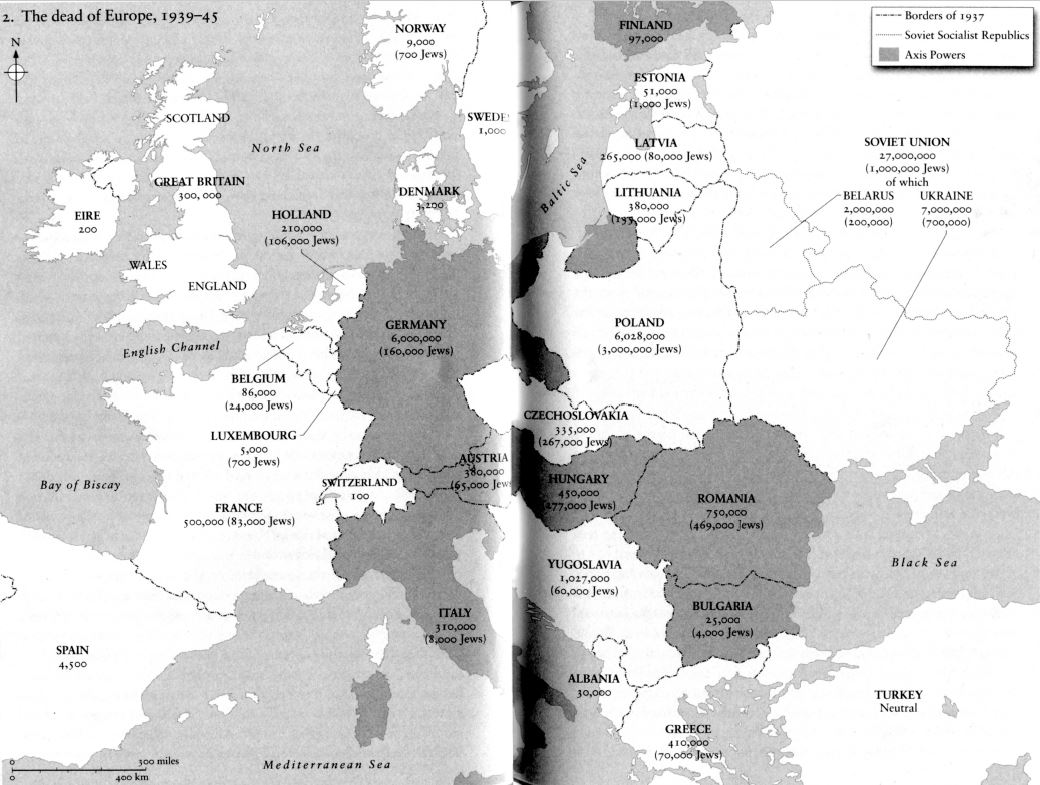
A record of how many people died in a long and extensive war is difficult to pin down with any precision, but the following map gives an interesting picture of the order of magnitude for different European countries in the 1939-1945 period. Brackets below the totals for each country show another chilling statistic for the murders of Jewish people. The bulk of the figures are from Germany, Austria, Central and Eastern Europe and the Soviet Union, but it is also worth comparing the absolute numbers with the sizes of the relevant populations to get an idea of the scale of the human destruction. While Poland’s number is large in both absolute and relative terms, six million dead (of which three million Jews) and around 17% of the population, Latvia’s and Lithuania’s figures are much smaller but still more than 12% of their populations. A Wikipedia tabulation here gives a fuller record.[1]
The dessert

With its topic being World War Two, the previously cited Wikipedia article and tables do not spell out that the human carnage in Europe continued until well after 1945. That is the focus of a book by Keith Lowe, from which the European map is taken: Savage Continent: Europe in the Aftermath of World War II (Penguin/Viking, 2004). To read Lowe’s review of post-war Europe is shocking, even if one first allows for the fact that it is unlikely that violence completely stops when formal hostilities cease.
Among other things, Lowe’s book details the continued attacks on Jewish people from 1944-45, especially in Central and Eastern Europe. Discussing the anti-Semitism and pogroms in Poland, he notes that
‘Poland was easily the most dangerous country for Jews after the war. At least 500 Jews were murdered by Poles between the German surrender and the summer of 1946, and most historians put the figure at around 1,500.’
It was not only murder, but also looting and theft:
‘In Hungary many peasants came into possession of decent clothes and footwear for the first time when the property of expelled Jews was shared out in 1944. In Poland, where the Jews had made up a substantial portion of the middle class, a new, Polish middle class rose to take their place.’
As you might imagine, any Jewish people returning home did not have much success in getting compensation.
But don’t think the violence was limited to anti-Semitism. The immediate post-war years had to deal with the aftermath of the destruction, with famine and millions of ‘displaced persons’ across the continent. Although some former collaborators with the German occupation found a way into the post-war establishment, they also risked humiliation or summary execution. Under the cover of revenge by resistance fighters, personal scores were settled. More importantly, there was a dramatic trend of ‘ethnic cleansing’ in the immediate post-war years.
In terms of numbers, the most striking development was the expulsion of over 11 million Germans from countries in Central and Eastern Europe. These were the so-called Volksdeutsch, the long-established populations of expatriate German speakers. Many also suffered forced labour in camps in Poland and Czechoslovakia.
Often the attacks on different groups were linked to their supposed role in the war. But the motive of revenge easily came to embrace all those in the ‘wrong’ community. Referring to developments in 1944-46, Lowe notes the tens of thousands killed in Poland and the Ukraine: ‘Poles and Ukrainians slaughtered one another and burned each other’s villages with an enthusiasm that far exceeded any of their actions against the German or Soviet occupiers’.
There was an attempted genocide of Serbs in Croatia, and Hungarians were expelled from Slovakia. Summing up on the Central and Eastern Europe dimensions, Lowe puts it like this:
‘These were the kinds of actions that were taking place all across Europe. Hungarians were also expelled from Romania, and vice versa. Albanian Chams were expelled from Greece; Romanians were expelled from Ukraine; Italians were expelled from Yugoslavia. A quarter of a million Finns were forced to leave western Karelia when the area was finally ceded to the Soviet Union at the end of the war. As late as 1950 Bulgaria began expelling some 140,000 Turks and Gypsies across their border with Turkey. And so the list goes on.’
‘As a result of all this forced population movement, Eastern Europe became far less multicultural than it had been at any time in modern history. In the space of only one or two years, the proportion of national minorities more than halved. Gone were the old imperial melting pots where Jews, Germans, Magyars, Slavs and dozens of other races and nationalities intermarried, squabbled and rubbed along together as best they could. In their place was a collection of mono-cultural nation-states, whose populations were more or less ethnically homogeneous.’
These events, barely 70 years ago, are something to consider when you observe the reactionary developments in European politics today.

Tony Norfield, 2 October 2018


[1] The Wikipedia article lists casualties from a wide range of countries, not just in Europe. Notable is the huge number of deaths in China, some 15-20 million and 3-4% of the population. China is little covered in films and books on the Second World War, but a good source is Rana Mitter’s Forgotten Ally: China’s World War II, 1937-1945, First Mariner Books, 2013.

Wednesday, 22 August 2018

Jews, Zionism and Israel


The reason behind the turmoil in the British Labour Party about anti-Semitism is not any actual anti-Semitism among party members. Instead, the turmoil is largely promoted by supporters of Israel who have worries about Jeremy Corbyn, and it is joined by other Corbyn opponents. Here is a leader of a major British political party who supports (some) Palestinian rights and who has dared to criticise the Israeli government for oppressing them. Given that the Labour Party has traditionally been the major pro-Israel force in British politics, one can see why the pro-Israelis have been apoplectic. Issues brought out by this episode (‘series’?) lead me to examine the relationship between being Jewish, Zionism and Israel.


Religion and ethnicity

Judaism is an unusual religion in having an ethnic, or genealogical dimension of how a ‘Jewish’ person is defined, rather than focusing only upon religious affiliation. Religion is commonly a social-political marker, not an ethnic one, although often people follow the religious label, if not the religious practice, of their parents or of the community in which they live. In the cases of Christianity and Islam, anyone who decides to follow the relevant beliefs can become a Christian (Catholic, Protestant, etc) or a Muslim (Sunni, Shia, etc), once they have gone through certain rituals. But it is a more protracted process to become Jewish, and is often bound up with whether one’s mother is also determined as being Jewish. If the mother is not, that does not bar the son or daughter from becoming Jewish. But if the mother is already considered to be Jewish, then automatically her son or daughter is so too, even if that person does not practice Judaism. For example, it is possible to be a ‘Jewish atheist’. The line only seems to be drawn against those who openly practise another religion, who thereby are no longer defined as being Jews.
This genealogical factor is reflected in Israel’s infamous 1950 Law of Return, whereby it is possible for all Jews, both ‘ethnic’ and religious, to go to Israel and gain citizenship. As a 1970 amendment to the Law defines it: ‘For the purposes of this Law, “Jew” means a person who was born of a Jewish mother or has become converted to Judaism and who is not a member of another religion’. That amendment also added in the ‘grandchild of a Jew, the spouse of a Jew, the spouse of a child of a Jew and the spouse of a grandchild of a Jew’ for good measure.
Although the genealogical criterion of Judaism is not the same as a purely ethnic definition of ‘Jewishness’, it is something that fits very well with the Zionist political objective of identifying Israel as the ‘homeland of the Jews’, one from which they had supposedly been cast out some two thousand years before. There are many ironies and contradictions in this, not least that early Zionism was mainly atheistic and had been in conflict with Orthodox Judaism. David Ben-Gurion, a future founder of the state of Israel, was also not religious and did not believe in the ‘exile’ story – though by 1948 he had abandoned this view.[1] To add to the mix, one should also note that some branches of Judaism reject the establishment of an Israeli state before the coming of the Messiah, while some Christian Zionists see the ‘ingathering of the exiles’ as a precursor to the Second Coming of Jesus!

Zionist mythology

There is no evidence for any mass expulsion of the inhabitants of ancient Israel, by the Romans or by anyone else. But an ethnic definition of Jewishness seems to have taken root among Zionists who were heavily influenced by the blood and soil racism of 19th century Europe, and who looked to define an ethnic people for their corresponding ‘national home’. (That the Zionists were responding to anti-Semitism and pogroms, especially in Eastern Europe, does not excuse their reactionary views.) Studies showing close links between the DNA of many different groups originating in the Middle East, Jewish and non-Jewish, undermine the notion of a specific Jewish people. Judaism has also long been a proselytising religion, converting people in Europe, Asia and Africa, an inconvenient fact covered up by the story of an ethnic group that must ‘return’ to its lost land.
But let us suppose for a moment that this Zionist mythology were true. Let us imagine, for example, that all the Jewish settlers in Palestine who come from the US, from Poland, from Russia or wherever could claim to trace their bloodlines back to King David. Would this have any bearing on how to assess the state of Israel? It is no justification at all for the expulsion of Palestinians and the seizure of their land after the 1947 UN Plan of Partition or in the 1948 war – in which over 700,000 Palestinians were expelled – or in the subsequent years. Just imagine being kicked out of your home because somebody shows up and claims that their ancestors lived there more than a thousand years ago! Of course, Jewish settlers in Palestine do not need to make this absurd claim; they can just rely upon the power of the Israeli state to drive out, kill or marginalise non-Jews.

Jews, the Holocaust and Israel

Many people who identify themselves as being culturally or religiously Jewish may not support political Zionism. To be more specific, they may not support political organisations and parties labelled Zionist, and especially not the right-wing parties that now dominate Israeli politics. But how many do not support the state of Israel, or do not see it as a necessary haven just in case there is a resumption of murderous anti-Semitism seen in Europe from the early 1930s and in the Holocaust? Those events turned even some prominent socialists and anti-Zionists into supporters of Israel.
The problem with this view is that it takes the crimes of Europeans and asks, even demands, that the Palestinians pay for them! Somehow, the slaughter of Jewish people by Europeans is seen to justify the dispossession of Palestinians from their land. This foundation stone of the state of Israel in 1948 is commonly ignored in public debate. At most, concerns are raised only about the subsequent outrageous injustices and land grabbing of the Israeli regime.
To understand the establishment of the state of Israel one needs to examine imperialist politics, not the Old Testament of the Bible or Hebrew scriptures. Important issues were not so much the efforts of Zionists to designate Palestine as the rightful homeland of ‘the Jews’. More significant were the rabid nationalism that swept Germany in the wake of the post-1918 international treaties that had impoverished and humiliated it, and the more general conditions of the time that had promoted fascism. Attacks on Jewish communities were rife, not only in Germany, and major countries like the US and the UK had also taken steps in their immigration laws to restrict the influx of Jewish, and other, refugees. In that context, the Zionist choice of Palestine as a destination became an attractive option by the time of the post-World War Two deliberations among the major powers.

Imperialist politics

The Balfour Declaration of 1917 that the British ‘Government view with favour the establishment in Palestine of a national home for the Jewish people’ is widely seen as the beginning of the process to establish the Israeli state. But while it was the first major concession to Zionist opinion by a big power, its main aim was to build support for Britain’s war effort, both in Europe and the US. It was a deceitful document, pretending also to be concerned with the rights of other communities in Palestine, and it was not seen by the British then as a definite commitment that they could or would need to implement in the future. Above all, the Balfour Declaration was an expression of imperial arrogance, relating to a land that the British had not yet even taken from the Ottomans. However, this seizure was later endorsed by the League of Nations, and the British Mandate for Palestine included the terms of the Balfour Declaration.
In the event, British policy was not especially pro-Zionist in the thirty years after the Balfour Declaration. This was both because there were different factions in the British ruling elite and because its policy was mainly concerned not to ruin important relationships with Arab countries – for example, the UK abstained in the vote on the 1947 UN Plan of Partition. Although the British put down Arab rebellions in Palestine and British military and police commanders usually supported the Zionists, they also limited the immigration of Jewish refugees from Europe into Palestine. Zionist leaders continued to press their case with the British, but this did not stop their terror attacks on the British in Palestine – notably the King David Hotel bombing in 1946. They also moved to do deals with the French, who, rivals with the British for control of the Middle East, provided Zionist militias with military aid with which to oppose British control.
Zionist leaders were fully aware of the precarious position they would find themselves in with their plans to steal Palestinian land. That problem was to be overcome by a deal with one or more of the major powers. The early, but only partial success was with the Balfour Declaration, with some British statesmen seeing the future Israel as a ‘little loyal Jewish Ulster in a sea of potentially hostile Arabism’, so they were open to such deals. Later, the French would also cooperate with any local force to combat Arab nationalism opposed to its colonial rule in the region. The culmination of these views resulted in the British-French-Israeli plot against Egypt’s Nasser in the 1956 Suez crisis. But when that failed, and the British and French were revealed as second rate powers, the Zionists turned more fully towards cooperation with the US, which was growing concerned about how to control the Middle East.
These days, Israel’s US connection is paramount, exemplified by US support in terms of military supplies, of US vetoes at the UN of any resolution criticising Israel and by the billions of dollars of US government aid and private contributions every year. However, support from European powers is also important for Israel. Europe is sometimes more critical of Israel, but offers special trade deals and, highlighting the contradictions of the ‘Jewish homeland’ supporters, allows Israel to take part in the Eurovision Song Contest and to be affiliated with UEFA, the Union of European Football Associations!

Too much trouble?

Israel was established as a tool for imperialism. It remains one today, but in recent years Israel has become more of an embarrassment than an unquestioned asset. It is a ‘country’ that cannot define its borders, because it always wants to seize more land; a ‘democracy’ that oppresses a large proportion of its citizens on ethno-religious grounds, with discriminatory laws, checkpoints, police brutality and murder; a racist, gangster state that repeatedly threatens destabilising military action in the Middle East and steps beyond its boundaries by interfering in major power politics. Israel has another problem too: recollections of the Holocaust that in past decades had given it so much unquestioned support are fading as a political force. Despite the efforts of pro-Israel lobbies to talk up the threat of anti-Semitism today, and despite the continued acquiescence of mainstream media in covering up its crimes, the foundational non sequitur, Europeans kill, so Palestinians must pay, is no longer enough completely to silence liberal concern about the massacres in Gaza and to prevent questions being raised about the nature of the Israeli state.

Tony Norfield, 22 August 2018


[1] On these topics, I would recommend the book by Shlomo Sand, The Invention of the Jewish People, Verso, 2009, and also Sand’s more recent article in the Israeli newspaper Haaretz, ‘How Israel Went From Atheist Zionism to Jewish State’, 21 January 2017.