Showing posts with label Zionism. Show all posts

Tuesday, 18 June 2019

The Promised Land


Palestine really was the Promised Land. So much so that it was promised to three different groups within a couple of years.[1] The promises were made by British imperialism, a real world power, not by an imaginary deity in a book of very dubious provenance. What made the promises remarkable was that they were about a land which, at the time, the British neither possessed nor controlled. But imperial arrogance was a commodity in ample supply when the promises were made, and it has not become scarce in the years since.

Map of Ottoman Palestine, 1878 (Source: www.passia.org/maps/view/2)

Balfour Declaration

The most famous promise, the one most widely known, almost to the exclusion of the others, was to ‘the Jewish people’. Issued by the British Foreign Secretary, Arthur Balfour, in the Balfour Declaration of November 1917, it read:
“His Majesty's government view with favour the establishment in Palestine of a national home for the Jewish people, and will use their best endeavours to facilitate the achievement of this object, it being clearly understood that nothing shall be done which may prejudice the civil and religious rights of existing non-Jewish communities in Palestine, or the rights and political status enjoyed by Jews in any other country.”
While something short of an outright promise, if a major imperialist power was willing to use its ‘best endeavours’ that was good enough for the Zionist lobbyists, after they had failed to make much ground with the Ottoman Empire or with Germany. In particular, they could ignore the annoying bit about not prejudicing the ‘civil and religious rights of existing non-Jewish communities in Palestine’ and be hopeful that their ethno-religious racism would eventually win the day. Neither were Zionist leaders very concerned about Jewish people being denied rights or status elsewhere as a result, since surely that would only add to the supply of the right kind of immigrant into Palestine.
Furthermore, it looked to them like a step up from British East Africa! After meeting with British Colonial Secretary Joseph Chamberlain in 1903, Theodor Herzl, the founder of modern political Zionism, had been offered an area of land in what was later Kenya as a refuge for those fleeing from pogroms in Eastern Europe. Herzl raised this option at the 1903 Zionist Congress in Basel, but, following protests from Russian Zionists and Herzl’s death in 1904, nothing further came of this so-called ‘Uganda’ Scheme.
Balfour’s brief letter should also be put in context. He already had form as having an ambiguous view on Jewish people. For example, while being opposed to Russian persecution of Jews, he was strongly in favour of the 1905 Aliens Act, Britain’s first immigration controls. The 1905 Act was focused on stopping Jewish refugees coming to Britain, and many British politicians, encouraged by Zionists, also came to see Palestine as a useful place to send the unwanted Jewish immigrants.
There were several other strands in the British political class that led up to the 1917 Declaration.
Some British politicians were Jewish themselves, and were worried that setting up a ‘Jewish homeland’ would raise questions about their British nationality. The final part of the Declaration about ‘Jews in any other country’ comes from this concern. Some were evangelical Christians who, while often also anti-Semitic, saw Jewish settlement in Palestine as part of God’s plan, and a step on the road to salvation, just as the British Empire was in its own divine manner bringing justice and order to the world. Some saw it as useful to have a grateful group of people loyal to Britain settling in what would be a strategic area as the Ottoman Empire was waiting to be carved up.
Many were also influenced by the anti-Semitic ideas of the time, in particular the notion that Jewish financiers had immense power and influence. So the Declaration might be a sensible policy for gaining important friends. Naturally, the Zionist leaders discussing with British politicians talked up this ‘Jewish power’. To complete the factors leading up to the Declaration it is worth noting too that by 1917, with the First World War proving very costly in lives and treasure, British politicians cast an eye on the apparent influence of the Zionist lobby in America. They saw the Balfour Declaration as a way of gaining further American support.

The Hussein option

But before getting carried away with the idea that a ‘national home’ for Jewish people in Palestine was an inescapable outcome, it is worth considering some other plans British imperialism had for the Promised Land. Two stand out and they were made before the much more famous Declaration. The first British proposal was implied by the correspondence in 1915-16 between the British High Commissioner in Cairo, Sir Henry McMahon, and Sharif Hussein, the Emir of Mecca.
It is important to realise that the background to this communication was the British attempt to get support from the Arabs for an attack on the Ottomans in the Middle East. In 1914, Turkey had taken the Central Powers’ side in the war, and the British were aware that there was some political opposition to Turkish rule in Arab areas of the Ottoman Empire that they might exploit.
As an incentive for this opposition, the British offered a kind of Arab independence over a vaguely defined region, with two caveats. One was that, as McMahon stated, ‘it is understood that the Arabs have decided to seek the advice and guidance of Great Britain only’ in the administration of such an area and they would also give Britain economic and commercial privileges over other powers. But perhaps the most important caveat was on the territorial region of Arab ‘independence’: it would exclude certain areas that the British might have to concede to the French, a British ally in the war that also looked forward to greater influence in the Middle East when the Ottoman Empire was carved up.
Quite which territory was excluded from the offer to the Arabs was not entirely clear. Sharif Hussein read in McMahon’s letters that these concerned an area of Syria west of Damascus. He rejected that, but continued the correspondence and the discussion of terms. Nevertheless, he did not think that Palestine or the important religious centre of Jerusalem were excluded. While Palestine was also west of Damascus, it was further south and not considered to be part of Syria.
Historians have long debated how far McMahon deliberately misled Hussein. It is probably best to see McMahon’s letters not just as an example of manipulative diplomacy, but also as contingent on the circumstances. After all, even the more explicit commitments of the McMahon-Hussein correspondence were completely contradicted by the Sykes-Picot Agreement of early 2016!
The latter Agreement was a plan to divide up the Middle East into regions run by the British and the French. The French felt they had been short-changed, but they got Syria – and Lebanon, which they later carved out from Syria. The British would not accept French rule in Palestine, however, since it was a little too close to Britain’s important strategic and trade route at the Suez Canal in Egypt to have a rival power sitting there. In discussing with François Georges-Picot, Britain’s Sir Mark Sykes sidelined the issue of Palestine by arguing that it should be managed under an international agreement, one that he was confident would favour British interests. That turned out to be the British Mandate for Palestine, endorsed by the League of Nations in negotiations after 1918, in which the British included the terms of the Balfour Declaration.[2]
It turned out that not even the Sykes-Picot Agreement between two imperialist powers was implemented as agreed. Responding to a more favourable conjuncture after 1918, the British were in a much stronger position than the French and no longer had need to take account of potential Russian incursions into the Middle East region, for which they had favoured a French ‘buffer’ in Syria. The British also decided to shift a portion of the Sykes-Picot ‘line in the sand’ and included Mosul in the newly carved out Iraqi state that they would control. This was seized from the defeated Ottomans and added to the oil reserves available to the British.

A deal with the Ottomans?

Britain’s second pre-Balfour plan for Palestine was discussed indirectly with the Ottoman Empire in July 1917. The British Foreign office sent Aubrey Herbert to Switzerland to discuss with Turkish dissidents the possibility of having a separate peace with Turkey. Herbert was a Conservative MP, the son of an earl and had considerable experience of the Ottoman Empire, which he much favoured over Tsarist Russia. For some time he had been advocating this plan, and the British government was happy to explore it as a means of weakening Germany’s position in the war.
As was typical of the British in these diplomatic discussions, much was implied and little was made explicit. Herbert said he was not authorised to discuss terms of an agreement, but he indicated that Britain would not wish to seize Ottoman territories. Instead it would allow continued Turkish control, with (left unsaid) the British pulling the strings as it had done in Egypt. There is no documentation of these discussions, but if they had reached fruition, they would have allowed Palestine, among other regions, to remain in a reconfigured Ottoman Empire.
In a memorandum to the Foreign Office after the Swiss meetings, Herbert made clear what kind of future he, and the British, had in mind for the Ottoman territories:
“If we get the luggage it does not matter very much if the Turks get the labels. When Lord Kitchener was all-powerful in Egypt his secretary was wearing a fez. Mesopotamia and Palestine are worth a fez.”
Nothing came of this Ottoman initiative, as indeed nothing came of the McMahon correspondence. They are nevertheless useful examples of how one should not take at face value the ‘news’ that does get into the headlines. Very often there is something else going on. Furthermore, as in many other cases, an investigation usually suggests that the term ‘Perfidious Albion’ does not do justice to the full extent of British duplicity.

Tony Norfield, 18 June 2019


[1] Some material for this article is taken from the very informative book by Jonathan Schneer, The Balfour Declaration, Bloomsbury, London, 2011.
[2] In the event, Britain limited the scale of Jewish immigration into Palestine during the Mandate period. It turned back boatloads of Jews escaping the Holocaust in Europe, even though they had nowhere else to go. America, Britain and other countries were reluctant to accept the refugees and the British did not want to damage their relationships with other Arab countries.

Friday, 19 April 2019

Strange Fruit in Palestine


Palestinians observe the aftermath of settler violence (B’Tselem, 6 December 2018)

Recently I listened to Billie Holiday’s rendition of the classic song ‘Strange Fruit’. Written in 1937 by Abel Meeropol, a member of the US Communist Party, it condemned the lynching of blacks in the US by white mobs. I adapted the three verses to highlight a modern set of outrages backed by the US government:

Palestine’s trees bear little fruit
Torn down branches and cut at the root
Land and lives stolen, by Israelis seized
No fruit hanging from the olive trees

Killed in the west, the east, north and south
Destruction, lies with a twisted mouth
Funds from America, sweet and fresh
And the soldiers shoot, maim and arrest

Here are walls, settlers run amok
A death camp in Gaza, human life is blocked
People will not bow, and they will not stop
Here are the racists’ bitter crops


Three verses cannot cover all the key points one needs to know about Israel, so it may be useful for readers if I note some articles on this blog:

Murdering Europeans, 2 October 2018

Jews, Zionism and Israel, 22 August 2018


Tony Norfield, 19 April 2019

Wednesday, 22 August 2018

Jews, Zionism and Israel


The reason behind the turmoil in the British Labour Party about anti-Semitism is not any actual anti-Semitism among party members. Instead, the turmoil is largely promoted by supporters of Israel who have worries about Jeremy Corbyn, and it is joined by other Corbyn opponents. Here is a leader of a major British political party who supports (some) Palestinian rights and who has dared to criticise the Israeli government for oppressing them. Given that the Labour Party has traditionally been the major pro-Israel force in British politics, one can see why the pro-Israelis have been apoplectic. Issues brought out by this episode (‘series’?) lead me to examine the relationship between being Jewish, Zionism and Israel.


Religion and ethnicity

Judaism is an unusual religion in having an ethnic, or genealogical dimension of how a ‘Jewish’ person is defined, rather than focusing only upon religious affiliation. Religion is commonly a social-political marker, not an ethnic one, although often people follow the religious label, if not the religious practice, of their parents or of the community in which they live. In the cases of Christianity and Islam, anyone who decides to follow the relevant beliefs can become a Christian (Catholic, Protestant, etc) or a Muslim (Sunni, Shia, etc), once they have gone through certain rituals. But it is a more protracted process to become Jewish, and is often bound up with whether one’s mother is also determined as being Jewish. If the mother is not, that does not bar the son or daughter from becoming Jewish. But if the mother is already considered to be Jewish, then automatically her son or daughter is so too, even if that person does not practice Judaism. For example, it is possible to be a ‘Jewish atheist’. The line only seems to be drawn against those who openly practise another religion, who thereby are no longer defined as being Jews.
This genealogical factor is reflected in Israel’s infamous 1950 Law of Return, whereby it is possible for all Jews, both ‘ethnic’ and religious, to go to Israel and gain citizenship. As a 1970 amendment to the Law defines it: ‘For the purposes of this Law, “Jew” means a person who was born of a Jewish mother or has become converted to Judaism and who is not a member of another religion’. That amendment also added in the ‘grandchild of a Jew, the spouse of a Jew, the spouse of a child of a Jew and the spouse of a grandchild of a Jew’ for good measure.
Although the genealogical criterion of Judaism is not the same as a purely ethnic definition of ‘Jewishness’, it is something that fits very well with the Zionist political objective of identifying Israel as the ‘homeland of the Jews’, one from which they had supposedly been cast out some two thousand years before. There are many ironies and contradictions in this, not least that early Zionism was mainly atheistic and had been in conflict with Orthodox Judaism. David Ben-Gurion, a future founder of the state of Israel, was also not religious and did not believe in the ‘exile’ story – though by 1948 he had abandoned this view.[1] To add to the mix, one should also note that some branches of Judaism reject the establishment of an Israeli state before the coming of the Messiah, while some Christian Zionists see the ‘ingathering of the exiles’ as a precursor to the Second Coming of Jesus!

Zionist mythology

There is no evidence for any mass expulsion of the inhabitants of ancient Israel, by the Romans or by anyone else. But an ethnic definition of Jewishness seems to have taken root among Zionists who were heavily influenced by the blood and soil racism of 19th century Europe, and who looked to define an ethnic people for their corresponding ‘national home’. (That the Zionists were responding to anti-Semitism and pogroms, especially in Eastern Europe, does not excuse their reactionary views.) Studies showing close links between the DNA of many different groups originating in the Middle East, Jewish and non-Jewish, undermine the notion of a specific Jewish people. Judaism has also long been a proselytising religion, converting people in Europe, Asia and Africa, an inconvenient fact covered up by the story of an ethnic group that must ‘return’ to its lost land.
But let us suppose for a moment that this Zionist mythology were true. Let us imagine, for example, that all the Jewish settlers in Palestine who come from the US, from Poland, from Russia or wherever could claim to trace their bloodlines back to King David. Would this have any bearing on how to assess the state of Israel? It is no justification at all for the expulsion of Palestinians and the seizure of their land after the 1947 UN Plan of Partition or in the 1948 war – in which over 700,000 Palestinians were expelled – or in the subsequent years. Just imagine being kicked out of your home because somebody shows up and claims that their ancestors lived there more than a thousand years ago! Of course, Jewish settlers in Palestine do not need to make this absurd claim; they can just rely upon the power of the Israeli state to drive out, kill or marginalise non-Jews.

Jews, the Holocaust and Israel

Many people who identify themselves as being culturally or religiously Jewish may not support political Zionism. To be more specific, they may not support political organisations and parties labelled Zionist, and especially not the right-wing parties that now dominate Israeli politics. But how many do not support the state of Israel, or do not see it as a necessary haven just in case there is a resumption of murderous anti-Semitism seen in Europe from the early 1930s and in the Holocaust? Those events turned even some prominent socialists and anti-Zionists into supporters of Israel.
The problem with this view is that it takes the crimes of Europeans and asks, even demands, that the Palestinians pay for them! Somehow, the slaughter of Jewish people by Europeans is seen to justify the dispossession of Palestinians from their land. This foundation stone of the state of Israel in 1948 is commonly ignored in public debate. At most, concerns are raised only about the subsequent outrageous injustices and land grabbing of the Israeli regime.
To understand the establishment of the state of Israel one needs to examine imperialist politics, not the Old Testament of the Bible or Hebrew scriptures. Important issues were not so much the efforts of Zionists to designate Palestine as the rightful homeland of ‘the Jews’. More significant were the rabid nationalism that swept Germany in the wake of the post-1918 international treaties that had impoverished and humiliated it, and the more general conditions of the time that had promoted fascism. Attacks on Jewish communities were rife, not only in Germany, and major countries like the US and the UK had also taken steps in their immigration laws to restrict the influx of Jewish, and other, refugees. In that context, the Zionist choice of Palestine as a destination became an attractive option by the time of the post-World War Two deliberations among the major powers.

Imperialist politics

The Balfour Declaration of 1917 that the British ‘Government view with favour the establishment in Palestine of a national home for the Jewish people’ is widely seen as the beginning of the process to establish the Israeli state. But while it was the first major concession to Zionist opinion by a big power, its main aim was to build support for Britain’s war effort, both in Europe and the US. It was a deceitful document, pretending also to be concerned with the rights of other communities in Palestine, and it was not seen by the British then as a definite commitment that they could or would need to implement in the future. Above all, the Balfour Declaration was an expression of imperial arrogance, relating to a land that the British had not yet even taken from the Ottomans. However, this seizure was later endorsed by the League of Nations, and the British Mandate for Palestine included the terms of the Balfour Declaration.
In the event, British policy was not especially pro-Zionist in the thirty years after the Balfour Declaration. This was both because there were different factions in the British ruling elite and because its policy was mainly concerned not to ruin important relationships with Arab countries – for example, the UK abstained in the vote on the 1947 UN Plan of Partition. Although the British put down Arab rebellions in Palestine and British military and police commanders usually supported the Zionists, they also limited the immigration of Jewish refugees from Europe into Palestine. Zionist leaders continued to press their case with the British, but this did not stop their terror attacks on the British in Palestine – notably the King David Hotel bombing in 1946. They also moved to do deals with the French, who, rivals with the British for control of the Middle East, provided Zionist militias with military aid with which to oppose British control.
Zionist leaders were fully aware of the precarious position they would find themselves in with their plans to steal Palestinian land. That problem was to be overcome by a deal with one or more of the major powers. The early, but only partial success was with the Balfour Declaration, with some British statesmen seeing the future Israel as a ‘little loyal Jewish Ulster in a sea of potentially hostile Arabism’, so they were open to such deals. Later, the French would also cooperate with any local force to combat Arab nationalism opposed to its colonial rule in the region. The culmination of these views resulted in the British-French-Israeli plot against Egypt’s Nasser in the 1956 Suez crisis. But when that failed, and the British and French were revealed as second rate powers, the Zionists turned more fully towards cooperation with the US, which was growing concerned about how to control the Middle East.
These days, Israel’s US connection is paramount, exemplified by US support in terms of military supplies, of US vetoes at the UN of any resolution criticising Israel and by the billions of dollars of US government aid and private contributions every year. However, support from European powers is also important for Israel. Europe is sometimes more critical of Israel, but offers special trade deals and, highlighting the contradictions of the ‘Jewish homeland’ supporters, allows Israel to take part in the Eurovision Song Contest and to be affiliated with UEFA, the Union of European Football Associations!

Too much trouble?

Israel was established as a tool for imperialism. It remains one today, but in recent years Israel has become more of an embarrassment than an unquestioned asset. It is a ‘country’ that cannot define its borders, because it always wants to seize more land; a ‘democracy’ that oppresses a large proportion of its citizens on ethno-religious grounds, with discriminatory laws, checkpoints, police brutality and murder; a racist, gangster state that repeatedly threatens destabilising military action in the Middle East and steps beyond its boundaries by interfering in major power politics. Israel has another problem too: recollections of the Holocaust that in past decades had given it so much unquestioned support are fading as a political force. Despite the efforts of pro-Israel lobbies to talk up the threat of anti-Semitism today, and despite the continued acquiescence of mainstream media in covering up its crimes, the foundational non sequitur, Europeans kill, so Palestinians must pay, is no longer enough completely to silence liberal concern about the massacres in Gaza and to prevent questions being raised about the nature of the Israeli state.

Tony Norfield, 22 August 2018


[1] On these topics, I would recommend the book by Shlomo Sand, The Invention of the Jewish People, Verso, 2009, and also Sand’s more recent article in the Israeli newspaper Haaretz, ‘How Israel Went From Atheist Zionism to Jewish State’, 21 January 2017.

Saturday, 23 December 2017

Some Books #2


These are some of the better books I have read in the past year, and ones to look for if you want to find out about …

The British Labour Movement and Ireland

Geoffrey Bell, Hesitant Comrades: The Irish Revolution and the British Labour Movement, Pluto Press, 2016
This book is an interesting study that undermines the notion that the British labour movement was ever progressive when faced with a challenge to British imperialism. Its focus is on Britain and Ireland in the early 20th century, and it shows there was only some limited support for Irish freedom from British rule in British cities where there were many Irish workers. Neither the mainstream workers’ organisations, nor the more radical ones, took up the issue in any substantial way. This leads Bell to his book’s title of ‘hesitant comrades’. The Catholic Herald summed it all up in March 1920: ‘Ireland is in the throes of a national agony, a victim of merciless militarism, and British Labour remains quiescent and inactive’ (p. 218).
William O’Brien of the Irish TUC and Labour Party had made a similar point a year after the 1916 Easter Rising. Addressing delegates at the Leeds Convention in 1917, he said: ‘In Ireland you have a small nationality at your door which is demanding the right of its own life, … I gather from reading some of the capitalist papers that revolution is popular nowadays. Twelve months ago you had a revolution in Ireland. The papers and politicians that acclaimed the revolution in Russia did not acclaim the revolution in Ireland whose leaders were taken out and shot like dogs’ (pp. 217-218).
Even Sylvia Pankhurst’s Workers’ Dreadnought sidelined the issue of Irish freedom from political oppression by belittling the Sinn Fein-supporting nationalists. It promoted hopes for the class struggle instead. It is tricky to follow the development of inconsistent comments by labour movement radicals. But while some, like the Communist Party of Great Britain (CPGB), ended up being more ‘theoretically’ correct, they still did next to nothing about the issue, or even wrote much about it.
All the workers’ organisations wanted to avoid the question of sectarianism in Ulster, which was replicated in the working class in Liverpool, Glasgow and elsewhere. Confronting sectarianism would also have caused problems for the trade unions. So they blamed sectarianism on Unionist politicians, like Carson, and on the British Government, and downplayed the material basis for the support of anti-Catholic policies among the Protestant-Loyalist working class.
In the second half of 1921, after anti-Catholic pogroms by the Ulster Loyalists, CPGB member William Paul, in his pamphlet Irish Crisis, said: ‘The peculiar psychology of Orangeism … with its fierce and violent hatred against its enemies will be easily diverted against a capitalist class during a revolutionary crisis. It was Carson who taught them how to arm against the status quo … When the workers move against Capitalism, the revolutionary movement of Ulster will have good reason for thanking Carson for his magnificent work’ (p. 191). This view rested on the delusion that somehow the loyalist workers’ ‘fierce and violent hatred’ towards Catholics would be overcome in a ‘move against Capitalism’. It dishonestly used the mirage of future workers’ unity to avoid dealing with the ugly reality of the day.
The left sometimes recognised how Ireland’s struggle was a political embarrassment. For example, in June 1920 the British Communist paper, The Call, said: “The suppression of Ireland is one of the world’s great crimes; the silence of Englishmen is one of the tragedies” (p. 111). But despite this, and other, similar statements by the CPGB in 1920-21, they did little about it. To say the least, they would have scored few points when measured on the Bolshevik reckoning of how many Communist supporters had been imprisoned for their agitation on Ireland.


The British and India

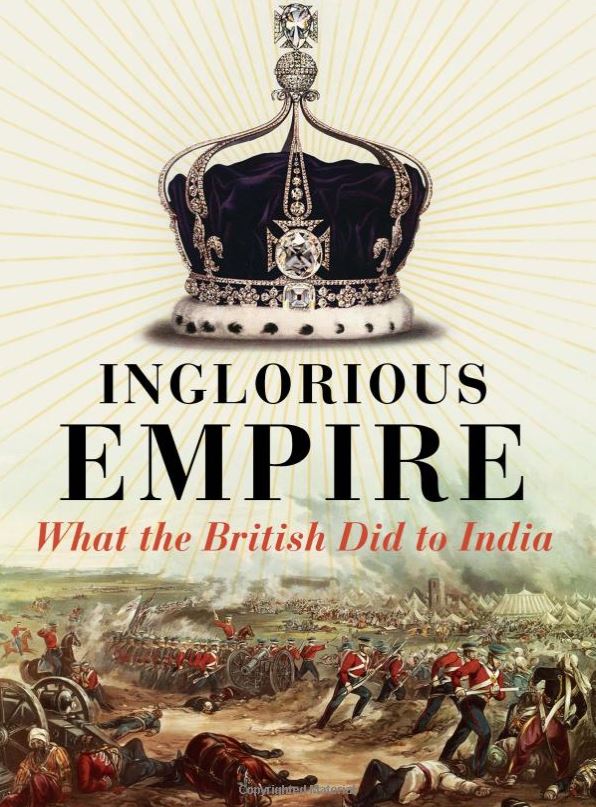
Shashi Tharoor, Inglorious Empire: What the British Did to India, Hurst & Co, 2017
Tharoor is an Indian politician, and a good polemicist. Two points stood out for me in this well-written book. Firstly, he does a good job of confronting Niall Ferguson, the historian and apologist for British (and American) imperialism, on the subject of India. This illustrates how a polemic can provide a useful theme for guiding the exposition of an argument.
Secondly, and for me the most interesting parts of the book, were not where he detailed how the British destroyed the Indian textile industry to promote India’s imports of British textile products – often woollen clothes that were completely unsuited to India’s climate. This has been covered many times by others. The new point for me was where he showed how British domination undermined India’s commercial shipping sector and its shipbuilding industry, an industry that, at the time, was at least as advanced as the British one. This resulted from British commercial power, setting the rules on what ships could be used between British controlled ports and also who could run that business. Commercial power is often greatly underestimated by those who focus only on industry, and these examples help explain more fully Britain’s exploitation of India.


Machinations in the Middle East

Christopher Davidson, Shadow Wars: The Secret Struggle for the Middle East, One World, 2016
This book is a good, easy to read, although lengthy review of events in the Middle East and Northern Africa. It will help a lot in understanding the background to present day news stories, since it details the actions both of the major powers – the US, Britain and France in particular – and of the different political groupings in the region. There is a welcome coverage of countries from Nigeria, to Libya, to Saudi Arabia, Syria and Turkey, with comprehensive information on the supporters of ISIS, Al-Qaeda, Al-Nusra, Boko Haram, etc.
Davidson has incorporated a mass of material into the book, providing some important details that even close observers of these events are likely to have missed. His 2,500 footnotes are encyclopedic, even to excess, covering 121 of the near-700 pages, but they do give useful documentation for anyone doing research on these issues. However, although in many places the book gives a useful summary of the relevant historical background, its disadvantage is that it reads more like an extended news review. This is at the cost of giving a more theoretical assessment of what is going on and explaining how this results from the latest phase of imperial disintegration.


The Balfour Declaration, British Support for Zionism

David Cronin, Balfour’s Shadow: A Century of British Support for Zionism and Israel, Pluto Press, 2017
This book does what it says in the title, and reviews British government policy towards Palestine and Zionism from the time of the Balfour Declaration in 1917 up to the present day. There are more twists and turns in this story than it is easy to summarise here, but I would recommend Cronin’s work as well-written, well-documented and mercifully concise!
Although it covers some similar ground, I would also recommend reading John Newsinger’s telling critique of the British Labour Party and Zionism, available here.

Tony Norfield, 23 December 2017

Wednesday, 20 August 2014

Palestine, 'Israel' and Justice


Israeli racism and violence should obviously be condemned, but land theft is the key question. Consider this: on what basis should the slaughter by Europeans of Jews before 1945 result in the allocation of Palestinian land to Zionist settlers by imperialist powers in 1948? It is not only the post-1967 land grab by Israel that is a crime. The Israeli state is illegitimate and a result of imperialism in the region.

The term 'apartheid' to describe the Israeli system is also incorrect. Israel far prefers to kill Palestinians and steal their land, which is not the same process as formerly in South Africa. For example, Gaza is not Israel's Bantustan for the disenfranchised and exploited; it is a prison in which the inmates are expected to die. That much should be evident from Israel's actions over many years.

Fundamental injustice leads to resistance by Palestinians, a resistance that should hearten, and be supported by, anyone with a conscience. Calling for a 'Two-state solution', or 'peace', or 'negotiation' between the thieves and their victims only legitimises the prevailing injustice.


Tony Norfield, 20 August 2014