Tuesday, 23 January 2018

Warren Buffett & Imperial Economics


Warren Buffett is one of the wealthiest people in the world. He is also Chairman of the Board, President and Chief Executive Officer of Berkshire Hathaway, a huge US investment conglomerate. Looking at Berkshire’s investment policy reveals some important features of the economics of imperialism today and the role of money capitalists. Buffett’s public image as a kindly old gentleman – the Sage of Omaha – who favours increasing taxes on the rich and donates to charitable causes, does not sit well with evidence that he is a predatory gouger of profit. But these are the times in which we live.[1]

Berkshire’s nondescript name belies the fact that it is the fifth or sixth largest publicly quoted company by market capitalisation, at more than $500bn. It owns an extraordinarily wide range of companies, from insurance and banking, to specialist engineering, consumer electronics, news media, real estate, energy, railroads and airlines. Berkshire has more than 240 subsidiaries, but in addition to these it has large and small equity stakes in many other companies. Some are enterprises that few have heard of; others are household names. Six big companies account for nearly 70% of its $180bn portfolio of equity holdings: Apple, Coca Cola, Kraft Heinz, American Express, Bank of America and Wells Fargo bank.
Warren Buffett’s business strategy has not always been successful. He has made a number of duff investments, not least an early one in the textiles business that gave his company its name. Subsequent failures include investments in IBM and Tesco, and he was quite late into the boom in ‘technology’ stocks, having viewed these with a traditionalist’s scepticism. But his fund has nevertheless registered dramatic returns over a long period, well above those that would have been gained from investing in a broad index of companies. Like some other companies reviewed on this blog, Berkshire Hathaway does not pay dividends to its investors, instead relying upon an increasing share price to keep them happy. So far they have been content: from close to $100,000 in early 2010, the share price had risen to more than $300,000 by early 2018, to become the most expensive share in history.[2]
As one might expect, Berkshire Hathaway uses its financial strength to negotiate deals to its advantage. There are two guiding themes for its investments. Firstly, Berkshire looks for companies with brand loyalty and potential or actual monopolistic positions that are likely to keep future profits secure. Secondly, as far as possible, it wants only to allocate money capital and not to get involved in business operations.

Monopoly sectors and Berkshire investments

The market power of a monopolist is a wonderful thing – if you are the monopolist. There is rarely only one supplier unchallenged by rivals. But being one of very few suppliers, or having a government contract that guarantees high prices for your product, or using advertising and brand recognition to cement market domination, or building a commercial barrier to limit what competitors can do, or using patents to stall their development, are all means of building a favourable position in the market. These are the kinds of company, big and small, that Berkshire Hathaway seeks.
On the big side is Apple. Although he was late to the party, Buffett started jumping into Apple’s shares in 2016, after its price had fallen over the previous year. By late 2017, Berkshire had accumulated more than $20bn in Apple shares, some 2.5% of the company. The rationale for this investment was that Apple had an ‘ecosystem’ and level of brand loyalty that meant consumers were not very sensitive to the exorbitant charges it makes for its products, particularly the iPhone – as revealed in Apple’s confidence when putting a premium price on the iPhone X.
Other large companies include not only the well-known ones like Coca Cola and Kraft Heinz, noted above, but also those that usually remain out of sight. Take energy distribution, for example.
Berkshire owns 99% of Berkshire Hathaway Energy. In addition to its businesses in the US and Canada, this subsidiary owns two of the fourteen ‘distribution network operators’ in the UK. Each of these UK operators is a regional monopoly; there are five other holding companies owning the remaining twelve. Berkshire’s are managed by its Northern Powergrid company, with operations in Yorkshire and the North East of England.
When people complain about high costs of gas and electricity, it is usually the energy producing companies that get the blame, not the distributors. But the latter are often responsible for something like 25% of a household’s energy bill through the distribution prices they charge the producers. In 2016-17, Northern Powergrid (Yorkshire)’s total revenues were £417m and a high proportion of those, nearly half, were its operating profit of £199m.
Berkshire also invests in many smaller companies, often those in a strong niche position. Examples are Precision Castparts (metal components and castings), IMC Group (tungsten carbide metal cutting tools) and Lubrizol (specialist chemicals). These are an important component of the holding company’s returns.
Berkshire’s funds come from its direct subsidiaries and from its portfolio of equity investments and interest bearing securities. Its many investments give a claim on revenues from all areas of the economy, both nationally (in the US) and internationally.[3] This is shown by the breakdown of its $25.9bn earnings (profits) before taxes in 2016. Insurance underwriting brought in $2.1bn, with an additional $4.6bn of earnings from the portfolio investments of its insurance division. BNSF, its railroad freight division, brought in $5.7bn, Berkshire Hathaway Energy $3.0bn, its manufacturing subsidiaries $6.2bn, and the remainder came from a variety of other businesses and investments.

Being a money capitalist

Many big corporations today do as little production themselves as they can get away with. Instead they monopolise design, technology patents and marketing, while the producers of the goods and services they control become part of their ‘value chains’. Owning many producing, transport and servicing companies, Berkshire Hathaway would not seem to be doing this. But it has its own way of working, as spelled out in its latest annual report:
operating businesses are managed on an unusually decentralized basis. There are essentially no centralized or integrated business functions (such as sales, marketing, purchasing, legal or human resources) and there is minimal involvement by Berkshire’s corporate headquarters in the day-to-day business activities of the operating businesses.”
In other words, Berkshire may buy out a company and allocate extra capital for investment, but, although it may choose the Chief Executive of the operating business, the holding company stays clear of directly managing anything. This shows Berkshire’s role as money capitalist, even for its operating businesses, quite apart from those companies in which it just holds a portfolio stake.
The funds for Berkshire’s investments are mainly held by its insurance division – a large volume of mostly US dollar-denominated cash, cash equivalents and US Treasury Bills, which amounted to $71bn at end-2016 (total cash, etc, available was $86bn). A portion of those funds may be required to meet payments on insurance and reinsurance policies. More importantly, this is also a store of cash to use for the opportunistic gouging of other capitalists, especially in times of crisis when cash is king.
Berkshire has often acted as a lender of last resort to selected companies in trouble. They are willing to pay a premium cost for its funds, not only because they have little choice, but also because backing from a big, well-known investor helps restore some financial market confidence in their business. In this type of investment, Berkshire has purchased ‘preference shares’ paying a high fixed rate of interest and which can only be bought back by the company at a premium, usually around 10%. As part of these preference shares, the company may also issue Berkshire long-dated options to buy the company’s stock at very favourable prices.
Examples of such deals include Berkshire investing $5bn in the preferred stock of Goldman Sachs back in 2008. This stock yielded an annual interest rate of 10%. Goldman bought it back in 2011, but had to pay $5.5bn. Berkshire also gained from the stock options it received. Similarly, Berkshire bought $5bn of Bank of America’s preference stock in 2011, although market conditions were not quite so bad and the yield was 6%. Other companies that have been through this Berkshire process include General Electric, Dow, Wrigley, Kraft Heinz and Home Capital.

Buffett and the law of value

Berkshire Hathaway’s business is an example of how a big corporation is often much bigger than you think. Its fortunes derive from the operation of hundreds of companies it owns directly and from its myriad of investments that stake a claim on the value produced worldwide, even though most of Berkshire’s business looks US-based. Its mode of operation also responds to how the imperialist world economy works today. Do not just look for a ‘good company’ to invest in, but find the ones with a more protected niche in the market. Do not just lend to a company with ‘good prospects’, but wait to pounce on those with a future that are desperate enough to accept your terms.
Warren Buffett is quite abstemious and gets a relatively small salary for being the Chairman and CEO of a major corporation. Nevertheless, he is one of the top 10 richest people on the planet, with a large income from his personal investments as well as the wealth represented by his Berkshire holdings. Buffett owns some 18% of Berkshire Hathaway’s shares and, like some of his plutocrat peers, he has also organised the company’s shareholdings so that his voting power is higher than this, at nearly 32% of the total.[4]
He has many fans and receives the kinds of accolade that would go to a sports team with a great track record. But this is not a game. It is the world economy, and Buffett’s fund is a prime example of the power of parasitism today. Berkshire ‘puts money to work’ by relying upon the work of others, and it siphons off the product of social labour into the fortunes of private investors.

Tony Norfield, 23 January 2018


[1] This review of Berkshire Hathaway extends the list of corporations covered on this blog. Earlier ones were: Apple, Alibaba, Amazon, Facebook and Alphabet/Google. I do not plan to give a comprehensive overview of Berkshire’s operations, for which see Wikipedia and other Internet sources. Here I want to focus on key points that illustrate the nature of imperial economics today. Information cited is mainly from Berkshire’s accounts.
[2] This is the price of the main Class A shares. See footnote 4 for further details.
[3] When looking at the details, I was surprised that little of Berkshire’s revenue seems to come directly from non-US sources. A lot of Buffett’s attention seems to have been spent scouring the nooks and crannies of the domestic US economy for profitable openings and to buy into cheapened assets. Berkshire owns stakes in airlines, regional newspapers, real estate brokerages and automobile dealerships, among other things.
[4] Berkshire’s Class A shares are the ones that are priced around $300,000 each. The company also has Class B shares that are priced around 1,500th of the A shares, but have only one 10,000th of the voting power. There are 1.65bn Class A shares authorised and 3.225bn Class B shares.

Friday, 19 January 2018

Worse Than You Think


Michael Wolff, Fire and Fury: Inside the Trump White House, Little Brown, 2018

This book is fun to read and a best seller. Everyone loves a gossipy book about someone they dislike. Fluently written, although not well written, it is built mainly on interviews with those in and around the Trump White House. Wolff takes us through the plots and screw-ups of this double-dealing menagerie with relish.
Much of what the book says will not be new to those following The Donald. Probably the most striking new point Wolff makes is that part of the reason for the political and administrative chaos is that Trump was not expecting to win the presidential election and become POTUS #45. The insiders on Team Trump were perfectly happy to lose, as long as the margin was not too big. Up to the last minute that was what they were betting on. Losing like that would have been a ‘victory’, especially because it would do wonders for the Trump family brand name. Winning for real would carry the risk of a closer examination of the Trump family’s finances and put all their schemes in the public spotlight.
However, Wolff’s journalistic approach does not get to grips with some fundamental issues. Wolff gives many amusing stories of Trump’s egotistical self-deception, mind-boggling inconsistencies and shameless invention of ‘facts’. Trump may think he is multi-tasking, but sitting on his bed eating a cheeseburger, watching three cable TV channels at once while making phone calls is more a signal of not being able to concentrate on anything at all. Such character traits have recently led to questions about Trump’s mental health, and also the hope in liberal quarters that this might be a means of getting him to resign. Yet these factors, while important features of his presidency, do not give the proper context for what is going on.
Trump is not the only president to have been a few sandwiches short of a picnic. In recent history, just consider Ronald Reagan and George ‘Dubya’ Bush. Or what about Barack Obama, the great black hope of liberal America, who in eight years failed to close Guantanamo Bay concentration camp and instead became drone-killer in chief, a Nobel Peace Prize winner up to his neck in covert operations? The point to recognise is that it does not matter much who is the president, the imperial machine grinds on.
Where Trump has been an anomaly is that he came from outside the political establishment. This meant that there were fewer pre-arranged ties into the networks of political force and influence, from Congressional interest groups and big business, to the CIA and the military. That Trump has been reliant upon a small group of trusted acolytes and chancers is not so unusual. That these have been made up largely from his family is more so, since with Ivanka Trump and Jared Kushner he has gone several steps beyond Bill Clinton’s promotion of Hillary. This anomalous regime has produced some embarrassments for America’s self-image. Apart from the stream of reactionary consciousness tweets, there is the border wall with Mexico, pulling out of the Paris Climate Accord and much else besides.
The question is then: how could this have happened? Of course, Wolff recognises that Trump is an outsider. But he does not dwell upon how such an outsider could win the presidency, except to review the events in the 2016 election campaign. In other words, what were the social forces behind this anomaly occurring? Wolff’s coverage of the alt-right pundit and Trump ideas man Steve Bannon notes his financial backing from the billionaire Robert Mercer, but he does not discuss why the America First, anti-immigrant, anti-Muslim, racist policies Bannon supports gained so many votes for Trump in the US electorate.
It remains uncomfortable for Trump’s critics that resurgent nationalism in an imperialist country looks so ugly when spewing unfiltered from Trump’s mouth. That is part of the reason to blame Russia for Trump’s election victory – if it was the Commies evil Russkies, then they can avoid facing the problem that a large part of the US electorate agrees with these policies.
It is depressing fact that in imperialist countries a squeeze on the economic lives of people usually results in political reaction. There may be brave dissidents and protests, but these are outweighed by mass opinion that calls upon the state to punish foreigners and any others they see as responsible for undermining their privileges. What has emerged from this cauldron of discontent is Trump, not a radical current that challenges imperialism.
For now, Trump’s sociopathic tweetarama will continue. But it is only a matter of time before the imperial machine takes back full control to limit disruption to the way US imperialism presents itself to the world, which can also have a big impact on business. In the interim, Trump’s tax cuts for the rich and for corporations are not a problem, and in late December the US Congress passed these plans.

Tony Norfield, 19 January 2018

Saturday, 23 December 2017

Some Books #2


These are some of the better books I have read in the past year, and ones to look for if you want to find out about …

The British Labour Movement and Ireland

Geoffrey Bell, Hesitant Comrades: The Irish Revolution and the British Labour Movement, Pluto Press, 2016
This book is an interesting study that undermines the notion that the British labour movement was ever progressive when faced with a challenge to British imperialism. Its focus is on Britain and Ireland in the early 20th century, and it shows there was only some limited support for Irish freedom from British rule in British cities where there were many Irish workers. Neither the mainstream workers’ organisations, nor the more radical ones, took up the issue in any substantial way. This leads Bell to his book’s title of ‘hesitant comrades’. The Catholic Herald summed it all up in March 1920: ‘Ireland is in the throes of a national agony, a victim of merciless militarism, and British Labour remains quiescent and inactive’ (p. 218).
William O’Brien of the Irish TUC and Labour Party had made a similar point a year after the 1916 Easter Rising. Addressing delegates at the Leeds Convention in 1917, he said: ‘In Ireland you have a small nationality at your door which is demanding the right of its own life, … I gather from reading some of the capitalist papers that revolution is popular nowadays. Twelve months ago you had a revolution in Ireland. The papers and politicians that acclaimed the revolution in Russia did not acclaim the revolution in Ireland whose leaders were taken out and shot like dogs’ (pp. 217-218).
Even Sylvia Pankhurst’s Workers’ Dreadnought sidelined the issue of Irish freedom from political oppression by belittling the Sinn Fein-supporting nationalists. It promoted hopes for the class struggle instead. It is tricky to follow the development of inconsistent comments by labour movement radicals. But while some, like the Communist Party of Great Britain (CPGB), ended up being more ‘theoretically’ correct, they still did next to nothing about the issue, or even wrote much about it.
All the workers’ organisations wanted to avoid the question of sectarianism in Ulster, which was replicated in the working class in Liverpool, Glasgow and elsewhere. Confronting sectarianism would also have caused problems for the trade unions. So they blamed sectarianism on Unionist politicians, like Carson, and on the British Government, and downplayed the material basis for the support of anti-Catholic policies among the Protestant-Loyalist working class.
In the second half of 1921, after anti-Catholic pogroms by the Ulster Loyalists, CPGB member William Paul, in his pamphlet Irish Crisis, said: ‘The peculiar psychology of Orangeism … with its fierce and violent hatred against its enemies will be easily diverted against a capitalist class during a revolutionary crisis. It was Carson who taught them how to arm against the status quo … When the workers move against Capitalism, the revolutionary movement of Ulster will have good reason for thanking Carson for his magnificent work’ (p. 191). This view rested on the delusion that somehow the loyalist workers’ ‘fierce and violent hatred’ towards Catholics would be overcome in a ‘move against Capitalism’. It dishonestly used the mirage of future workers’ unity to avoid dealing with the ugly reality of the day.
The left sometimes recognised how Ireland’s struggle was a political embarrassment. For example, in June 1920 the British Communist paper, The Call, said: “The suppression of Ireland is one of the world’s great crimes; the silence of Englishmen is one of the tragedies” (p. 111). But despite this, and other, similar statements by the CPGB in 1920-21, they did little about it. To say the least, they would have scored few points when measured on the Bolshevik reckoning of how many Communist supporters had been imprisoned for their agitation on Ireland.


The British and India

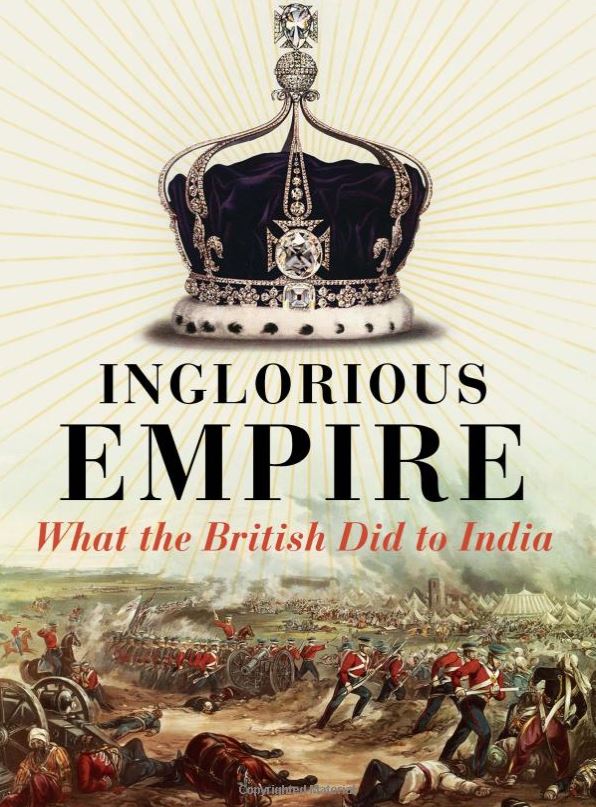
Shashi Tharoor, Inglorious Empire: What the British Did to India, Hurst & Co, 2017
Tharoor is an Indian politician, and a good polemicist. Two points stood out for me in this well-written book. Firstly, he does a good job of confronting Niall Ferguson, the historian and apologist for British (and American) imperialism, on the subject of India. This illustrates how a polemic can provide a useful theme for guiding the exposition of an argument.
Secondly, and for me the most interesting parts of the book, were not where he detailed how the British destroyed the Indian textile industry to promote India’s imports of British textile products – often woollen clothes that were completely unsuited to India’s climate. This has been covered many times by others. The new point for me was where he showed how British domination undermined India’s commercial shipping sector and its shipbuilding industry, an industry that, at the time, was at least as advanced as the British one. This resulted from British commercial power, setting the rules on what ships could be used between British controlled ports and also who could run that business. Commercial power is often greatly underestimated by those who focus only on industry, and these examples help explain more fully Britain’s exploitation of India.


Machinations in the Middle East

Christopher Davidson, Shadow Wars: The Secret Struggle for the Middle East, One World, 2016
This book is a good, easy to read, although lengthy review of events in the Middle East and Northern Africa. It will help a lot in understanding the background to present day news stories, since it details the actions both of the major powers – the US, Britain and France in particular – and of the different political groupings in the region. There is a welcome coverage of countries from Nigeria, to Libya, to Saudi Arabia, Syria and Turkey, with comprehensive information on the supporters of ISIS, Al-Qaeda, Al-Nusra, Boko Haram, etc.
Davidson has incorporated a mass of material into the book, providing some important details that even close observers of these events are likely to have missed. His 2,500 footnotes are encyclopedic, even to excess, covering 121 of the near-700 pages, but they do give useful documentation for anyone doing research on these issues. However, although in many places the book gives a useful summary of the relevant historical background, its disadvantage is that it reads more like an extended news review. This is at the cost of giving a more theoretical assessment of what is going on and explaining how this results from the latest phase of imperial disintegration.


The Balfour Declaration, British Support for Zionism

David Cronin, Balfour’s Shadow: A Century of British Support for Zionism and Israel, Pluto Press, 2017
This book does what it says in the title, and reviews British government policy towards Palestine and Zionism from the time of the Balfour Declaration in 1917 up to the present day. There are more twists and turns in this story than it is easy to summarise here, but I would recommend Cronin’s work as well-written, well-documented and mercifully concise!
Although it covers some similar ground, I would also recommend reading John Newsinger’s telling critique of the British Labour Party and Zionism, available here.

Tony Norfield, 23 December 2017

Tuesday, 21 November 2017

Mugabe, Land, Thatcher, Blair & Imperialism


So, farewell then, Robert Mugabe, ruler of Zimbabwe for 37 years. As the western media celebrate your demise, and Zimbabwe’s people wonder what will happen next, it is worth making a note of some forgotten events that helped pave the way for your country’s crisis. As one might expect, this involves the Brits. Perhaps less anticipated, it also involves the Labour Government from 1997.


One key question for an African country like Zimbabwe fighting off racist colonialism was that whites had held all the best land. This made land reform critical for some version of economic justice and liberation for the mass of people. But the Lancaster House agreement, managed by the British in 1979 to oversee the transition from white minority rule, pressured Mugabe into delaying any serious land reform for another 10 years. The British and American governments, worried about Soviet influence in the region, offered to compensate white citizens for any land they sold and a fund was established, to operate from 1980 to 1990.
Lack of money to assist agricultural investment, with funds only available to compensate the white landowners, meant that Zimbabwe’s land reform was doomed to fail. Thatcher’s government from 1979 allocated those funds for compensation and many landless people were resettled, but in 1997 Tony Blair’s ever-so-progressive New Labour stopped even that. Clare Short, Blair’s Secretary of State for International Development, told Mugabe’s government in November 1997 that while Labour might be willing to assist in some ‘poverty eradication’ it would not continue to help with land reform. Blair repudiated all commitments to help on this, so Mugabe responded by forcibly confiscating white farms without compensation. While this got popular support, it exacerbated Zimbabwe’s economic problems. These were worsened from 2001 by economic sanctions the ‘British Commonwealth’ and other imperialists imposed on the country.
This is not to excuse Mugabe’s politics. It is just to illustrate a more general rule that imperialism, even in its ‘Labour’ forms, cannot be trusted.

Tony Norfield, 21 November 2017

Wednesday, 8 November 2017

End of the Anglosphere


Big Ben no longer chimes, Trump tweets every quarter hour
Silence and media noise mock the fading imperial powers.
Governments of fools, though few fools can now be found
Brave enough to smirk at the turmoil all around.
Undone by popular will to revive their imperial benefits
Trump tears off the US veneer, and Brexit befuddles the Brits.
Comfort reigned for few while the Anglosphere held sway
War and chaos summon all as the Anglosphere decays.

Tony Norfield, 8 November 2017

Thursday, 26 October 2017

The British Labour Party and Israel


Why was Moshé Machover expelled from the Labour Party on 4 October for anti-Semitism? Machover, an emeritus professor of mathematics, was born in Israel and has been a lifelong socialist, anti-racist and critic of Israeli policy. For the Labour Party’s Legal Queries Unit to allege that he has been anti-Semitic is ludicrous, so much so that there has been widespread support for Machover from within the Labour Party itself. But this absurdity reflects two things that stem from a third: imperialist politics.

Israel and imperialist politics

Firstly, there is the attempt by supporters of Israel to label all critics of that 1948 creature of imperialism as being anti-Semitic. This is a longstanding policy of Israeli governments, their foreign embassies and support groups. But this Israeli policy has become more hysterical in recent years as opposition to their oppression of Palestinians has become more widespread, and as Israel has found itself facing a more uncertain future. A series of disasters in the Middle East for imperial policy – from Iraq, to Libya, Syria and the rise of Islamic State – has led the major powers to play a more direct role in the region, a development that threatens to sideline the traditional Israeli role as policeman for these powers.
Secondly, a keystone of UK foreign policy has been to support Israel. This has been based upon Israel’s value in helping undermine Arab nationalism. An early example was the 1956 Suez fiasco, a deal between the UK, France and Israel to stage an invasion of Egypt to try and depose Egypt’s President Nasser. Another little noted example is how Israel fostered the growth of Hamas in the 1980s to undermine the Palestinian Liberation Organisation. This promotion of an Islamist group to defeat an enemy has backfired, as have similar imperial enterprises like backing Al-Qaeda (in Afghanistan, etc) and Islamic State (in Iraq, Syria, etc).
That Israel could play a role for different major powers was evident even before the state’s foundation in 1948,[1] following a resolution from the United Nations to replace the former British Mandate over Palestine and partition the territory.[2] But the creation of Israel was based upon a fundamental injustice: Palestinians were made to pay the price for the European slaughter of Jews in the previous decade![3] From its birth, the military and terror forces of the new Israeli state seized Palestinian land and property, through mass expulsions and murder.
The razing of Palestinian villages and destroying signs of Palestinian culture and society, even uprooting olive groves, tries to construct the Zionist myth of ‘a land without people for a people without land’. These crimes were prettified by the Jewish National Fund, a ‘charity’ that gives Palestinian land to those who claim to be Jewish. Many UK Conservative Party and Labour Party leaders have supported this organisation – most recently Tony Blair, Gordon Brown, David Cameron and Theresa May.[4]
The British Labour Party’s links to Israel were acknowledged in the autobiography of a senior Labour politician, Denis Healey, The Time of My Life, published in 1989. He noted that ‘the Labour Party was overwhelmingly Zionist, and had far closer relations with Israel than the Conservatives – apart from a small group of Tory Zionists such as Churchill himself, Julian Amery and Hugh Fraser’. This relationship was often based upon Labour’s racism towards Arabs, and was supported by Labour’s notion that European Jews could bring ‘civilisation’ to the Middle East in a way that would also be aligned with British interests.[5]

Supporting the Palestinians?

One political party leader for whom endorsing the Jewish National Fund is off limits is Labour’s Jeremy Corbyn. But, to go back to my opening question, how then did Moshé Machover’s expulsion from the Labour Party occur when the leader of the Labour Party supports the Palestinians?
Denials of Palestinian rights by the Israeli state have been so outrageous that one would have to be an accomplished ignoramus, an anti-social psychopath, or an ardent Zionist, not to have any sympathy with the Palestinians. The Israeli oppression of the near two million people in Gaza, which has become the world’s largest prison camp, possibly stands out most. These things have now led to a smaller number of Labour MPs to sign up for membership of the Labour Friends of Israel lobby group.[6] But what form does that sympathy take for Jeremy Corbyn? It is the ‘two-state solution’ and an acceptance of the 1948 deal that set up the Israeli state in the first place.
At the Labour Party conference in September 2017, Corbyn said: ‘Let’s give real support to end the oppression of the Palestinian people, the 50-year occupation and illegal settlement expansion and move to a genuine two-state solution of the Israel-Palestine conflict’.
For Corbyn, the ‘50 year’ point only refers to Israel’s extension of its borders to seize yet more land in the 1967 war with other Arab states. Similarly, the ‘settlement’ point refers only to the further seizure of land that has continued since 1967, ones that are illegal even under United Nations law – but violations of which have gone unpunished, given the service that Israel has provided for the major powers that run the world. The failure to recognise the crime of 1948 and the setting up of Israel in the first place – on the majority of Palestinian land – reflects an all-too common view, even among those sympathetic to the Palestinians, like Corbyn.
Getting back to the 1948 set up would endorse the UN decision for the two states, one led especially by the US, but also by the Soviet Union (despite the Balfour Declaration, the UK abstained in the UN’s 1947 vote on partitioning Palestine, not wishing to damage its position with other Arab countries). A 1948 starting point would also leave unchallenged the additional Zionist seizure of land at that time, beyond what was envisaged by the UN’s calculation, let alone the additional annexation of land in later years.
Corbyn’s endorsement of a ‘two state solution’ does not recognise that one of the parties has the imperial jackboot on its neck and a gun to its head in any negotiations. It is also out of bounds for Israel, given the nature of the Israeli state. A state that cannot even define its borders, a state that has an ethnic definition of citizenship, a state that has promoted the influx of hundreds of thousands of subsidised settlers on Palestinian land – that state is hardly likely to agree a return to pre-1967 borders. Nevertheless, a minimum demand on the Israelis to achieve some justice for the Palestinians remains: Give back the land you have stolen!
The imperial modus operandi is that when people rise up against injustice they are killed, or at least prevented from upsetting plans, perhaps by co-opting their leaders. Palestinians have rarely been in the latter, more ‘lucky’ situation, so they remain terrorised and defamed. However, the image of continual Palestinian oppression can still be an embarrassing bloodstain on those who talk about the values of western democracy.

Changing times

For Jeremy Corbyn to raise the issue of Palestine in his Labour Party conference speech might be seen as a breakthrough. Until now, there has not been the slightest indication that the Labour Party would move from its faithful backing of the global power structure that has Israel as its armed guard against Arab nationalism. But the rise to prominence of Corbyn’s view reflects a subtle change in how Israel is now seen by the major powers.
Israel’s increasingly reactionary policies have become a problem for politicians claiming to hold a progressive view, especially under Netanyahu’s Likud Party. No longer can pro-Zionist Labour politicians point to those Potemkin villages, known as kibbutzim, as examples of socialism in action. For every celebration of rejuvenating desert land, there are dozens of Israeli bulldozers destroying Palestinian homes, and systematic brutality meted out to Palestinians by Israeli police, soldiers and settlers. For those of a more conservative outlook, who do not worry about such things, Israel is also beginning to be seen as more of a troublemaker than a useful ally.
The structure of imperial support for Israel was built upon acceptance of its immunity from UN resolutions, no matter what it does, an immunity backed especially by the US. That has worked well before, but now less so, given that a more overtly pro-Israel Donald Trump also tramples liberal opinion in the wider world. If this US backs Israel, and the US is overturning the established order with an ‘America First’ policy, then it indirectly also helps to undermine acceptance of Israel’s policies by the other powers. For now, although maybe not for much longer, the traditional political support for Israel stays in place. But its foundations are being eroded.
These crumbling foundations are the reason the Labour Party machine is now accusing Moshé Machover, a committed socialist and anti-racist, of anti-Semitism. With support for Israel under threat, it is urgent for pro-Israel advocates to argue that being anti-Zionist is also to be anti-Semitic. One lesson from World War Two is that this version of racism is not acceptable in polite company, so this smear is a way of indirectly sustaining support for Israel.
The role Israel plays for imperialism has probably not yet diminished enough to lead UK political parties to criticise its policies in any way that has consequence. In line with this, I would not expect Jeremy Corbyn to reject the absurd allegations against Moshé Machover. The issue is one of imperialist politics, not common sense. Even if Corbyn did, a socialist should not look for a place in the pro-imperialist Labour Party.

Tony Norfield, 26 October 2017


[1] For example, the French assisted Zionist militias in their war against the British prior to 1948, reflecting the rivalry of the two powers in the region. See James Barr, A Line in the Sand: Britain, France and the Struggle that Shaped the Middle East, 2011.
[2] Just to make clear, I do not accept that the United Nations, dominated by the major-powers, can be considered as some kind of neutral or fair arbiter of justice. The British state, much weakened by the mid-1940s, was in no position to manage its Palestine Mandate any longer, which was why it left the decision to the UN. The decision to set up a ‘national home’ for ‘Jewish people’ on Palestinian land was based partly upon Britain’s 1917 Balfour Declaration, a deliberately ambiguous and deceitful document that promised both a Jewish state and that the rights of the local non-Jewish population in Palestine would not be harmed. Labour had the same idea for a Jewish state before this declaration and also fully supported it when it was published.
[3] Germany has been singled out for this slaughter, but this ignores the other western and eastern European countries who also took part in the crime. The refusal of the US and the UK to accept more than a token number of Jewish refugees in the 1930s and 1940s should also be noted.
[4] The notion that Israel is the ‘ethnic homeland’ of people calling themselves Jewish is rubbish. For example, historians such as Shlomo Sand (see his Invention of the Jewish people, 2009) document how followers of Judaism were ardent proselytisers and converted Europeans and Asians, and others, to their faith over many centuries. So, far from all current ‘Jews’ being able to trace back their ethnic heritage to ancient Israel, they mostly come from elsewhere. In any case, the point comes down to imperialism – where the political institutions stand in relation to the major powers – not to ethnicity.
[5] For more on this point, see the excellent article by John Newsinger detailing the historical relationship of the Labour Party to Zionism and anti-Semitism here
[6] Al-Jazeera did an exposé of how such groups are used to whitewash Israel and bring down any critics, see here. One of the key Israeli embassy officials involved was recorded as complaining that not enough young people or MPs were now joining Labour Friends of Israel.

Friday, 20 October 2017

Dimensions of Economic Power: Today's Key Corporations

The images below are from a lecture I gave at SOAS, London University, on 18 October. This was part of a series organised by the SOAS Economics Department, and my lecture covered the forms taken by corporate power today, focusing on Apple, Google/Alphabet, Facebook, Amazon and Alibaba.

The lecture was a little longer than planned because the projector repeatedly turned itself off, probably due to a loose cable! Both the 45 minute lecture and the following 30 minute discussion can be heard here.

You are welcome to make use of the slides, although do cite the source of the information you use.*

Tony Norfield, 20 October 2017

Note *: The images below have my name, the lecture title and the date running through them because on previous occasions some websites had simply used my lecture slides with no attribution.